
TL;DR

Get home appliances delivered free with Prime
- Fast, free delivery on millions of items
- Prime Video, Amazon Music and more included
- Member-only deals all year
A Hunker report identifies decorative, layered lighting as a kitchen design trend expected in 2027, including sconces, sculptural fixtures and portable lamps. The trend reflects a move away from relying on one central ceiling light, but the report does not establish how widely homeowners will adopt it.
Decorative, layered lighting is the kitchen trend Hunker expects to gain attention in 2027, with designers using sconces, sculptural fixtures and portable lamps alongside conventional overhead lights. The report describes a design direction, not a measured forecast of sales or homeowner adoption, so how widely it will appear remains uncertain.
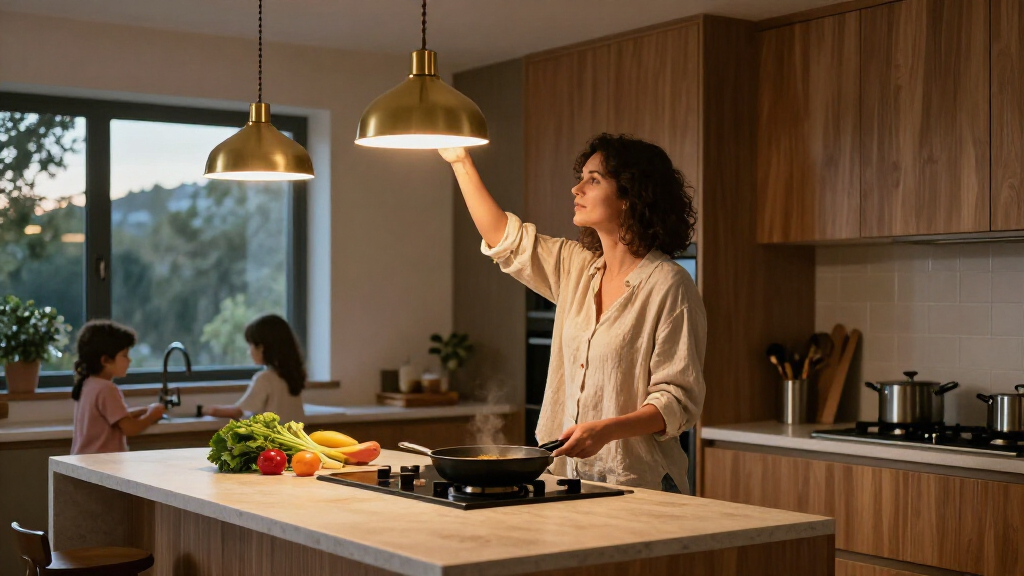
The approach treats kitchen lighting as both practical illumination and part of the room’s decor. Instead of relying chiefly on a single central fixture, a scheme might combine general lighting with pendants, wall sconces, under-cabinet task lights and smaller accent sources. Hunker says using fixtures at different heights can make the room’s light more adaptable and less uniformly overhead.
Design choices cited in the report include sculptural shapes, warm metal finishes, textured shades and dimmable or portable options. Rechargeable table lamps are one example: they can be placed on a counter for accent or task lighting without needing a permanently wired fixture at that spot. The article also points to accent lighting that draws attention to architectural features or areas such as a home bar.
Hunker draws on a comment from Michaela Sedlak of ODE Design, who spoke to House Beautiful. Sedlak said sconces, art-style picture lights and other architectural lighting would become “just as important if not more than pendant lights.” That is a designer’s view of the direction of the market, rather than evidence that pendants are being replaced across kitchens.
Lighting Moves Beyond the Ceiling
The forecast matters to homeowners planning a renovation or updating a kitchen because it puts lighting in the role of a design decision, not just a utility. Multiple light sources can serve different jobs: brighter task lighting for food preparation, softer sources for meals or gathering, and accent lights for selected features. Dimmers and portable fixtures can offer additional flexibility as the room’s use changes.
There may also be practical trade-offs. Adding wired sconces or other permanent fixtures can require electrical work, while portable lamps need suitable counter space and rechargeable batteries. The report offers styling ideas, but it does not compare costs, energy use, performance, or installation requirements. Readers should treat the forecast as inspiration, not as proof that every kitchen needs more fixtures.
Products Worth Considering

Philips Hue Festavia Outdoor Globe String Lights, 8 Bulbs, 22 ft

Philips Hue Play Gradient 65-Inch Smart TV Light Strip

Philips Hue Festavia 65-Foot Smart LED String Lights, 250 Color-Changing Mini LEDs
As an affiliate, we earn on qualifying purchases.
From Single Fixtures to Layers
Hunker frames the forecast around the kitchen’s use as both a work area and gathering space. In its account, lighting has often been treated as an afterthought, with a central ceiling fixture doing most of the work. The proposed shift is toward a scheme with distinct sources for general, task and accent lighting, similar to the layered approach used in other living spaces.
The article does not present a new building standard or a formal industry-wide trend survey. It offers design recommendations and cites Sedlak’s comment in House Beautiful. Examples include updating a basic flush-mount or spotlight fixture, adding a pendant or sconce, and using lamps or accent strips to highlight chosen areas. These are possibilities described by the report, not documented installations or adoption figures.
““Sconces, art-style picture lights, and other architectural lighting will become just as important if not more than pendant lights.””
— Michaela Sedlak of ODE Design, speaking to House Beautiful
Adoption and Costs Remain Unknown
The source does not provide survey results, sales figures or market data to show how many homeowners are adopting layered decorative lighting, or how quickly adoption may grow. Its claim is a design forecast based on examples and a designer’s assessment. It is not clear whether this look will be common across different home types, budgets or regions in 2027.
The report also does not specify typical project costs, product availability, energy effects or the technical requirements for installing permanent fixtures. It does not establish that decorative lighting will replace central fixtures; its examples describe combining light sources. The eventual reach of the trend, and how it may vary between new builds and renovations, remain open questions.
Watch for 2027 Design Coverage
The forecast can be checked against 2027 product launches, designer recommendations and renovation coverage as those appear. More concrete evidence of adoption would require market data, homeowner surveys or documented project figures, none of which is included in the report. Until then, the trend is best understood as a design direction to watch rather than a confirmed shift across kitchens.
Key Questions
What kitchen lighting trend is forecast for 2027?
Hunker forecasts decorative, layered lighting, with multiple sources such as sconces, pendants, lamps and accent lights used alongside general lighting.
Does the forecast mean ceiling lights are going away?
No. The report describes adding varied light sources rather than removing overhead fixtures. It does not say central ceiling lights will disappear.
What are examples of decorative kitchen lighting?
Examples in the report include wall sconces, sculptural pendants, textured shades, dimmable fixtures and rechargeable table lamps placed on counters.
Is this trend proven to be widespread?
No adoption data is provided. The article presents a 2027 design forecast based on design suggestions and a comment from a designer, not a survey of homeowners or market figures.
Can homeowners add these fixtures without renovation work?
Some portable lamps may not require permanent installation, but adding wired fixtures can involve electrical work. The report does not give installation instructions or assess individual projects.
Source: rss