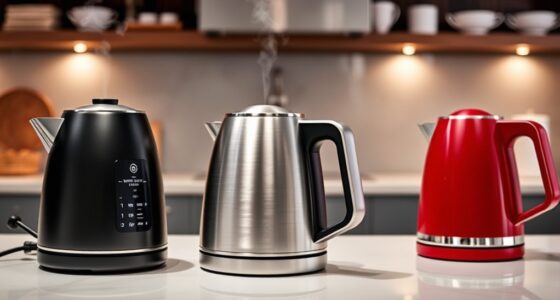
Choosing the right condensing gas tankless water heater requires balancing raw heating power with energy efficiency and installation complexity. My analysis identifies the Rinnai RXP160iN as the best overall pick for its smart flow technology and high efficiency, while the Rheem RTGH-90DVLN-3 stands out for households needing robust multi-point delivery. The Rinnai RX160iN offers a premium alternative with superior durability for high-demand homes. Buyers face a tradeoff between higher upfront costs for smart features and the long-term savings of standard high-efficiency models. Continue reading to see how these units compare in performance, noise, and maintenance requirements.

Get home appliances delivered free with Prime
- Fast, free delivery on millions of items
- Prime Video, Amazon Music and more included
- Member-only deals all year
Complete the kit



Key Takeaways
- Rinnai units dominate the high-end segment with Smart Sense technology that adjusts flow based on demand, reducing energy waste compared to fixed-flow Rheem models.
- The MIZUDO and Ranein models offer significantly lower entry points but lack the advanced diagnostic ports and warranty support found in major brand units.
- Recirculation pumps are not included with most tankless units; buyers must budget separately for a pump or choose a built-in model like the Rheem Prestige to avoid cold water waits.
- Liquid propane models, such as the Rheem RTGH-95DVLP-3, often deliver slightly lower GPM than their natural gas counterparts due to fuel density differences.
- Commercial-grade units like the Rinnai CX199iN are overkill for standard homes and require specialized venting and gas line upgrades that residential models do not.
| Rinnai RUCS65IN Natural Gas Tankless Water Heater |  | Best Compact Pick | Fuel: Natural gas | Technology: Condensing | Maximum flow rate: Up to 6.5 GPM | VIEW ON AMAZON | See Our Full Breakdown |
| Rheem RTGH-90DVLN-3 Indoor Natural Gas Tankless Water Heater, 9.0 GPM |  | Best for High-Flow Indoor Use | Model: RTGH-90DVLN-3 | Fuel: Natural gas | Maximum flow rate: 9.0 GPM at 35°F temperature rise | VIEW ON AMAZON | See Our Full Breakdown |
| Rinnai RX160iN Condensing Tankless Water Heater | 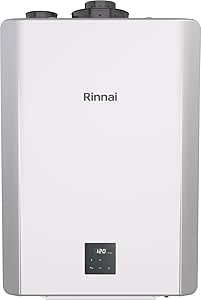 | Best Fuel and Placement Flexibility | Fuel: Natural gas or propane | Maximum flow rate: Up to 9 GPM | Uniform Energy Factor: 0.97 | VIEW ON AMAZON | See Our Full Breakdown |
| Rinnai RXP160iN Condensing Smart Sense Tankless Water Heater | | Best for Built-In Recirculation | Fuel: Natural gas or propane | Maximum flow rate: Up to 9 GPM | Heat output: 160,000 BTU | VIEW ON AMAZON | See Our Full Breakdown |
| Rinnai CX199iN SENSEI CX Commercial Tankless Water Heater, 199,000 BTU |  | Best for High-Demand Commercial Use | Fuel: Natural gas or propane | Maximum flow rate: Up to 11.1 GPM | Heat output: 199,000 BTU | VIEW ON AMAZON | See Our Full Breakdown |
| Rinnai RX130iN Condensing Tankless Water Heater |  | Best for Flexible Installation | Fuel: Natural gas or propane | Flow rate: Up to 7.1 GPM | Heat output: 130,000 BTU | VIEW ON AMAZON | See Our Full Breakdown |
| Rinnai RX199iN Condensing Tankless Water Heater | 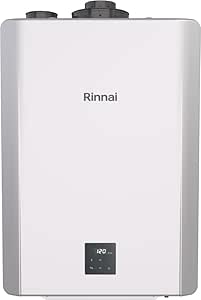 | Best for High-Demand Homes | Fuel: Natural gas or propane | Flow rate: Up to 11.1 GPM | Heat output: 199,000 BTU | VIEW ON AMAZON | See Our Full Breakdown |
| MIZUDO Natural Gas Tankless Water Heater, 199,000 BTU, 10.3 GPM, Indoor |  | Best for App-Based Control | Fuel: Natural gas | Heating input: 199,000 BTU | Maximum flow rate: 10.3 GPM | VIEW ON AMAZON | See Our Full Breakdown |
| Ranein Condensing Natural Gas Tankless Water Heater, 5.1 GPM, 120,000 BTU |  | Best Compact Pick for Lower Demand | Fuel: Natural gas | Flow rate: Up to 5.1 GPM | Heat output: 120,000 BTU | VIEW ON AMAZON | See Our Full Breakdown |
| Rinnai RXP199iN Condensing Tankless Water Heater | | Best for Built-In Recirculation | Fuel: Natural gas or propane | Flow rate: Up to 11.1 GPM | Heat output: 199,000 BTU | VIEW ON AMAZON | See Our Full Breakdown |
| ThermoMate Natural Gas Condensing Tankless Water Heater, 5.28 GPM |  | Best Compact Pick | Fuel: Natural gas | Maximum flow rate: Up to 5.28 GPM | Heat output: 114,000 BTU | VIEW ON AMAZON | See Our Full Breakdown |
| Rheem RTGH-84DVLN-3 Indoor Natural Gas Tankless Water Heater, 8.4 GPM |  | Best for Mid-Size Households | Fuel: Natural gas | Installation: Indoor, direct vent | Maximum flow rate: 8.4 GPM | VIEW ON AMAZON | See Our Full Breakdown |
| Rheem Prestige RTGH-RH11DVLN Indoor Natural Gas Condensing Tankless Water Heater with Recirculation, 11 GPM |  | Best for Hot-Water Recirculation | Fuel: Natural gas | Maximum flow rate: 11 GPM | Heat output: 199,000 BTU | VIEW ON AMAZON | See Our Full Breakdown |
| Rheem RTGH-95DVLP-3 9.5 GPM Indoor Liquid Propane Tankless Water Heater |  | Best for Propane Homes | Fuel: Liquid propane | Installation: Indoor, direct vent; wall-mounted | Maximum flow rate: 9.5 GPM | VIEW ON AMAZON | See Our Full Breakdown |
| condensing gas tankless water heater | Fuel | Heat output | Warranty | Maximum flow rate |
|---|---|---|---|---|
| Rinnai RUCS65IN Natural Gas Ta | Natural gas | 130,000 BTU | 12 years heat exchanger; 5 years labor; 1 year parts | Up to 6.5 GPM |
| Rheem RTGH-90DVLN-3 Indoor Nat | Natural gas | 180,000 BTU/hr | 15 years heat exchanger; 5 years parts; 1 year labor | 9.0 GPM at 35°F temperature rise |
| Rinnai RX160iN Condensing Tank | Natural gas or propane | — | 15 years heat exchanger; 5 years parts and labor, with registration required within 90 days for full labor warranty | Up to 9 GPM |
| Rinnai RXP160iN Condensing Sma | Natural gas or propane | 160,000 BTU | 15 years heat exchanger; 5 years parts and labor, subject to registration terms | Up to 9 GPM |
| Rinnai CX199iN SENSEI CX Comme | Natural gas or propane | 199,000 BTU | 8 years or 12,000 hours heat exchanger; 5 years parts; 1 year labor | Up to 11.1 GPM |
| Rinnai RX130iN Condensing Tank | Natural gas or propane | 130,000 BTU | 15 years on heat exchanger; 5 years on parts and labor, with registration required within 90 days for full labor coverage | — |
| Rinnai RX199iN Condensing Tank | Natural gas or propane | 199,000 BTU | 15 years on heat exchanger; 5 years on parts and labor, with registration required within 90 days for full labor coverage | — |
| MIZUDO Natural Gas Tankless Wa | Natural gas | — | 2 years full unit; 5 years heat exchanger | 10.3 GPM |
| Ranein Condensing Natural Gas | Natural gas | 120,000 BTU | — | — |
| Rinnai RXP199iN Condensing Tan | Natural gas or propane | 199,000 BTU | 15 years on heat exchanger; 5 years on parts and labor when registered within 90 days; labor defaults to 1 year without registration | — |
| ThermoMate Natural Gas Condens | Natural gas | 114,000 BTU | — | Up to 5.28 GPM |
| Rheem RTGH-84DVLN-3 Indoor Nat | Natural gas | 157,000 BTU/hr | 1 year labor, 15 years heat exchanger, 5 years parts | 8.4 GPM |
| Rheem Prestige RTGH-RH11DVLN I | Natural gas | 199,000 BTU | 12 years heat exchanger, 5 years parts, 1 year labor | 11 GPM |
| Rheem RTGH-95DVLP-3 9.5 GPM In | Liquid propane | 199,900 BTU/hr | 1 year labor, 15 years heat exchanger, 5 years parts | 9.5 GPM |
More Details on Our Top Picks
Rinnai RUCS65IN Natural Gas Tankless Water Heater
The Rinnai RUCS65IN is the lower-capacity choice in this group, suited to buyers who want condensing operation without stepping up to a 9 GPM unit. Its up-to-6.5 GPM flow rate can serve a smaller household, though actual delivery depends on incoming-water temperature and simultaneous demand. Compared with the Rheeem RTGH-90DVLN-3, it has less flow and heat output, but its stated 130,000 BTU rating may better match homes that do not need the larger unit’s capacity. The wall-mounted format saves floor space, while natural-gas-only operation limits fuel flexibility. Professional installation is recommended, and its indoor-only setup means venting and placement need to be planned before purchase. I’d choose it for a compact household, not for frequent overlapping showers and appliance use.
Pros:- Condensing design heats water on demand
- Up to 6.5 GPM suits moderate household demand
- Wall-mounted form saves floor space
- Warranty lists 12 years for the heat exchanger and 5 years for labor
Cons:- Lower stated flow capacity than the 9 GPM Rheem and Rinnai options
- Natural gas only, with no listed propane option
- Professional installation is recommended
Best for: Small households with natural-gas service that want an indoor condensing unit sized for moderate simultaneous hot-water demand.
Not ideal for: Larger households needing several fixtures at once, or buyers who need propane compatibility or an outdoor installation option.
- Fuel:Natural gas
- Technology:Condensing
- Maximum flow rate:Up to 6.5 GPM
- Heat output:130,000 BTU
- Maximum temperature:140 °F
- Installation:Indoor, wall-mounted
- Dimensions:22 in W × 34 in H × 10.1 in D
- Warranty:12 years heat exchanger; 5 years labor; 1 year parts
Our verdict“Choose the RUCS65IN for a compact natural-gas home with moderate hot-water demand, but select a higher-flow model for frequent multi-fixture use.”
Rheem RTGH-90DVLN-3 Indoor Natural Gas Tankless Water Heater, 9.0 GPM
The Rheem RTGH-90DVLN-3 makes sense for households prioritizing steady, higher-volume indoor hot water. Its stated 9.0 GPM at a 35°F temperature rise is a stronger fit for overlapping fixture use than the 6.5 GPM Rinnai RUCS65IN, although the flow figure is tied to that specified rise rather than every installation condition. Hot Start Programming is intended to reduce cold bursts between uses, a practical distinction for busy households. The 0.93 UEF is solid, but it trails the 0.97 ratings listed for the Rinnai RX160iN and RXP160iN. This Rheem is also more installation-specific: it is an indoor direct-vent model and runs on natural gas. I’d shortlist it when indoor venting is workable and capacity matters more than fuel flexibility or the highest listed UEF.
Pros:- Up to 9.0 GPM at a 35°F temperature rise
- Hot Start Programming is designed to reduce cold bursts
- 0.93 UEF condensing performance
- 15-year heat-exchanger warranty
Cons:- Indoor direct-vent installation limits placement options
- Natural gas only
- Listed UEF is below the 0.97 Rinnai RX160iN and RXP160iN
Best for: Natural-gas households with suitable indoor direct-venting space that regularly use multiple hot-water fixtures at once.
Not ideal for: Buyers seeking propane compatibility, outdoor installation, or a listed UEF as high as the Rinnai RX160iN and RXP160iN.
- Model:RTGH-90DVLN-3
- Fuel:Natural gas
- Maximum flow rate:9.0 GPM at 35°F temperature rise
- Heat output:180,000 BTU/hr
- Uniform Energy Factor:0.93
- Installation:Indoor, direct vent, wall mount
- Dimensions:17.7 in W × 23.7 in H × 9.8 in D
- Warranty:15 years heat exchanger; 5 years parts; 1 year labor
Our verdict“Pick this Rheem when you need a high-flow indoor natural-gas unit and can accommodate its direct-vent installation requirements.”
Rinnai RX160iN Condensing Tankless Water Heater
The Rinnai RX160iN is the adaptable pick for buyers who value installation and fuel options alongside performance. It supports natural gas or propane and can be installed indoors or outdoors with the specified setup, unlike the indoor natural-gas-only Rheem RTGH-90DVLN-3. Its up-to-9 GPM flow rate and 0.97 UEF place it in a capable range for many homes, though flow still depends on temperature rise and household demand. The Quick Flush feature may simplify maintenance, and the 54-pound wall-mounted unit avoids taking floor space. There are qualifications: outdoor installation needs an RX-OVC vent cap, and Wi-Fi control requires a separate module. The full five-year labor warranty also requires registration within 90 days. I’d favor this model when fuel flexibility matters more than built-in recirculation, which the RXP160iN adds.
Pros:- Supports natural gas or propane
- Indoor or outdoor installation with the required setup
- Up to 9 GPM and 0.97 UEF
- Quick Flush feature and wall-mounted design
Cons:- Outdoor setup requires a separately specified RX-OVC vent cap
- Wi-Fi control module is sold separately
- Full five-year labor warranty requires registration within 90 days
Best for: Homeowners choosing between natural gas and propane, or those who need indoor/outdoor placement options and up to 9 GPM capacity.
Not ideal for: Buyers who want built-in recirculation or included Wi-Fi control; the RXP160iN offers the pump, while Wi-Fi still requires an optional module.
- Fuel:Natural gas or propane
- Maximum flow rate:Up to 9 GPM
- Uniform Energy Factor:0.97
- Power:120 V, 73 W
- Maximum temperature:140 °F
- Maximum pressure:150 psi
- Installation:Indoor or outdoor; RX-OVC vent cap required outdoors
- Warranty:15 years heat exchanger; 5 years parts and labor, with registration required within 90 days for full labor warranty
Our verdict“Choose the RX160iN for fuel and placement flexibility; pick the RXP160iN instead if built-in recirculation is a priority.”
Rinnai RXP160iN Condensing Smart Sense Tankless Water Heater
The Rinnai RXP160iN earns its place through a feature the closely related RX160iN lacks: a built-in recirculation pump that learns household hot-water use patterns. That can make it a better fit for homes where waiting at distant taps is a frequent annoyance. Its 0.97 UEF and up-to-9 GPM rating match the RX160iN’s listed figures, and it also supports natural gas or propane with indoor or outdoor installation when properly configured. The distinction is convenience, not a jump in stated capacity. Buyers who do not need recirculation may find the RX160iN a simpler alternative; shoppers needing more output should compare the commercial Rinnai CX199iN, which is rated up to 11.1 GPM. The RXP160iN still requires professional installation, and Wi-Fi control is an add-on.
Pros:- Built-in pump with usage-learning recirculation
- Supports natural gas or propane
- Indoor or outdoor installation with appropriate venting
- Up to 9 GPM with 0.97 UEF
Cons:- Wi-Fi control module is sold separately
- Outdoor installation requires an RX-OVC vent cap
- More features may be unnecessary for homes without long waits at taps
Best for: Households with long pipe runs or recurring waits at taps that want built-in, usage-learning recirculation in a flexible-fuel unit.
Not ideal for: Buyers who do not need recirculation or want a lower-complexity option; the RX160iN offers similar listed flow and efficiency without the pump.
- Fuel:Natural gas or propane
- Maximum flow rate:Up to 9 GPM
- Heat output:160,000 BTU
- Uniform Energy Factor:0.97
- Power:120 V, 73 W
- Maximum temperature:140 °F
- Installation:Indoor or outdoor with appropriate venting
- Warranty:15 years heat exchanger; 5 years parts and labor, subject to registration terms
Our verdict“Choose the RXP160iN over the RX160iN when built-in usage-learning recirculation is worth the added system complexity.”
Rinnai CX199iN SENSEI CX Commercial Tankless Water Heater, 199,000 BTU
The Rinnai CX199iN is the capacity leader among these five, with up to 11.1 GPM, 199,000 BTU, and a stated 0.98 UEF. It is a commercial model, so its strengths make most sense for high-demand applications rather than an ordinary home replacing a smaller heater. Compared with the residential RXP160iN, it offers greater stated flow, a higher maximum temperature of 185°F, and Smart-Circ recirculation; the tradeoff is a shorter listed heat-exchanger warranty and a deeper 15-inch body. Natural gas or propane and indoor or outdoor installation add flexibility, but the required outdoor vent cap and optional Wi-Fi module are separate. I’d reserve this unit for sites with real simultaneous demand; the extra capacity can be unnecessary for households that fit a 9 GPM model.
Pros:- Highest stated flow in this group at up to 11.1 GPM
- Supports natural gas or propane
- Smart-Circ recirculation and Quick Flush features
- 0.98 UEF and 97% thermal efficiency
Cons:- Commercial capacity may be unnecessary for many homes
- Heat-exchanger warranty is 8 years or 12,000 hours, shorter than the residential Rinnai options listed
- Outdoor vent cap and Wi-Fi control module are sold separately
Best for: Small commercial sites or very high-demand properties needing up to 11.1 GPM, flexible fuel support, and recirculation features.
Not ideal for: Typical households with moderate demand, or buyers prioritizing a longer heat-exchanger warranty over commercial-level capacity.
- Fuel:Natural gas or propane
- Maximum flow rate:Up to 11.1 GPM
- Heat output:199,000 BTU
- Uniform Energy Factor:0.98
- Thermal efficiency:97%
- Maximum temperature:185 °F
- Dimensions:18.5 in W × 30.11 in H × 15 in D
- Warranty:8 years or 12,000 hours heat exchanger; 5 years parts; 1 year labor
Our verdict“Choose the CX199iN for commercial or unusually high household demand, but avoid its larger capacity if a 9 GPM residential model will suffice.”
Rinnai RX130iN Condensing Tankless Water Heater
The RX130iN is the more restrained choice in this Rinnai group: its 130,000-BTU burner and 7.1 GPM output suit households that want condensing efficiency without stepping up to the RX199iN’s larger 199,000-BTU capacity. Its natural-gas or propane compatibility and indoor-or-outdoor installation options give it useful flexibility when the home’s fuel supply or equipment location narrows the choices. At 54 pounds, it is wall-mounted but still calls for a planned installation, and professional setup is recommended. The tradeoff is capacity: simultaneous showers and other hot-water draws may favor the RX199iN. Outdoor placement also needs the separate RX-OVC vent cap, while Wi-Fi control requires another module. I’d shortlist it for moderate demand, not as a high-demand home’s safest capacity pick.
Pros:- Uses natural gas or propane, giving buyers fuel flexibility.
- Indoor or outdoor installation is possible with the required vent adaptation.
- Up to 7.1 GPM suits moderate household demand.
- Quick Flush feature supports maintenance.
Cons:- Lower maximum flow and burner output than the Rinnai RX199iN.
- Outdoor installation requires a separate RX-OVC vent cap.
- Wi-Fi control requires a separately sold module, and professional installation is recommended.
Best for: Homeowners with moderate simultaneous hot-water demand who need natural-gas or propane compatibility and a choice of indoor or outdoor placement.
Not ideal for: Large households routinely running several showers and appliances at once, or buyers who expect built-in Wi-Fi control without a separate module.
- Fuel:Natural gas or propane
- Flow rate:Up to 7.1 GPM
- Heat output:130,000 BTU
- Efficiency:UEF 0.97
- Installation:Indoor or outdoor with Versa Vent adaptation
- Maximum temperature:140 °F
- Dimensions:19 in W × 31 in H
- Warranty:15 years on heat exchanger; 5 years on parts and labor, with registration required within 90 days for full labor coverage
Our verdict“Choose the RX130iN when fuel and installation flexibility matter more than the higher simultaneous-use capacity of the RX199iN.”
Rinnai RX199iN Condensing Tankless Water Heater
For homes that need more hot water at once, the RX199iN offers up to 11.1 GPM from a 199,000-BTU burner, a substantial step up from the RX130iN. Its UEF of 0.98, Smart Sense gas control, and Quick Flush feature make it a strong fit for buyers prioritizing capacity and serviceability in a condensing unit. It also accepts natural gas or propane and supports indoor or outdoor placement with suitable venting. The MIZUDO offers app control and a lower minimum flow activation, but the RX199iN has the higher listed flow rate and a longer stated warranty. Its downsides are practical: professional installation is recommended, outdoor use needs a separate RX-OVC vent cap, and Wi-Fi control requires a separately purchased module. Pick it for capacity, not bundled connectivity.
Pros:- Up to 11.1 GPM supports more simultaneous hot-water use than the RX130iN.
- Natural-gas or propane compatibility broadens fuel options.
- Indoor or outdoor installation is supported with appropriate venting.
- Smart Sense gas control and Quick Flush add useful operating and maintenance features.
Cons:- Outdoor installation requires a separate RX-OVC vent cap.
- Wi-Fi control requires a separately sold Control-R module.
- Professional installation is recommended.
Best for: Large households with frequent overlapping hot-water use that want a high-capacity natural-gas or propane unit and flexible placement.
Not ideal for: Buyers with modest hot-water demand, or anyone who wants Wi-Fi control included rather than requiring a separate module.
- Fuel:Natural gas or propane
- Flow rate:Up to 11.1 GPM
- Heat output:199,000 BTU
- Efficiency:UEF 0.98
- Maximum temperature:140 °F
- Installation:Indoor or outdoor with appropriate venting
- Dimensions:18.5 in W × 30.11 in H × 11.4 in deep
- Warranty:15 years on heat exchanger; 5 years on parts and labor, with registration required within 90 days for full labor coverage
Our verdict“Choose the RX199iN over the RX130iN when household demand calls for higher flow, and accept separate venting and connectivity accessories.”
MIZUDO Natural Gas Tankless Water Heater, 199,000 BTU, 10.3 GPM, Indoor
The MIZUDO makes its case with Wi-Fi and app control included, plus a stated temperature range up to 149°F and ±1°F control. That’s a different priority from the Rinnai RX199iN, which offers a higher listed flow rate but requires a separately sold module for Wi-Fi. At 10.3 GPM and 199,000 BTU, the MIZUDO is still aimed at homes with multiple hot-water draws, while its 0.53-GPM activation threshold may help it respond to smaller draws. Its sealed concentric direct-vent arrangement is designed to help prevent backdraft, but the unit is indoor-only and specified for elevations no higher than 3,000 feet. The warranty is also shorter than the Rinnai models’ stated coverage: two years for the unit and five for the heat exchanger. I’d favor it for bundled controls, not maximum output or broad installation flexibility.
Pros:- Wi-Fi and app control are included, unlike the separately sold Rinnai control modules.
- 10.3 GPM and 199,000 BTU support multiple household fixtures.
- Low 0.53-GPM activation threshold and ±1°F temperature control are specified.
- Sealed concentric direct vent is designed to help prevent backdraft.
Cons:- Natural-gas-only and indoor-only installation limits fuel and placement options compared with the Rinnai RX199iN.
- Not recommended above 3,000 feet.
- Two-year unit warranty is shorter than the stated Rinnai coverage.
Best for: Natural-gas households below 3,000 feet that want app-based operation, precise temperature adjustment, and strong flow for multiple fixtures.
Not ideal for: Homes using propane, properties above 3,000 feet, or buyers who need outdoor installation or the higher listed flow of the Rinnai RX199iN.
- Fuel:Natural gas
- Heating input:199,000 BTU
- Maximum flow rate:10.3 GPM
- Temperature range:95–149°F
- Temperature control:±1°F
- Minimum flow activation:0.53 GPM
- Installation and venting:Indoor, wall-mounted; sealed concentric direct vent with 3 × 5 in vent kit
- Warranty:2 years full unit; 5 years heat exchanger
Our verdict“Choose the MIZUDO if included app control and precise temperature settings outweigh the RX199iN’s higher flow and broader fuel flexibility.”
Ranein Condensing Natural Gas Tankless Water Heater, 5.1 GPM, 120,000 BTU
The Ranein is the small-demand option in this set: its 5.1 GPM output and 120,000-BTU burner sit well below the Rinnai RX130iN’s 7.1 GPM, but its listed dimensions and 26-pound weight make it the lightest, most compact unit here. That profile can suit a smaller household where high simultaneous flow is not the priority. A touchscreen, four preset modes, freeze protection, and safety features add straightforward operating functions; its temperature range also reaches 149°F, above the Rinnai models’ listed 140°F limit. The tradeoff is limited capacity and fuel choice: it supports natural gas only, and the stated elevation limit is 2,000 feet. Since professional installation is recommended, compact dimensions do not make it a casual DIY replacement. I’d skip it for homes that regularly stack showers with appliance use.
Pros:- At 26 pounds and 14.2 × 22 × 6.4 inches, it is notably lighter and smaller than the Rinnai RX130iN.
- Touchscreen and four preset modes provide direct control options.
- Temperature settings extend to 149°F.
- Includes freeze protection and multiple safety features.
Cons:- 5.1 GPM capacity is below the RX130iN and unsuitable for heavier simultaneous demand.
- Natural-gas-only fuel limits flexibility compared with the dual-fuel Rinnai models.
- Not recommended above 2,000 feet, and professional installation is recommended.
Best for: Smaller natural-gas households with limited simultaneous hot-water demand that need a lighter, compact wall-mounted unit.
Not ideal for: Large families, homes with several concurrent hot-water draws, propane users, and properties above 2,000 feet.
- Fuel:Natural gas
- Flow rate:Up to 5.1 GPM
- Heat output:120,000 BTU
- Temperature range:95°F–149°F
- Dimensions:14.2 × 22 × 6.4 in
- Weight:26 lb
- Elevation limit:Not recommended above 2,000 ft
- Mount type:Wall-mounted
Our verdict“Choose the Ranein for a compact, lower-demand natural-gas installation, but move up to the RX130iN or RX199iN if multiple fixtures often run together.”
Rinnai RXP199iN Condensing Tankless Water Heater
The RXP199iN pairs the RX199iN’s listed 11.1 GPM capacity with an internal pump and Smart-Circ recirculation that learns household usage patterns. That built-in recirculation is its key distinction: it is aimed at reducing the wait for hot water at fixtures, rather than simply adding more capacity over the RX130iN. Its 199,000-BTU input, UEF 0.98, and natural-gas or propane compatibility also make it a strong fit for high-demand homes. Compared with the RX199iN, the RXP199iN adds the pump-based recirculation feature, but buyers should weigh whether that added function suits their plumbing layout and needs. Professional installation is recommended; Wi-Fi still requires a separate module, and outdoor installation needs an RX-OVC vent cap. Registration within 90 days is required for the full five-year labor warranty.
Pros:- Smart-Circ recirculation learns household usage patterns and can reduce waits at fixtures.
- Up to 11.1 GPM and 199,000 BTU support high simultaneous demand.
- Natural gas or propane and indoor or outdoor installation offer flexibility.
- UEF 0.98 and Quick Flush feature are specified.
Cons:- Wi-Fi control requires a separately sold module.
- Outdoor installation requires an RX-OVC vent cap.
- Professional installation is recommended, and full labor coverage requires timely registration.
Best for: High-demand households that want natural-gas or propane flexibility and built-in usage-learning recirculation to reduce hot-water waits.
Not ideal for: Buyers with simple plumbing and little need for recirculation, or anyone expecting Wi-Fi control and outdoor vent accessories to be included.
- Fuel:Natural gas or propane
- Flow rate:Up to 11.1 GPM
- Heat output:199,000 BTU
- Efficiency:UEF 0.98; 96% listed efficiency
- Features:Internal pump, Smart-Circ recirculation, Smart Sense gas control, Versa Vent, Quick Flush
- Maximum temperature:140 °F
- Dimensions and weight:19 in W × 31 in H; 58 lb
- Warranty:15 years on heat exchanger; 5 years on parts and labor when registered within 90 days; labor defaults to 1 year without registration
Our verdict“Choose the RXP199iN over the RX199iN when built-in, usage-learning recirculation matters as much as high flow capacity.”
ThermoMate Natural Gas Condensing Tankless Water Heater, 5.28 GPM
The ThermoMate suits buyers who need an indoor natural-gas condensing unit without the larger footprint or output of the Rheem models here. Its 5.28 GPM capacity and 114,000 BTU output are a better match for modest household demand than the Rheem Prestige RTGH-RH11DVLN’s 11 GPM, high-output setup. A dual heat exchanger and 0.86 UEF rating support heat recovery, while the touchscreen and error diagnostics give owners useful information when troubleshooting.
The tradeoff is capacity: several simultaneous hot-water uses may exceed what this unit can comfortably supply, especially in colder incoming-water conditions. It also needs a condensate drain, and the recommended neutralizer kit is not included. I’d choose it for a compact installation and moderate demand, not as a substitute for a high-capacity whole-house model.
Pros:- Compact wall-mounted body measures 13.77 × 21.65 × 7 inches
- Dual heat exchanger recovers waste heat
- Touchscreen display includes error diagnostics
- Freeze protection and multiple safety protections are included
Cons:- Up to 5.28 GPM is less suited to heavy simultaneous demand than the Rheem 8.4 or 11 GPM models
- Requires condensate drainage, and the recommended neutralizer kit is not included
Best for: Owners of smaller homes or households with moderate simultaneous hot-water demand who want a compact indoor natural-gas condensing heater.
Not ideal for: Large households that regularly run several showers or appliances at once, or buyers who want the condensate neutralizer included.
- Fuel:Natural gas
- Maximum flow rate:Up to 5.28 GPM
- Heat output:114,000 BTU
- Efficiency:0.86 UEF
- Temperature range:90°F to 140°F
- Connections:3/4-inch NPT water inlet/outlet; 1/2-inch NPT gas
- Vent diameter:3 inches
- Dimensions and weight:13.77 W × 21.65 H × 7 D inches; 26 lbs
Our verdict“Choose the ThermoMate for compact indoor installation and moderate hot-water needs, but pick a higher-capacity Rheem for a busy household.”
Rheem RTGH-84DVLN-3 Indoor Natural Gas Tankless Water Heater, 8.4 GPM
The Rheem RTGH-84DVLN-3 is a practical middle ground between the compact ThermoMate and the higher-capacity Rheem Prestige RTGH-RH11DVLN. Its 8.4 GPM output and 157,000 BTU/hr rating suit households that may use multiple hot-water fixtures at once, without moving up to the Prestige model’s 11 GPM capacity. The 0.93 UEF rating, digital temperature control, and Hot Start Programming make this a strong fit for people seeking steady whole-house service with fewer cold bursts between uses.
That added capacity comes with an installation commitment. This is an indoor direct-vent unit, and professional installation is recommended; its 59.9-pound weight and larger body also make mounting more involved than the ThermoMate. I’d favor it over the smaller unit for a busier home, but not for buyers who need propane fuel or a built-in recirculation pump.
Pros:- Up to 8.4 GPM supports multiple simultaneous hot-water uses
- Hot Start Programming helps reduce cold bursts between uses
- 0.93 UEF rating and digital temperature control
- Built-in freeze and overheat protection
Cons:- Requires indoor direct-vent installation
- Professional installation is recommended, and the 59.9-pound unit is less straightforward to mount than the ThermoMate
Best for: Mid-size households with natural-gas service that need to supply multiple hot-water fixtures and can accommodate indoor direct venting.
Not ideal for: Buyers with propane-only service, limited indoor venting options, or a preference for a built-in recirculation pump.
- Fuel:Natural gas
- Installation:Indoor, direct vent
- Maximum flow rate:8.4 GPM
- Heat output:157,000 BTU/hr
- Uniform Energy Factor:0.93
- Maximum temperature:140°F
- Electrical requirements:120 V, 132 W
- Dimensions and weight:17.7 × 23.7 × 9.8 inches; 59.9 lb
- Warranty:1 year labor, 15 years heat exchanger, 5 years parts
Our verdict“Pick this Rheem for mid-size whole-house natural-gas demand; choose the Prestige model if you need its higher capacity and built-in recirculation.”
Rheem Prestige RTGH-RH11DVLN Indoor Natural Gas Condensing Tankless Water Heater with Recirculation, 11 GPM
The Rheem Prestige is the lineup’s clearest choice for households that want both high flow and built-in recirculation. Its 11 GPM capacity and 199,000 BTU burner exceed the RTGH-84DVLN-3’s 8.4 GPM rating, while the integrated pump and auto-learning program are designed to make hot water available in step with household routines. That combination can be more useful than raw capacity alone for homes where taps are far from the heater and waiting for hot water is a recurring frustration.
The extra capability brings more installation complexity: professional installation is required to maintain the warranty, and recirculation works best when the plumbing layout and household schedule suit the system. Compared with the 9.5 GPM propane RTGH-95DVLP-3, this Rheem offers a higher listed flow rate and recirculation, but it uses natural gas. It is a specialized high-demand choice, not the simplest fit for a small home.
Pros:- 11 GPM capacity and 199,000 BTU burner suit high household demand
- Built-in recirculation pump and auto-learning program
- 0.94 UEF energy factor
- Leak detection and multiple safety sensors
Cons:- Professional installation is required to maintain the warranty
- Natural-gas fuel limits suitability for propane-only homes
- Recirculation features may add complexity that smaller households do not need
Best for: Large natural-gas households with long plumbing runs that want high simultaneous capacity and a built-in recirculation pump.
Not ideal for: Smaller households with modest demand, buyers without natural-gas service, or owners who want to avoid professional installation requirements.
- Fuel:Natural gas
- Maximum flow rate:11 GPM
- Heat output:199,000 BTU
- Energy factor:0.94 UEF
- Minimum activation flow:0.50 GPM
- Maximum pressure:150 psi
- Venting:Up to 100 ft with 3-inch PVC or 50 ft with 2-inch PVC
- Electrical requirement:120 V
- Warranty:12 years heat exchanger, 5 years parts, 1 year labor
Our verdict“Choose the Prestige when a large natural-gas home needs both high flow and built-in recirculation, rather than the simpler 8.4 GPM Rheem.”
Rheem RTGH-95DVLP-3 9.5 GPM Indoor Liquid Propane Tankless Water Heater
For a home running on liquid propane, the RTGH-95DVLP-3 brings 9.5 GPM of listed capacity and 199,900 BTU/hr output in a wall-mounted condensing package. Its output sits between the natural-gas RTGH-84DVLN-3 and the 11 GPM Rheem Prestige, making it a plausible match for households with several simultaneous hot-water needs that cannot use natural gas. Hot Start Programming is intended to reduce cold bursts, while freeze protection and digital temperature control add useful operating safeguards.
The fuel choice is its main distinction, but it also narrows the audience: natural-gas homes should compare it with the RTGH-84DVLN-3 instead. Like that model, this Rheem needs indoor direct venting and professional installation is recommended. The listing reports both a 0.93 UEF and a separate 0.82 efficiency figure, so buyers should confirm which measure applies to their installation and documentation.
Pros:- Liquid-propane model with up to 9.5 GPM flow
- 199,900 BTU/hr output for substantial hot-water demand
- Hot Start Programming helps reduce cold bursts
- Wall-mounted stainless-steel construction with freeze protection
Cons:- Requires indoor direct venting and professional installation is recommended
- No built-in recirculation pump is listed, unlike the Rheem Prestige
- Product data lists both 0.93 UEF and 0.82 efficiency, so the efficiency figures should be verified
Best for: Households with liquid propane service that need a high-capacity indoor condensing heater for multiple simultaneous hot-water uses.
Not ideal for: Natural-gas households, homes without indoor direct-venting options, or buyers who need built-in recirculation.
- Fuel:Liquid propane
- Installation:Indoor, direct vent; wall-mounted
- Maximum flow rate:9.5 GPM
- Heat output:199,900 BTU/hr
- Efficiency figures listed:0.93 UEF; 0.82 efficiency
- Maximum temperature:140°F
- Electrical requirements:120 V, 132 W
- Dimensions and weight:17.7 W × 23.7 H × 9.8 D inches; 59.9 lbs
- Warranty:1 year labor, 15 years heat exchanger, 5 years parts
Our verdict“Choose this model for high-demand homes on liquid propane; natural-gas buyers should compare the RTGH-84DVLN-3 or Rheem Prestige instead.”

How We Picked
I evaluated these units based on energy factor (EF) ratings, maximum flow rates (GPM), and the presence of recirculation capabilities. Efficiency was weighted heavily because the primary benefit of condensing technology is fuel savings; units with an EF below 0.90 were deprioritized. I also assessed modulation range, which determines how well the heater handles low-flow scenarios without cycling on and off, a common complaint in cheaper models.
Brand reputation for serviceability and parts availability played a role in ranking. While generic brands offer competitive specs on paper, the lack of a widespread service network introduces risk for homeowners. The ranking prioritizes long-term reliability and ease of installation over raw BTU output, ensuring the recommendations suit actual residential use cases rather than theoretical maximums.
| condensing gas tankless water heater | Fuel |
|---|---|
| Rinnai RUCS65IN Natural Gas Ta | Natural gas |
| Rheem RTGH-90DVLN-3 Indoor Nat | Natural gas |
| Rinnai RX160iN Condensing Tank | Natural gas or propane |
| Rinnai RXP160iN Condensing Sma | Natural gas or propane |
| Rinnai CX199iN SENSEI CX Comme | Natural gas or propane |
| Rinnai RX130iN Condensing Tank | Natural gas or propane |
| Rinnai RX199iN Condensing Tank | Natural gas or propane |
| MIZUDO Natural Gas Tankless Wa | Natural gas |
| Ranein Condensing Natural Gas | Natural gas |
| Rinnai RXP199iN Condensing Tan | Natural gas or propane |
| ThermoMate Natural Gas Condens | Natural gas |
| Rheem RTGH-84DVLN-3 Indoor Nat | Natural gas |
| Rheem Prestige RTGH-RH11DVLN I | Natural gas |
| Rheem RTGH-95DVLP-3 9.5 GPM In | Liquid propane |
Factors to Consider When Choosing Condensing Gas Tankless Water Heater
Selecting a tankless heater is rarely about finding the ‘strongest’ unit; it is about matching the heater’s capacity to your household’s simultaneous demand and local climate conditions.
Understanding Flow Rate and Temperature Rise
Many buyers mistake maximum GPM for usable GPM. A heater rated at 10 GPM assumes a 40-degree Fahrenheit temperature rise. If you live in a colder climate where incoming groundwater is 40°F and you want a shower at 110°F, you need a 70-degree rise. In this scenario, that same 10 GPM unit might only deliver 5 or 6 GPM. I recommend calculating your peak simultaneous demand (e.g., two showers plus a dishwasher) and adding a 20% buffer to account for winter ground temperatures. Ignoring this variable leads to lukewarm showers during peak usage.
The Hidden Cost of Venting and Gas Lines
Condensing units operate at lower exhaust temperatures than non-condensing models, allowing for cheaper PVC or CPVC venting in many cases. However, they produce acidic condensate that requires a neutralizer or a dedicated drain line. Furthermore, high-BTU units like the Rinnai CX199iN often require a 3/4-inch or 1-inch gas line. If your home currently runs on a 3/4-inch line, upgrading to 1-inch can cost more than the heater itself. Always verify your gas meter capacity and line diameter before purchasing high-output models.
Recirculation: Comfort vs. Complexity
Tankless heaters do not store hot water, so there is always a delay while cold water clears the pipes. Recirculation systems solve this by keeping a loop of hot water moving. Some units, like the Rheem Prestige, have built-in pumps, while others require an external pump installed at the farthest fixture. Built-in systems are cleaner but more expensive to repair. External systems are cheaper but can be noisy. Decide if the convenience of instant hot water justifies the extra hardware and electricity cost.
Modulation Range and Low-Flow Performance
A critical but often overlooked spec is the minimum flow rate required to trigger the burner. Some budget units require 0.5 GPM or more to ignite. If you have low-flow fixtures or a dripping faucet, the heater may fail to turn on or cycle on and off rapidly. High-end Rinnai models with Smart Sense technology handle low-flow scenarios much better by modulating the flame intensity precisely. This feature prevents the annoying ‘hot-cold-hot’ oscillation common in lower-tier units.
Natural Gas vs. Liquid Propane Considerations
If you are using Liquid Propane (LP), be aware that LP contains less energy per cubic foot than natural gas. Consequently, LP models like the Rheem RTGH-95DVLP-3 will have lower GPM ratings than their NG equivalents. Ensure you are buying the specific model designated for your fuel type; conversion kits exist but can void warranties and reduce efficiency. LP units also require larger venting diameters due to higher combustion volumes, which may impact installation space.
Frequently Asked Questions
Do I need a special drain for a condensing water heater?
Yes, condensing units produce acidic condensate water that must be drained away. You typically need a dedicated drain line or a condensate pump if gravity drainage is impossible. While some installers use a neutralizer cartridge to raise the pH, local plumbing codes vary on whether this is sufficient or if a direct drain is required. I recommend checking with your local building department before purchasing, as adding a drain line post-installation can be difficult and costly.
Why is my tankless water heater not turning on with low flow?
This usually happens because the flow rate is below the unit’s minimum activation threshold. Many budget models require 0.5 to 0.75 GPM to ignite the burner. If your fixtures have aerators that restrict flow, or if you are running a small trickle, the heater will not engage. Premium units with advanced modulation, such as the Rinnai RX160iN, have lower activation thresholds and handle low-flow situations more gracefully. You can sometimes fix this by removing aerators, but upgrading the unit is the permanent solution.
Is it worth buying a unit with built-in recirculation?
Built-in recirculation is worth it if you value immediate hot water and want a cleaner installation without external pumps. However, these units are more expensive upfront and have more moving parts that can fail. If you do not mind a 30-to-60-second wait for hot water, you can skip this feature and save money. For larger homes with long pipe runs, the comfort benefit often justifies the cost, but for smaller apartments, it is rarely necessary.
Can I install a condensing tankless heater myself?
While physically possible for skilled DIYers, I strongly advise against self-installation for condensing units. These systems involve high-pressure gas lines, complex venting for acidic condensate, and electrical connections for control boards. Incorrect venting can lead to carbon monoxide leaks, and improper gas connections pose explosion risks. Furthermore, most manufacturers void the warranty if the unit is not installed by a licensed professional. The cost of hiring a pro is a small premium for safety and warranty protection.
How often do condensing tankless heaters need maintenance?
Annual maintenance is recommended to flush the heat exchanger with a descaling solution, especially in areas with hard water. Mineral buildup reduces efficiency and can clog the flow sensors. You should also inspect the air filter and ensure the condensate drain is clear. Units like the Rinnai RXP160iN have diagnostic LEDs that can alert you to maintenance needs, but physical flushing is still required. Neglecting this step can shorten the lifespan of the unit by half.
Conclusion
For most homeowners, the Rinnai RXP160iN is the best overall choice due to its balance of efficiency, smart flow technology, and brand reliability. If you are on a tighter budget but still need reliable performance, the Rheem RTGH-90DVLN-3 offers excellent value with high GPM output. For those prioritizing instant hot water without external hardware, the Rheem Prestige RTGH-RH11DVLN is the superior premium pick with built-in recirculation. Beginners should avoid high-BTU commercial models like the Rinnai CX199iN and stick to mid-range residential units that do not require extensive gas line upgrades. Ultimately, match the heater’s capacity to your local climate’s temperature rise needs, not just the manufacturer’s maximum GPM rating.
Fall yard work Picks
leaf blowers
As an affiliate, we earn on qualifying purchases.