A bathroom ventilator has to manage moisture and odors, but a heat recovery ventilator also aims to limit the warmth lost when indoor air leaves. My leading pick for a bathroom that needs more controlled, measurable ventilation is the Panasonic FV-06VE1, with selectable airflow up to 60 CFM. For app control and better particle filtration, the Pioneer ERV-50 offers a stronger feature set, while the LINGGONGAIR WiFi 4-inch model is the simpler choice for a small room with an existing standard-size wall opening.
The main tradeoff is that these products are not interchangeable bathroom exhaust fans. Some descriptions do not specify moisture-sensing performance, rated bathroom exhaust duty, or installation clearances, and compact reversible units have less stated airflow than the larger Panasonic. I’ve ranked these picks by the usefulness of their stated ventilation capacity, heat-recovery features, bathroom suitability, and the practical demands of installation—not by smart features alone.
Complete the kit


Key Takeaways
- The Panasonic FV-06VE1 has the clearest stated airflow range for a bathroom: adjustable from 20 to 60 CFM, but it needs a hardwired selector and more installation planning.
- The Pioneer ERV-50 pairs heat recovery with an F7 (MERV 13) filter and CO₂ monitoring; its maximum stated airflow is 35.3 CFM, so room needs still matter.
- The LINGGONGAIR WiFi 4-inch unit is the most approachable plug-in smart pick, with six modes, but it is limited to a 4-inch opening and depends on Wi-Fi for app functions.
- The Linggongair remote-controlled 4-inch model is the simpler choice when reversible supply and exhaust matter more than app control or higher stated airflow.
- The Weiworld 6-inch model offers a larger stated capacity of 60 m³/h and quiet operation under 30 dB, but its single-room design and wall-mount requirements call for careful placement.
| Panasonic FV-06VE1 WhisperComfort 60 ERV | 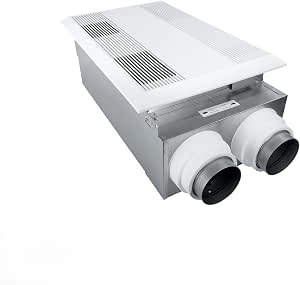 | Best Overall for Adjustable Bathroom Ventilation | Airflow: 20–60 CFM | Control: Hardwired manual airflow selector | Speeds: 3 | VIEW ON AMAZON | See Our Full Breakdown |
| Pioneer ERV-50 Wi-Fi Wall-Mounted Energy Recovery Ventilator |  | Best for Filtration and Smart Monitoring | Airflow with F7 filter: 11.8 / 23.5 / 29.4 / 35.3 CFM | Heat recovery: Up to 97% | Filter: F7 (MERV 13) with washable prefilters | VIEW ON AMAZON | See Our Full Breakdown |
| 4-Inch Heat Recovery Ventilator with WiFi App and Remote – Wall-Mount Ceramic Core |  | Best Smart Pick for a Small Bathroom | Duct diameter: 4 in (100 mm) | Motor: EC | Power: 5 W | VIEW ON AMAZON | See Our Full Breakdown |
| 6-Inch Heat Recovery Ventilator with Ceramic Heat Exchanger |  | Best for a Larger Single Room | Duct size: 6 in (150 mm) | Airflow capacity: 60 m³/h | Heat recovery: Up to 90% | VIEW ON AMAZON | See Our Full Breakdown |
| Linggongair 4-Inch Ceramic Core Heat Recovery Reversible Wall Ventilator |  | Best Simple Reversible Ventilator | Duct size: 4 in | Heat recovery: Up to 97% | Motor: 5 W EC motor | VIEW ON AMAZON | See Our Full Breakdown |
| heat recovery ventilator for bathroom | Controls | Power | Heat recovery |
|---|---|---|---|
| Panasonic FV-06VE1 WhisperComf | — | 50 W | — |
| Pioneer ERV-50 Wi-Fi Wall-Moun | App, remote, and onboard interface | — | Up to 97% |
| 4-Inch Heat Recovery Ventilato | Wi-Fi app and remote | 5 W | — |
| 6-Inch Heat Recovery Ventilato | App, push button, and remote | 8.5 W | Up to 90% |
| Linggongair 4-Inch Ceramic Cor | Reversible remote | — | Up to 97% |
More Details on Our Top Picks
Panasonic FV-06VE1 WhisperComfort 60 ERV
I rank the Panasonic WhisperComfort 60 first because it supplies the most actionable airflow information in this group: a selectable range from 20 to 60 CFM across three settings. That gives a buyer a more concrete starting point for matching ventilation to a room than the compact 4-inch models, whose supplied specs do not list comparable CFM figures. Its capillary core is designed to recover heat while exchanging air, making it the most balanced pick here for someone who wants a dedicated ERV rather than a basic reversible wall ventilator.
Its flexibility comes with a more involved setup. The unit can mount on a ceiling or wall, but its stated dimensions are much larger than the small through-wall units, and the controller is hardwired with a manual selector. Compared with the Pioneer ERV-50, it has a higher stated maximum airflow and a simpler speed-selection approach, but the Pioneer adds app control, a CO₂ sensor, and F7 filtration. Panasonic lists operation at 2.5 sones; that is described as quiet, but it is not the lowest noise claim in this lineup. I would confirm that the chosen setting and installation are appropriate for a bathroom, especially because the supplied details do not identify a humidity sensor or provide a bathroom-specific exhaust rating.
This is my strongest all-round recommendation when adjustable airflow and a recognized, detailed specification set matter more than wireless controls. It is less compelling for a renter seeking a plug-in DIY unit, or for anyone who wants automatic humidity response without adding a separate control system.
Pros:- Three selectable settings provide airflow from 20 to 60 CFM.
- Capillary core is designed to recover heat while ventilating.
- Can be mounted on a ceiling or wall.
- Static pressure ports support airflow verification.
Cons:- Hardwired manual selector is less convenient than app or remote control.
- Its larger listed dimensions call for more installation space.
- At 2.5 sones, it is not the quietest stated option here.
Best for: Homeowners who want an adjustable ERV with a stated 20–60 CFM range and can plan for a larger ceiling or wall installation.
Not ideal for: Renters, buyers who need plug-in installation, or anyone who expects built-in humidity sensing or smartphone controls.
- Airflow:20–60 CFM
- Control:Hardwired manual airflow selector
- Speeds:3
- Noise:2.5 sones
- Mounting:Ceiling or wall
- Power:50 W
- Core:High-efficiency capillary heat-exchange core
- Dimensions:17.32 × 31.81 × 12.64 in
Our verdict“I’d choose the Panasonic when adjustable, clearly specified airflow is the priority and the installation can accommodate a larger hardwired ERV.”
Pioneer ERV-50 Wi-Fi Wall-Mounted Energy Recovery Ventilator
The Pioneer ERV-50 earns second place for combining heat recovery with the most substantial filtration and monitoring package here. Its F7 (MERV 13) filter and washable prefilters can make incoming air cleaner than the ceramic-core filtration described for the smaller Linggongair units. App and remote controls, plus a built-in CO₂ sensor, also provide more ways to monitor and manage room ventilation than the Panasonic’s manual selector. Those features are useful in a bathroom connected to a bedroom or a tightly sealed home where a user wants more than a simple on/off exhaust routine.
Airflow is the qualification. With the F7 filter installed, the listed range runs from 11.8 to 35.3 CFM, below the Panasonic’s 60 CFM maximum. The manufacturer description also recommends two units to maximize heating and cooling benefits, so I would not treat one unit as an automatic fit for every bathroom. Its maximum sound output is 32.7 dB(A), and its wall channel needs a span of 11 to 18.5 inches. That makes it more installation-specific than a standard 4-inch plug-in ventilator, even though it avoids the larger ceiling-mounted format of the Panasonic.
I see this as the better option when air filtration and automated monitoring outrank peak airflow. It is not the easiest pick for a small bathroom where a simpler exhaust routine is enough, and the supplied description does not specify humidity sensing. Confirm that its airflow and wall dimensions suit the room before treating it as the bathroom’s primary ventilation system.
Pros:- F7 (MERV 13) filter is paired with washable prefilters.
- App, onboard interface, and handheld remote provide multiple controls.
- Built-in CO₂ sensor supports ventilation monitoring.
- Low listed power draw ranges from 6 to 8 W across settings.
Cons:- Maximum stated airflow with the F7 filter is 35.3 CFM.
- Wall channel must fit an 11–18.5-inch span.
- Description suggests two units may be needed for maximum heating and cooling benefits.
Best for: Buyers who value app control, CO₂ monitoring, and stronger stated filtration alongside heat recovery.
Not ideal for: Anyone who needs airflow above the stated 35.3 CFM maximum from a single unit or wants a standard 4-inch installation.
- Airflow with F7 filter:11.8 / 23.5 / 29.4 / 35.3 CFM
- Heat recovery:Up to 97%
- Filter:F7 (MERV 13) with washable prefilters
- Controls:App, remote, and onboard interface
- Sensor:Built-in CO₂ sensor
- Maximum sound:32.7 dB(A)
- Power draw:6–8 W
- Duct diameter:6-1/4 in
Our verdict“I’d pick the Pioneer over the Panasonic when filtration and smart monitoring matter more than a higher single-unit airflow ceiling.”
4-Inch Heat Recovery Ventilator with WiFi App and Remote – Wall-Mount Ceramic Core
This LINGGONGAIR WiFi 4-inch ventilator stands out for its combination of a standard-size opening, plug-in power, app control, and six operating modes. Supply, exhaust, recirculation, humidity, sleep, and continuous modes give it more stated operating choices than the simpler remote-controlled Linggongair model. The 5-watt EC motor and sleep mode also suit a small bathroom near a bedroom, where a bulky or intrusive unit may be harder to live with.
That convenience does not make it the strongest choice for a high-moisture or larger bathroom. Its listed duct diameter is 4 inches, and the provided specs do not give a CFM figure or a heat-recovery percentage. The Panasonic is a safer comparison when the buyer needs a quantified airflow range; the Pioneer is a stronger match when filtration performance is central. This unit’s main case is ease of control and a compact format, not a proven capacity advantage. Its app features also depend on a stable Wi-Fi connection, though the included remote gives a local alternative.
I would shortlist it for a small bathroom with an existing 4-inch wall opening and a buyer who wants flexible controls without hardwiring. I would not buy it on the assumption that its humidity mode alone guarantees adequate moisture removal. Check the manufacturer’s airflow and bathroom-use guidance, and confirm the wall opening and exterior grille arrangement before installation.
Pros:- Six stated modes include humidity, sleep, supply, and exhaust.
- Wi-Fi app and handheld remote offer flexible operation.
- 5 W EC motor is a low-power format.
- Standard plug avoids hardwiring.
Cons:- Limited to a 4-inch duct opening.
- The supplied specifications do not state airflow or heat-recovery percentage.
- App features require a stable Wi-Fi connection.
Best for: Owners of small bathrooms with a standard 4-inch wall opening who want app and remote control without hardwiring.
Not ideal for: Larger bathrooms, buyers who need a verified CFM rating or heat-recovery percentage, and homes with unreliable Wi-Fi.
- Duct diameter:4 in (100 mm)
- Motor:EC
- Power:5 W
- Controls:Wi-Fi app and remote
- Modes:Supply, exhaust, recirculation, humidity, sleep, continuous
- Heat exchanger:Ceramic core
- Power supply:Standard plug; no hardwiring
- Exterior grille:Stainless steel
Our verdict“I’d choose this model for compact smart control, but only after verifying that its rated airflow suits the bathroom.”
6-Inch Heat Recovery Ventilator with Ceramic Heat Exchanger
The Weiworld VT501 takes a different route from the two 4-inch LINGGONGAIR models: its 6-inch wall connection and listed capacity of 60 m³/h suit a buyer looking for more room-level airflow. It combines a ceramic exchanger rated to recover up to 90% of exhaust heat with three modes, app and remote control, and a claimed noise level under 30 dB. Compared with the Pioneer, it has a higher stated airflow figure, though the Pioneer provides more detailed filtered airflow steps and an F7 filter.
Its fit is less universal than the compact plug-in options. The unit is intended for single-room use, needs wall mounting, and supports walls 250–500 mm thick; those dimensions and the 6-inch duct are worth checking before buying. The listing gives universal 100–240 V compatibility but also specifies 230 V, so I would verify the version and electrical requirements for the installation location. The product description includes attic, basement, bedroom, garage, and home-office examples, but does not specifically list a bathroom. I would confirm suitability for humid bathroom conditions and any required clearances rather than assume that a quiet wall ERV is a bathroom-rated exhaust fan.
This pick makes sense when a larger single room and quiet operation are more important than compact size or a clearly documented bathroom application. It is not my first choice for a standard 4-inch opening or a buyer who wants a clearly stated humidity-control feature. Compared with Panasonic, it brings wireless controls and a lower noise claim, but Panasonic provides a more explicit CFM range and a stronger bathroom-use fit in the supplied listing.
Pros:- Listed airflow capacity is 60 m³/h.
- Ceramic exchanger is rated to recover up to 90% of exhaust heat.
- App and remote controls pair with three operating modes.
- Claimed noise level is under 30 dB.
Cons:- Single-room design does not serve as whole-house ventilation.
- Requires a 6-inch wall installation and compatible wall thickness.
- Supplied room examples do not specifically identify bathrooms.
Best for: Buyers ventilating a larger single room who have a suitable 6-inch wall opening and prioritize quiet operation.
Not ideal for: Small bathrooms with 4-inch openings, whole-house ventilation plans, or buyers who need explicit bathroom-use and humidity-control details.
- Duct size:6 in (150 mm)
- Airflow capacity:60 m³/h
- Heat recovery:Up to 90%
- Noise:Under 30 dB
- Controls:App, push button, and remote
- Modes:3
- Power:8.5 W
- Wall thickness:250–500 mm
Our verdict“I’d consider the Weiworld for a larger, quiet single-room installation, after confirming bathroom suitability and electrical requirements.”
Linggongair 4-Inch Ceramic Core Heat Recovery Reversible Wall Ventilator
The Linggongair reversible 4-inch ventilator is the straightforward alternative to the WiFi LINGGONGAIR model. Its remote switches between intake and exhaust, and its plug-in setup avoids hardwiring. The washable ceramic core is described as recovering up to 97% of heat and capturing fine particles, while the 5 W EC motor is intended for quiet operation. For a small room where the owner wants a direct way to change airflow direction, this is a simpler control proposition than an app-dependent unit.
Its position at the bottom of my ranking reflects the limited bathroom-specific airflow information, not a lack of useful features. The listing provides no CFM figure, and its 4-inch size may constrain ventilation in a larger or frequently used bathroom. The WiFi LINGGONGAIR sibling provides more operating modes, including a humidity mode, and adds app control, so it is the better-equipped choice for someone seeking automation. The Panasonic remains the more defensible pick where stated airflow capacity matters. This Linggongair also needs a wall opening and drilling; plug-in power does not make it a no-installation product.
I’d use it as a compact option only after checking its rated airflow and bathroom installation instructions. The stainless steel rain hood is a useful exterior detail, but the supplied description names bedrooms, attics, and garages rather than bathrooms. Buyers should verify that the unit and its electrical placement are suitable for the bathroom’s moisture exposure. It suits someone who values simple reversible operation and a washable core, but not someone choosing primarily by documented bathroom exhaust performance.
Pros:- Remote changes airflow direction between intake and exhaust.
- Plug-in power avoids hardwiring.
- Washable ceramic core is reusable.
- 5 W EC motor and stainless steel rain hood are specified.
Cons:- The supplied specs do not list airflow in CFM.
- 4-inch format may be limiting in larger bathrooms.
- Wall drilling is still required, and bathroom suitability should be confirmed.
Best for: A buyer who wants a compact, remote-controlled reversible unit for a small room and can verify bathroom suitability.
Not ideal for: Larger bathrooms, buyers needing a stated CFM rating, or anyone who wants app control and a named humidity mode.
- Duct size:4 in
- Heat recovery:Up to 97%
- Motor:5 W EC motor
- Core:Washable ceramic heat-exchange core
- Controls:Reversible remote
- Installation:Through-wall, plug-in
- Voltage:110 V
- Exterior hood:Corrosion-resistant stainless steel
Our verdict“I’d choose this over the WiFi sibling only when simple reversible remote control matters more than app functions and extra modes.”

How We Picked
I compared these five products as bathroom heat recovery ventilators, rather than treating them as general-purpose fans. My ranking gives more weight to information a bathroom buyer can act on: stated airflow, the ability to adjust operation, heat-exchange or filtration details, control method, and whether the installation approach suits a single room. A high heat-recovery percentage alone does not tell me whether a unit can ventilate a particular bathroom effectively.
I also separated clear specification from broad product claims. For example, the Panasonic lists a 20–60 CFM range and selectable speeds, while the Pioneer provides several airflow figures with its F7 filter. By contrast, the two 4-inch LINGGONGAIR units have compact formats and convenient controls, but the supplied details do not state comparable CFM figures. That difference affects their ranking: I can identify their installation and control advantages, but buyers should verify actual airflow and bathroom application before choosing them as the sole exhaust solution.
Finally, I weighed drawbacks alongside strengths. Wall drilling, hardwiring, Wi-Fi dependence, noise figures, and room-size limits all affect real-world fit. These models may support heat recovery while ventilating, but they should not be assumed to replace a code-required bathroom exhaust fan or a moisture-control plan. I recommend checking local requirements, duct or wall details, and the manufacturer’s bathroom installation guidance before purchase.
| heat recovery ventilator for bathroom | Heat recovery | Controls |
|---|---|---|
| Panasonic FV-06VE1 WhisperComf | — | — |
| Pioneer ERV-50 Wi-Fi Wall-Moun | Up to 97% | App, remote, and onboard interface |
| 4-Inch Heat Recovery Ventilato | — | Wi-Fi app and remote |
| 6-Inch Heat Recovery Ventilato | Up to 90% | App, push button, and remote |
| Linggongair 4-Inch Ceramic Cor | Up to 97% | Reversible remote |
Factors to Consider When Choosing Heat Recovery Ventilator For Bathroom
I would begin by matching the ventilator to the bathroom’s actual ventilation need, then check installation fit and controls. Heat recovery can reduce the energy penalty of exchanging indoor and outdoor air, but it does not substitute for enough airflow or appropriate moisture management.Start With Airflow, Not the Heat-Recovery Claim
Airflow determines how much air a unit can move, so it is the first specification I compare for a bathroom. The Panasonic lists 20–60 CFM, while the Pioneer lists up to 35.3 CFM with its F7 filter. The Weiworld states 60 m³/h, a different unit that should not be compared as though it were CFM. The two compact 4-inch LINGGONGAIR listings do not provide a comparable airflow figure in the supplied information. Ask the manufacturer for the rated airflow at the intended setting and installation conditions, then compare that with local requirements and room needs.
Check Whether the Unit Is Suitable for Bathroom Moisture
A general room ventilator is not automatically a bathroom-rated exhaust fan. Moisture, splash zones, electrical placement, and local ventilation rules affect what can safely be installed. The Panasonic explicitly lists bathroom among its room types; the other product descriptions provide less direct bathroom guidance. Before choosing a model, I would verify the maker’s bathroom instructions, electrical clearances, and whether a separate exhaust fan is required. A humidity mode, such as the one stated for the WiFi LINGGONGAIR, is a control feature—not proof that the unit alone handles every moisture load.
Choose Controls That Fit Your Routine
The Panasonic uses a hardwired manual selector, a sensible choice for someone who values set airflow levels over connected controls. Pioneer adds an app, remote, and CO₂ sensor; the WiFi LINGGONGAIR has six modes plus a remote; and the simpler Linggongair uses a reversible remote. Smart controls can help manage schedules or settings, but app functions rely on connectivity. If you want straightforward operation or have unreliable Wi-Fi, favor a physical switch or remote and check what runs locally without an app.
Match the Opening and Installation to the Room
These products range from 4-inch through-wall units to a 6-inch model and a larger ceiling- or wall-mounted ERV. Measure the opening, wall thickness, available clearance, and power access before selecting one. The plug-in LINGGONGAIR models still need wall drilling; they are not installation-free. The Weiworld needs a 6-inch duct and supports a specified wall-thickness range, while the Pioneer has a wall-channel span of 11–18.5 inches. If the wall structure, wiring, or exterior termination is uncertain, have a qualified installer review the plan.
Weigh Filtration, Noise, and Maintenance
The Pioneer is the clear filtration pick because it specifies an F7 (MERV 13) filter and washable prefilters. The ceramic cores in the Linggongair products are washable or reusable according to their descriptions, but do not have the same stated filter rating. Noise figures also differ: Panasonic lists 2.5 sones, Pioneer lists a maximum of 32.7 dB(A), and Weiworld claims under 30 dB. Those measurements use different units and should not be treated as a direct ranking. Check filter access, cleaning guidance, and noise at the setting you expect to use.
Frequently Asked Questions
Can a heat recovery ventilator replace a bathroom exhaust fan?
Not automatically. A heat recovery ventilator exchanges air while recovering some heat, but whether it can serve as the bathroom’s required exhaust depends on its rated airflow, installation, product approval, and local rules. I would confirm the manufacturer’s bathroom-use instructions and check local code before removing or skipping a dedicated exhaust fan. A model’s heat-recovery claim does not establish that it can move enough air for every bathroom.
Which option has the clearest airflow information for a bathroom?
The Panasonic FV-06VE1 gives the clearest directly stated range in this comparison: 20 to 60 CFM across three settings. The Pioneer lists airflow from 11.8 to 35.3 CFM with its F7 filter, while the Weiworld uses a 60 m³/h capacity figure. The supplied details for both 4-inch LINGGONGAIR models do not state CFM, so I would request that figure before choosing either as the primary bathroom ventilator.
Do heat recovery ventilators remove bathroom humidity?
They exchange indoor and outdoor air, which can help carry moisture out when configured and sized appropriately, but performance depends on airflow, controls, and installation. The WiFi LINGGONGAIR lists a humidity mode, while the product information for several other models does not specify humidity sensing. I would not rely on a mode label alone: check how the unit responds to humidity, whether it has a suitable exhaust setting, and whether a separate fan or control is needed.
Which model is best for a small bathroom with an existing 4-inch opening?
The two 4-inch LINGGONGAIR units are the most direct physical fit on paper. The WiFi version offers six modes and app control, while the remote-controlled Linggongair provides simpler intake/exhaust reversal. Neither supplied description gives a comparable CFM figure, so I would confirm rated airflow and bathroom suitability before selecting one. If airflow certainty matters more than keeping the existing opening, the Panasonic has more detailed capacity information but a different installation format.
What should I check before ordering a wall-mounted model?
Measure the duct or wall opening, wall thickness, available interior and exterior clearance, and access to the required power source. Confirm that the exterior grille and wall penetration suit the building, and review moisture-related electrical placement and bathroom approval with the manufacturer or installer. The Pioneer and Weiworld have specific wall-channel or wall-thickness details, while the 4-inch units still require drilling. I would also verify noise, filter access, and whether the stated airflow applies to the chosen operating mode.
Conclusion
My overall recommendation is the Panasonic FV-06VE1 for buyers who want the clearest adjustable airflow range and can accommodate a larger, hardwired installation. Choose the Pioneer ERV-50 instead when app control, CO₂ monitoring, and F7 filtration matter more than a higher single-unit airflow ceiling. For a small bathroom with an existing 4-inch opening, the WiFi LINGGONGAIR offers more modes and connected controls, while the simpler Linggongair makes more sense if a reversible remote is enough. The Weiworld VT501 is a quieter, larger-format single-room option when a 6-inch installation fits. Before buying any of them, verify bathroom suitability and rated airflow; the best heat-recovery feature cannot make up for a poor fit or insufficient ventilation.