A high-capacity electric tankless water heater can supply hot water on demand, but the right choice depends on incoming water temperature, household demand, and your electrical service. My best overall pick is the Rheem RTEX-36, whose 36 kW rating puts it among the strongest options here for homes with high demand and suitable wiring. The WINTEMP 36 kW WiFi model adds connected controls, while the ThermoMate 27 kW 6.6 GPM stands out for buyers comparing a stated flow figure with mid-to-high power. The main tradeoff is output versus installation burden: higher-wattage units can serve more fixtures, but they may require substantial panel capacity and careful load planning. Read on for the full comparison, selection criteria, and advice on matching a heater to your home.

Get home appliances delivered free with Prime
- Fast, free delivery on millions of items
- Prime Video, Amazon Music and more included
- Member-only deals all year
Complete the kit



Key Takeaways
36 kW models lead this lineup on rated power, with Rheem RTEX-36 and WINTEMP’s two 36 kW options best suited to homes whose electrical service and climate support high simultaneous demand.
Wi-Fi is a control feature, not extra heating capacity: WINTEMP and Westinghouse offer connected models, but their actual fit still depends on kW, flow under local conditions, and circuit requirements.
The 27 kW group is the middle ground: NOVIEEX, Westinghouse, and ThermoMate units can suit substantial household demand without stepping up to 36 kW, subject to a load calculation.
14 kW models are not whole-home equivalents to 36 kW units. Rheem RTEX-13, Westinghouse 14 kW, ORBEK, and SIVUATEK are better matched to limited demand, warmer climates, or point-of-use roles.
Published GPM figures need context. ThermoMate’s stated 6.6 GPM and ORBEK’s 3.38 GPM should be compared with the temperature rise and test conditions, not treated as guaranteed flow at every home.



| high capacity electric tankless water heater | Power | Voltage | Maximum flow rate |
|---|---|---|---|
| NOVIEEX 27 kW Electric Tankles | 27 kW | 240 V | 7.4 GPM |
| Rheem RTEX-13 Residential Tank | 13 kW | 240 V | Up to 3.17 GPM |
| WINTEMP 36 kW WiFi Electric Ta | 36 kW | 240 V | Up to 8.7 GPM |
| Westinghouse 14 kW Electric Ta | 14 kW | 240 V | Up to 3.4 GPM |
| Westinghouse 27 kW Electric Ta | — | — | Up to 6.3 GPM, depending on inlet water temperature |
| Westinghouse Apolo 24 kW Elect | 24 kW | 240 V | Up to 5.55 GPM |
| Rheem RTEX-18 18 kW 240 V Tank | 18 kW | 240 V | Up to 4.4 GPM |
| ORBEK 14 kW Electric Tankless | 14 kW | 240 V | 3.38 GPM |
| ThermoMate 27 kW Electric Tank | 27 kW | 208–240 V | — |
| SIVUATEK 14 kW Electric Tankle | 14 kW | 240 V | — |
| Midea 18 kW Electric Tankless | 18 kW | 240 V | — |
| Rheem RTEX-36 36 kW Electric T | 36 kW | 240 V | — |
| ThermoMate 27 kW Electric Tank | 27 kW | 240 V | 6.6 GPM |
| SIVUATEK 18 kW Electric Tankle | 18 kW | 240 V | — |
| WINTEMP 36 kW Electric Tankles | 36 kW | 240 V | 8.7 GPM |
More Details on Our Top Picks
NOVIEEX 27 kW Electric Tankless Water Heater
The NOVIEEX 27 kW is a middle ground for buyers who need more than a one-fixture heater but do not want to jump to a 36 kW system. Its stated 7.4 GPM maximum flow is higher than the Westinghouse 27 kW model’s 6.3 GPM, though real output depends on incoming water temperature and household demand. The 1°F adjustment and LED display make temperature setting straightforward, while leakage, overheating, and dry-combustion protections add useful safeguards.
That capacity comes with a demanding electrical setup: it calls for 112.5 A, three double-pole breakers, and three sets of 8 AWG wiring, so panel capacity and electrician-led installation are central to the decision. Compared with the 36 kW WINTEMP, it asks less of the electrical system but offers less stated peak flow. Its one-year warranty is also a limitation for a major home fixture.
Pros:- Stated maximum flow of 7.4 GPM suits higher-demand use than the smaller Rheem RTEX-13.
- Temperature adjusts in 1°F increments with an LED display.
- Includes leakage, overheat, and dry-combustion protections.
- Wall-mounted design is only 3.18 inches deep.
Cons:- Requires 112.5 A and three double-pole breakers, making electrical compatibility a major constraint.
- Installation should be handled by a qualified electrician.
- One-year warranty is limited.
Best for: Households seeking a higher-flow 27 kW heater for several hot-water uses, with sufficient panel capacity and access to a qualified electrician.
Not ideal for: Homes with limited electrical service, buyers seeking a straightforward DIY installation, or shoppers who want a longer stated warranty.
- Power:27 kW
- Voltage:240 V
- Maximum current:112.5 A
- Maximum flow rate:7.4 GPM
- Temperature range:77°F–140°F
- Electrical setup:3 × 40 A double-pole breakers; 3 sets of 8 AWG wires with ground
- Water connections:3/4-inch NPT
- Dimensions:14.13 × 15.86 × 3.18 inches (W × H × D)
- Warranty:1 year
Our verdict“Choose the NOVIEEX if you want a high-flow 27 kW option and your electrical system can support its substantial installation requirements.”
Rheem RTEX-13 Residential Tankless Water Heater
The Rheem RTEX-13 is the most modest-capacity pick here, which makes it a better fit for a limited hot-water zone than for a whole household with overlapping showers and appliances. Its stated maximum is 3.17 GPM, far below the NOVIEEX 27 kW and WINTEMP 36 kW; buyers choosing it should plan around that lower ceiling rather than assume it can serve several high-demand fixtures at once. For a smaller load, the external LED thermostat and 1°F adjustments offer precise, accessible control.
Its self-modulating power control matches electrical draw to demand, and the copper immersion elements are field-serviceable, a practical distinction from the larger high-capacity units in this roundup. The included NPT adapters and water-saving shower head add useful installation and use details. Still, 13 kW and a 54 A draw require a 240 V supply, and the limited flow makes this a poor choice when capacity is the main goal.
Pros:- Self-modulating control adjusts power use to hot-water demand.
- Field-serviceable copper heating elements can simplify component maintenance.
- External digital thermostat provides LED readout and 1°F adjustments.
- Includes 1/2-inch NPT adapters and a 1.5 GPM water-saving shower head.
Cons:- Maximum flow of 3.17 GPM limits simultaneous hot-water use.
- Requires a 240 V supply and draws 54 A.
- Its lower 13 kW capacity is a mismatch for buyers prioritizing high-capacity whole-home service.
Best for: Owners of small homes, additions, or a dedicated bathroom zone who value serviceable components and do not need multiple high-flow fixtures at once.
Not ideal for: Large households or buyers seeking a high-capacity whole-home heater; its 3.17 GPM maximum is well below the 27 kW and 36 kW options.
- Power:13 kW
- Voltage:240 V
- Current:54 A
- Maximum flow rate:Up to 3.17 GPM
- Energy efficiency:99.8%
- Temperature control:External digital thermostat with LED display; 1°F increments
- Heating elements:Two field-serviceable copper immersion elements
- Water connections:1/2-inch compression; 1/2-inch NPT adapters included
Our verdict“Pick the Rheem RTEX-13 for a small or dedicated hot-water zone, not for a household that needs several fixtures supplied at once.”
WINTEMP 36 kW WiFi Electric Tankless Water Heater, 240 V
Among these five, the WINTEMP 36 kW has the highest stated capacity: up to 8.7 GPM. That makes it the clearest fit for a larger household trying to support several points of use, while the 27 kW NOVIEEX and Westinghouse units demand less electrical capacity but list lower maximum flow. Automatic flow control is intended to help keep outlet temperature steady as demand changes; it cannot remove the unit’s capacity limit, so simultaneous use can still reduce flow.
WiFi app control adds remote temperature adjustment and usage monitoring, and the stated Smart Home and Tuya Smart compatibility offers more connected control than the non-WiFi Rheem RTEX-13. The tradeoff is a substantial electrical installation: 150 A, four double-pole breakers, and four sets of 8 AWG wiring. At 38 lb, it is also heavier than a small point-of-use heater. Its stated two-year return and exchange warranty is longer than the NOVIEEX’s one-year coverage, but buyers still need to verify household service before selecting this capacity.
Pros:- Highest stated maximum flow in this group at up to 8.7 GPM.
- Automatic flow control is designed to help maintain water temperature as demand varies.
- WiFi app supports remote temperature control and usage monitoring.
- Includes leakage, overheat, and dry-fire protections and ETL certification.
Cons:- Requires 150 A, four 40 A double-pole breakers, and four sets of 8 AWG wiring.
- Flow can fall when household demand exceeds the unit’s capacity.
- At 38 lb, it is heavier than smaller wall-mounted options.
Best for: Larger households with substantial electrical service that want the highest stated flow in this group and app-based temperature control.
Not ideal for: Homes with limited panel capacity or buyers whose hot-water demand is modest; the 36 kW electrical requirements are difficult to justify for a small load.
- Power:36 kW
- Voltage:240 V
- Maximum current:150 A
- Maximum flow rate:Up to 8.7 GPM
- Temperature range:86°F–140°F
- Electrical setup:4 × 40 A double-pole breakers; 4 sets of 8 AWG wiring
- Water connections:3/4-inch NPT
- Weight:38 lb
- Smart and safety features:WiFi app; Smart Home and Tuya Smart compatible; leakage, overheat, and dry-fire protection; ETL certified
Our verdict“Choose the WINTEMP 36 kW when maximum listed flow and connected controls matter more than a simpler, lower-demand electrical installation.”
Westinghouse 14 kW Electric Tankless Water Heater with Wi-Fi, 240 V
The Westinghouse 14 kW is the compact, connected choice, not a high-capacity whole-home contender. Its listed maximum of 3.4 GPM is only slightly above the Rheem RTEX-13’s 3.17 GPM, and well below the NOVIEEX 27 kW or WINTEMP 36 kW. That makes it more suitable for a smaller household or a limited set of fixtures than for several simultaneous high-demand uses. At just 12.59 inches high and 9.56 inches wide, it also takes less wall space than the larger units.
WiFi plus Alexa and Google Home compatibility gives it a control advantage over the Rheem, while temperature memory means it retains its setting after a power outage. ETL certification and protections for leakage, overheating, dry-fire, and over-voltage add reassurance. The compromise is capacity: the 3.4 GPM figure depends on inlet and outlet temperatures. Its dedicated 60 A breaker and 6 AWG wire also mean compact dimensions do not make installation electrically simple.
Pros:- Compact 12.59 × 9.56-inch footprint saves wall space.
- WiFi control works with Alexa and Google Home, and the unit remembers its setting after a power outage.
- ETL certified with leakage, overheat, dry-fire, and over-voltage protection.
- Removable inlet filter and rotor support cleaning.
Cons:- Maximum stated flow of 3.4 GPM is limited for simultaneous household demand.
- Flow depends on inlet and outlet water temperatures.
- Requires a dedicated 60 A double-pole breaker and 6 AWG wire.
Best for: Owners of compact homes or secondary hot-water zones who want app and voice controls in a small wall-mounted unit.
Not ideal for: Families needing multiple high-flow fixtures at once; its 14 kW rating and 3.4 GPM maximum are below the larger 27 kW and 36 kW options.
- Power:14 kW
- Voltage:240 V
- Maximum flow rate:Up to 3.4 GPM
- Minimum startup flow:0.53 GPM
- Maximum temperature:140°F
- Thermal efficiency:98%
- Electrical requirements:Dedicated 60 A double-pole breaker and 6 AWG wire
- Dimensions:12.59 × 9.56 × 3.28 inches (H × W × D)
- Smart home compatibility:WiFi, Alexa, and Google Home
Our verdict“Choose this Westinghouse for compact placement and smart controls when modest hot-water demand matters more than high simultaneous flow.”
Westinghouse 27 kW Electric Tankless Water Heater with Wi-Fi
This Westinghouse 27 kW combines a substantial household rating with app and voice control, placing it between the compact 14 kW Westinghouse and the higher-output WINTEMP 36 kW. Its stated flow reaches 6.3 GPM, lower than the NOVIEEX 27 kW’s 7.4 GPM, so buyers focused on the highest listed flow at the same power rating may prefer the NOVIEEX. In return, this model offers WiFi app access, an LED display, 1°F temperature steps, and Alexa and Google Home compatibility.
The included scale inhibitor is a practical addition for managing mineral buildup, while leakage, overheat, and dry-fire protections cover common operating risks. Its 0.5 GPM activation threshold can accommodate lower-flow draws, but peak output still depends on incoming water temperature. Installation is the major hurdle: the unit draws 113 A at 240 V, and the panel needs to support that load. A qualified installation is recommended, and the stated 12-month warranty is brief for a major appliance.
Pros:- 27 kW capacity offers more household potential than the 14 kW Westinghouse model.
- WiFi app, LED display, and Alexa and Google Home compatibility provide flexible controls.
- Includes a scale inhibitor and leakage, overheat, and dry-fire protections.
- 0.5 GPM minimum activation flow supports lower-flow draws.
Cons:- Listed maximum flow of 6.3 GPM is below the NOVIEEX 27 kW’s 7.4 GPM.
- Requires 240 V service and a panel capable of supporting 113 A.
- Flow varies with incoming water temperature, and the stated warranty is 12 months.
Best for: Households wanting a 27 kW wall-mounted heater with app and voice control, and whose electrical panel can support a 113 A load.
Not ideal for: Buyers who need the highest listed flow at 27 kW, have limited panel capacity, or prefer a longer warranty; the NOVIEEX lists higher flow and this model carries 12-month coverage.
- Model:ET027CA0G
- Power and voltage:27 kW; 240 V
- Current:113 A
- Maximum flow rate:Up to 6.3 GPM, depending on inlet water temperature
- Minimum activation flow:0.5 GPM
- Temperature range:86°F–140°F; 1°F increments
- Water connection:3/4-inch NPT
- Controls and protection:LED display, WiFi app, Alexa and Google Home compatible; overheat, dry-fire, and leak protection
- Warranty:12 months
Our verdict“Choose this Westinghouse if connected controls and the included scale inhibitor outweigh its lower listed flow than the NOVIEEX at the same 27 kW rating.”
Westinghouse Apolo 24 kW Electric Tankless Water Heater with Wi-Fi
The 24 kW output and claimed flow of up to 5.55 GPM give this Westinghouse more simultaneous-use headroom than the 18 kW Rheem RTEX-18, while its app, Alexa, and Google Home controls add convenience the Rheem lacks. That flow figure is conditional: incoming water temperature and the desired temperature rise affect how many fixtures it can serve in practice. Its compact, wall-mounted body and temperature range of 86°F to 140°F suit households that want connected controls without stepping up to a 27 kW unit such as the ThermoMate ET270. The tradeoff is a demanding electrical installation: it calls for three 40 A double-pole breakers and three 8 AWG wires. I’d shortlist it for smart-home users with compatible electrical service, not buyers looking for a simple plug-in upgrade.
Pros:- Up to 5.55 GPM is a strong stated flow rate for a 24 kW unit.
- Wi-Fi app control works with Alexa and Google Home.
- Compact wall-mounted body measures 4.3 inches deep.
- ETL certification, IPX4 protection, and four listed safety protections.
Cons:- Electrical installation requires three 40 A double-pole breakers and three 8 AWG wires.
- The maximum stated flow depends on incoming water temperature and household demand.
Best for: Households with suitable electrical service that want app or voice control and enough capacity for several fixtures under favorable water-temperature conditions.
Not ideal for: Homes with limited panel capacity or buyers who cannot accommodate hardwiring, three 40 A double-pole breakers, and three 8 AWG wires.
- Power:24 kW
- Voltage:240 V
- Maximum flow rate:Up to 5.55 GPM
- Activation flow rate:0.79 GPM
- Electrical requirements:100 A; three 40 A double-pole breakers; three 8 AWG wires
- Temperature range:86°F–140°F
- Dimensions and weight:12.99 in. W × 17.05 in. H × 4.3 in. D; 17 lb
- Protection and controls:ETL certified; IPX4; leakage, overheat, dry-fire, and high-voltage protection; Alexa and Google Home compatibility
Our verdict“Choose this Westinghouse if you want smart controls and higher capacity than the Rheem RTEX-18, and your electrical system can support its demanding installation.”
Rheem RTEX-18 18 kW 240 V Tankless Electric Water Heater
The Rheem RTEX-18 takes a more restrained approach to high-capacity electric tankless heating: its 18 kW output and up-to-4.4-GPM flow are below the Westinghouse Apolo 24 kW, but may suit a home with fewer simultaneous hot-water draws. Self-modulating power adjusts output to demand, while the LED display gives a clear temperature readout. Its serviceable copper immersion elements are a practical distinction from the compact ORBEK 14 kW, which is aimed at lighter use rather than broader household coverage. The stated 99.8% efficiency and 140°F maximum temperature are useful specifications, but they do not remove the main constraint: real flow depends on incoming water temperature and the number of active fixtures. I’d favor this model for buyers who want a recognizable middle-capacity option, not homes expecting several high-flow uses at once.
Pros:- Self-modulating power adjusts to changing hot-water demand.
- Serviceable copper immersion heating elements can support maintenance.
- LED temperature display and stated ±1°F accuracy.
- Compact wall-mounted design weighs 14.8 lb.
Cons:- Its up-to-4.4-GPM capacity is below the Westinghouse Apolo 24 kW’s stated 5.55 GPM.
- Actual flow and whole-home suitability depend on incoming water temperature and simultaneous demand.
Best for: Small households or homes with moderate, predictable hot-water demand seeking an 18 kW unit with adjustable output and serviceable heating elements.
Not ideal for: Larger households that regularly run multiple showers and other hot-water fixtures simultaneously, especially in colder incoming-water conditions.
- Power:18 kW
- Voltage:240 V
- Maximum flow rate:Up to 4.4 GPM
- Maximum temperature:140°F
- Efficiency:99.8%
- Maximum pressure:150
- Dimensions and weight:14.5 in. W × 18.25 in. H; 14.8 lb
- Features:Self-modulating power, LED display, serviceable copper immersion heating elements
Our verdict“Pick the Rheem RTEX-18 for moderate household demand and serviceable elements, but choose a higher-output model if multiple fixtures commonly run together.”
ORBEK 14 kW Electric Tankless Water Heater, 240 V, 3.38 GPM
The ORBEK is the lineup’s compact, lower-output choice, not a stand-in for a whole-home high-capacity heater. At 14 kW and up to 3.38 GPM, it is intended for two or three points of use, while the 24 kW Westinghouse Apolo offers more stated flow for households with broader demand. ORBEK’s 1°F temperature stability and 86°F–140°F adjustment range give users useful control, and ETL certification plus leakage, overheating, and dry-heating protections address basic safety needs. Its compact dimensions also make placement easier where wall space is limited. The compromise is capacity: a 60 A two-pole breaker, 6 AWG wiring, and a recommended panel capacity of at least 150 A still make this a substantial electrical installation, despite its modest output. I’d choose it for localized or light multi-fixture use, not repeated simultaneous showers.
Pros:- Compact 14.2 × 9.5 × 3.1-inch body suits tight installation spaces.
- Up to 3.38 GPM is suited to limited multi-point demand.
- Temperature settings span 86°F–140°F with stated stability within 1°F.
- ETL certified with leakage, overheating, and dry-heating protection.
Cons:- Requires a 240 V, 60 A two-pole breaker and 6 AWG wiring.
- Recommended household panel capacity is at least 150 A.
- Its 14 kW output provides less capacity than the Rheem RTEX-18 or Westinghouse Apolo 24 kW.
Best for: Owners seeking a compact heater for a small home, addition, or limited two-to-three-point hot-water setup with adequate electrical panel capacity.
Not ideal for: Large households or anyone seeking dependable high flow for multiple showers and appliances at once; its 14 kW output is modest for that workload.
- Power:14 kW
- Voltage:240 V
- Maximum flow rate:3.38 GPM
- Electrical requirements:60 A two-pole breaker; one set of 6 AWG wires
- Recommended panel capacity:At least 150 A
- Temperature range and stability:86°F–140°F; within 1°F
- Dimensions:14.2 × 9.5 × 3.1 in. (H × L × W)
- Water connections and certification:1/2-inch NPT; ETL certified
Our verdict“Choose the ORBEK when compact size and light multi-point service matter more than the higher simultaneous-use capacity of the 18–24 kW models.”
ThermoMate 27 kW Electric Tankless Water Heater
Among the products in this batch, the ThermoMate ET270 has the highest rated output at 27 kW, making it the strongest fit for households that need more capacity than the Rheem RTEX-18 or ORBEK 14 kW can offer. Its stated 5.27 GPM flow is specified at a 35°F temperature rise, a useful qualification when comparing it with the Westinghouse Apolo’s up-to-5.55-GPM headline figure, which is not given at the same rise. Self-modulating operation responds to incoming water temperature and flow, and the digital control adjusts in 1°F increments. That added capacity brings a serious installation burden: the unit requires three double-pole 40 A breakers, three 8 AWG wires, and a recommended 200 A household service. I’d reserve it for homes with both substantial hot-water demand and electrical capacity to match.
Pros:- 27 kW output is the highest among these five products.
- Stated 5.27 GPM flow is reported at a 35°F temperature rise.
- Self-modulating operation adjusts power to water temperature and flow.
- Digital temperature control adjusts in 1°F increments.
Cons:- Requires three double-pole 40 A breakers and three 8 AWG wires.
- Recommended household service is 200 A.
- Actual flow changes with incoming water temperature and desired temperature rise.
Best for: Households with frequent simultaneous hot-water use, a compatible 200 A service, and room for a dedicated hardwired installation.
Not ideal for: Smaller homes or owners with limited panel capacity who need only one or two points of use; its electrical requirements are substantial.
- Power:27 kW
- Voltage:208–240 V
- Flow rate:5.27 GPM at a 35°F temperature rise
- Maximum current:114 A
- Electrical requirements:Three double-pole 40 A breakers; three 8 AWG wires
- Recommended household service:200 A
- Temperature range:80°F–140°F
- Dimensions and water connection:13.12 in. W × 17.12 in. H × 3.12 in. D; 3/4 in. NPT
Our verdict“Choose the ThermoMate ET270 for higher household demand if your electrical service can handle its 27 kW load and specified wiring.”
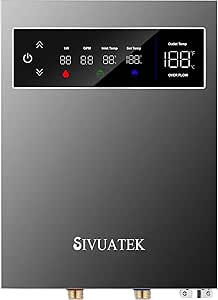
SIVUATEK 14 kW Electric Tankless Water Heater, 240 V
The SIVUATEK’s defining advantage is flexible placement: it can be wall-mounted or installed under a sink, making it a targeted choice for a kitchen, bathroom, or small addition rather than a high-demand whole-home system. Its 14 kW output and 3.3 GPM stated flow are close to the ORBEK 14 kW’s 3.38 GPM, so neither should be mistaken for the higher-capacity Westinghouse Apolo 24 kW. Here, the appeal is the compact 2.87-inch depth, 1°F temperature adjustments, and listed leakage, overheating, and automatic-shutoff protections. The temperature setting range ends at 131°F, even though the listed maximum temperature is 140°F. A dedicated 60 A breaker is still required, and the stated capacity is intended for only one or two usage points. I’d pick it for point-of-use convenience, not broad simultaneous household coverage.
Pros:- Can be wall-mounted or installed under a sink.
- Compact 2.87-inch depth helps fit confined locations.
- LED display offers 1°F temperature adjustments.
- ETL certified with leakage, overheating, and automatic-shutoff protection.
Cons:- Designed for only one or two usage points, with less capacity than the 24 kW Westinghouse Apolo.
- Requires a dedicated 60 A circuit breaker.
- Temperature setting range is 86°F–131°F despite a separately listed 140°F maximum.
Best for: Homeowners adding hot water at one or two nearby fixtures, especially where an under-sink installation would reduce the distance to the tap.
Not ideal for: Families seeking a high-capacity whole-home heater or regular hot water for several simultaneous fixtures; its 14 kW output is designed for limited use.
- Power:14 kW
- Voltage:240 V
- Flow rate:3.3 GPM
- Circuit breaker requirement:One 60 A breaker
- Temperature settings:86°F–131°F; listed maximum temperature 140°F
- Maximum pressure:7.5 bar
- Dimensions and weight:12.2 in. W × 17.25 in. H × 2.87 in. D; 15 lb
- Water connection and protection:1/2-inch NPT; ETL certified; leakage protection, overheating protection, automatic shutoff
Our verdict“Choose the SIVUATEK for compact point-of-use installation at one or two fixtures, not as a replacement for a higher-output whole-home unit.”
Midea 18 kW Electric Tankless Water Heater, 240 V
The Midea 18 kW stands out for pairing on-demand heating with app and Wi-Fi controls in a compact wall-mounted unit. Its self-modulating operation adjusts energy use as demand changes, while the LED display and touch panel make temperature settings accessible at the heater or through the app. Compared with the higher-output Rheem RTEX-36, this model is a better fit when a home’s hot-water demand is moderate and electrical capacity is a concern; it does not offer the same stated flow-rate figure, so buyers cannot readily compare its simultaneous-use capacity. The tradeoff is limited installation detail in the product information, including no flow-rate specification. I’d shortlist it for buyers who value smart controls, but not for households choosing primarily by documented high-flow performance.
Pros:- Self-modulating operation adjusts heating to demand and avoids tank-style standby losses.
- Wi-Fi and app control add remote temperature adjustment.
- Compact 11.38-by-15.75-inch wall-mounted format saves floor space.
- Overheat protection and child mode add control and safety features.
Cons:- The 18 kW output is below the 27 kW and 36 kW options for heavier simultaneous demand.
- No flow-rate figure is provided, making capacity comparisons difficult.
- Requires a 240 V supply, and installation requirements are not specified.
Best for: Households seeking an 18 kW wall-mounted heater with app-based temperature adjustments and a compact footprint.
Not ideal for: Buyers who need a published flow rate or documented simultaneous-fixture capacity to size a heater for a high-demand household.
- Power:18 kW
- Voltage:240 V
- Maximum temperature:140 °F
- Maximum pressure:150 psi
- Mounting:Wall-mounted
- Dimensions:11.38 in W × 15.75 in H
- Weight:9.5 lb
- Controls:Smart app, Wi-Fi, touch panel, LED display
- Certifications:ETL, NSF, DOE
Our verdict“Choose the Midea if smart control and compact installation matter more than a clearly documented high-flow rating.”
Rheem RTEX-36 36 kW Electric Tankless Water Heater
Among these options, the Rheem RTEX-36 makes a strong case for buyers prioritizing stated capacity: its listed 6 GPM flow rate and 36 kW output provide a more useful sizing reference than the Midea 18 kW, which has no flow figure in the supplied data. The external digital control also keeps temperature adjustment straightforward, and bottom-mounted 3/4-inch NPT connections give installers a defined connection format. Its listed 6-gallon capacity is not the same as a storage tank; this is an on-demand unit, so buyers should focus on flow and site conditions rather than interpreting that figure as stored hot water. Compared with the WINTEMP 36 kW, Rheem lists a lower maximum flow rate, but its specifications are simpler and less demanding on paper. The major hurdle is the substantial 240 V electrical requirement, which calls for a careful service-capacity check before purchase.
Pros:- 36 kW output and a stated 6 GPM flow rate help buyers compare capacity.
- External adjustable digital control provides direct temperature setting.
- 3/4-inch NPT bottom connections give installers a specified connection size and position.
- Indoor wall-mounted design keeps the unit off the floor.
Cons:- Requires a 240 V supply and substantial electrical capacity.
- Listed 6 GPM is below the WINTEMP 36 kW’s stated maximum of 8.7 GPM.
- The supplied specifications do not state circuit-breaker or wiring requirements.
Best for: Homeowners or small commercial buyers who want a 36 kW unit with a stated 6 GPM flow rate and external digital temperature control.
Not ideal for: Households seeking the highest listed flow in this group or buyers whose electrical service cannot support a 36 kW, 240 V heater.
- Power:36 kW
- Voltage:240 V
- Flow rate:6 GPM
- Maximum temperature:140 °F
- Mounting and installation:Indoor wall mount
- Water connections:3/4-inch NPT, bottom
- Temperature control:External adjustable digital control
- Weight:11.07 kg
- Materials:Brass, copper
Our verdict“Pick the Rheem RTEX-36 if you want a documented 6 GPM rating and 36 kW output, provided your electrical service can support it.”
ThermoMate 27 kW Electric Tankless Water Heater, 6.6 GPM
The ThermoMate 27 kW sits between the 18 kW Midea and the 36 kW Rheem in output, while listing a substantial 6.6 GPM maximum flow rate. That makes it an appealing middle ground for buyers who need more capacity than an 18 kW unit but do not want to jump straight to the highest power class. Self-modulating control responds to flow and inlet-water temperature, helping the heater adjust output rather than run at full power regardless of demand. The tradeoff is that 6.6 GPM is a stated maximum, not a promise of that flow at every incoming water temperature or temperature rise. Installation is demanding: the product calls for a 150 A panel, three 40 A double-pole breakers, and three sets of 8 AWG copper wires. Compared with the Rheem RTEX-36, this is lower wattage but has a higher listed flow figure; the electrical plan needs professional verification.
Pros:- 27 kW output and a listed maximum of 6.6 GPM place it between lower- and higher-power options.
- Self-modulating control responds to flow and inlet-water temperature.
- Temperature can be set from 80°F to 140°F.
- ETL listing and stated UL-499 and CAN/CSA-C22.2 standards provide certification details.
Cons:- Requires at least a 150 A electrical panel, three 40 A double-pole breakers, and three sets of 8 AWG copper wires.
- Actual simultaneous fixture capacity depends on incoming water temperature.
- The 6.6 GPM figure is a maximum and does not describe performance at every temperature rise.
Best for: Households wanting a 27 kW unit with a published high-flow figure and the electrical capacity for its specified dedicated circuits.
Not ideal for: Owners with limited panel capacity or buyers who cannot confirm the required breakers and wiring before installation.
- Power:27 kW
- Voltage:240 V
- Maximum flow rate:6.6 GPM
- Temperature range:80°F–140°F
- Maximum pressure:150 psi
- Dimensions:13.15 × 17.09 × 3.15 in
- Electrical requirements:At least 150 A panel; 3 × 40 A double-pole breakers; 3 sets of 8 AWG copper wires
- Efficiency:99%
- Certification:ETL listed; UL-499 and CAN/CSA-C22.2 standards
Our verdict“Choose the ThermoMate if you need a middle-power unit with a stated 6.6 GPM maximum and can meet its demanding electrical requirements.”
SIVUATEK 18 kW Electric Tankless Water Heater, 240 V
The SIVUATEK 18 kW is the more detail-oriented choice among the two 18 kW models here: its LED display supports 1°F adjustments, and the stated range runs from 86°F to 131°F. That precision may suit a household that wants close control over delivered temperature, while the Midea 18 kW offers Wi-Fi and app access instead. SIVUATEK also lists leakage, overheating, and automatic shut-off protections, plus an installation template and hardware pack. Its stated support for three to four usage points needs context: at 18 kW, actual simultaneous flow depends on inlet-water temperature and the required temperature rise, so it should not be read as a universal high-flow guarantee. The maximum temperature is also lower than the Midea’s 140°F. Buyers should check the dimensions before ordering, since the listing’s measurements differ between the description and specifications.
Pros:- LED controls allow temperature adjustments in 1°F increments.
- Lists leakage, overheating, and automatic shut-off protections.
- Includes installation hardware and a template.
- ETL certification is stated in the product data.
Cons:- At 18 kW, capacity may not suit heavy simultaneous demand, and no flow-rate figure is supplied.
- Maximum temperature of 131°F is lower than the Midea 18 kW’s 140°F limit.
- Listed dimensions differ between the description and specifications.
Best for: Buyers who want fine manual temperature adjustment and listed safety protections in an 18 kW wall-mounted heater.
Not ideal for: Households needing a clearly specified high flow rate, a 140°F maximum setting, or confidence in the listed dimensions before purchase.
- Power:18 kW
- Voltage:240 V
- Temperature range:86°F–131°F
- Temperature adjustment:1°F increments
- Thermal efficiency:Up to 99.8%
- Required breakers:2 × 40 A
- Water connection:3/4 in. NPT
- Dimensions:15.87 × 11.14 × 2.87 in. (listed in description; measurements differ across listing data)
- Certification:ETL
Our verdict“Pick the SIVUATEK for precise temperature control and bundled installation aids, not for a proven high-flow capacity.”
WINTEMP 36 kW Electric Tankless Water Heater
For shoppers whose main goal is the largest stated flow figure in this batch, the WINTEMP 36 kW leads with a listed maximum of 8.7 GPM, compared with 6 GPM for the Rheem RTEX-36. Self-modulating power is designed to match output to water flow and temperature, while Wi-Fi control and an LED display add convenience beyond Rheem’s external digital control. The capacity comes with a demanding installation plan: the product specifies a 150 A maximum current, four 40 A double-pole breakers, four 8/2 AWG cables with ground, and a recommended 300 A household service. That electrical load can rule it out even when the flow rating looks attractive. At 36.1 lb, it is also heavier than several smaller units, and its published maximum flow should not be treated as guaranteed under every inlet-water condition. I’d favor it over the Rheem only when the service and installation requirements check out.
Pros:- Listed maximum flow of 8.7 GPM exceeds the Rheem RTEX-36’s stated 6 GPM.
- Self-modulating operation adjusts output to flow and water temperature.
- Wi-Fi control, LED display, and temperature lock provide useful control options.
- ETL certification and leakage, overheat, and dry-fire protections are listed.
Cons:- Specifies four 40 A double-pole breakers and four 8/2 AWG cables with ground.
- Recommended 300 A household service may make installation impractical for many homes.
- At 36.1 lb, it is heavier than the compact 18 kW options, and maximum flow depends on site conditions.
Best for: Large households seeking a 36 kW heater with the highest stated maximum flow in this group and adequate electrical service.
Not ideal for: Homes with less than the recommended 300 A service, limited room for dedicated circuits, or no access to a licensed electrician.
- Power:36 kW
- Voltage:240 V
- Maximum flow rate:8.7 GPM
- Maximum current:150 A
- Recommended household service:300 A
- Circuit breakers and wiring:4 × 40 A double-pole breakers; 4 × 8/2 AWG cables with ground
- Maximum temperature:140 °F
- Dimensions and weight:13.7 × 21.5 × 5.2 in; 36.1 lb
- Certification and warranty:ETL; 2-year replacement warranty
Our verdict“Choose the WINTEMP if your household needs the highest listed flow here and an electrician confirms your service can support its installation requirements.”

How We Picked
I ranked these heaters around the factors that determine whether a high-capacity electric unit will work in a real home: rated kilowatts, stated flow information, electrical demands, and useful controls. I gave more weight to models positioned for heavier demand, while treating flow-rate claims cautiously because output changes with incoming water temperature and the required temperature rise. I also considered whether a model’s listed features help buyers manage use or installation, rather than treating Wi-Fi or a digital display as a substitute for heating capacity.
The ranking favors options that offer a plausible fit for broader household demand, then separates similar wattage models by documented flow information, controls, and brand positioning. Smaller units appear lower for this particular high-capacity roundup, not because they cannot be useful, but because they suit fewer simultaneous-use scenarios. Since the product list does not establish every model’s circuit specifications, certifications, warranty, or flow test conditions, buyers should confirm those details in the current manufacturer documentation and have an electrician verify the installation before choosing.
Factors to Consider When Choosing High Capacity Electric Tankless Water Heater
Choosing a heater by its largest kW number alone can lead to an expensive mismatch. I would start with the home’s cold-water conditions and electrical capacity, then compare expected simultaneous use, installation requirements, and the details behind any advertised flow figure.
Match Flow to Temperature Rise, Not Just the GPM Label
A flow figure only tells part of the story: the heater must raise incoming water to the desired temperature while maintaining that flow. In a cold climate, the temperature rise may be much larger than in a warm region, reducing the gallons per minute available from the same unit. Make a realistic list of fixtures likely to run at once, such as a shower and kitchen tap, rather than adding every faucet in the home as if they run continuously. Compare each model’s flow chart at a temperature rise close to your local winter water temperature. A prominently stated GPM number without test conditions is a starting point, not a promise. If household demand is high, ask a qualified installer to size the unit against actual use and local conditions before buying.
Check the Electrical Panel Before Choosing a High-Wattage Model
Electric tankless heaters draw substantial power while heating, so a 27 or 36 kW model can require multiple dedicated circuits and considerable panel capacity. Do not assume that a standard water-heater connection can support a tankless replacement simply because both appliances use electricity. Have an electrician check the service rating, available breaker spaces, wiring routes, and other large loads such as cooking or vehicle charging. A panel upgrade or new wiring can change the total project scope, even when the heater itself appears compact. This is where a smaller model may be the more practical choice, though it may not meet whole-home demand. Get installation requirements confirmed before ordering rather than treating them as a last-minute detail.
Decide Whether Whole-Home or Point-of-Use Service Fits
Not every household needs one heater to supply every fixture at the same time. A smaller unit may work well for a single bathroom, an addition, or a sink located far from a central heater, while a larger unit is more appropriate when several hot-water draws overlap. Point-of-use placement can shorten waits and reduce the need to heat water through long pipe runs, but it adds equipment and electrical work at another location. For whole-home use, identify the busiest likely period and size for that demand, not the number of people alone. A family with staggered shower schedules may need less simultaneous output than a smaller household running multiple fixtures together. Choose the layout and use case before comparing models within the same wattage band.
Treat Wi-Fi and Displays as Convenience Features
Connected controls may help with setting adjustments or monitoring, but they do not raise a heater’s maximum output. Decide whether remote access solves a real problem in your home, such as managing a heater in a hard-to-reach location, or whether simple onboard controls are enough. Ask what functions remain available if the network is down and whether the heater can be operated locally. Digital temperature adjustment can be useful, but clear installation instructions, accessible service information, and compatible electrical requirements matter more to a dependable setup. Avoid paying extra attention to app features while overlooking the capacity and circuit details that determine whether the unit can serve your fixtures. Compare Wi-Fi models with non-connected alternatives at similar kW ratings on those fundamentals first.
Verify Flow Claims, Warranty, and Service Details
Published flow rates can use different incoming-water temperatures, outlet targets, and test setups, so figures from separate brands may not be directly comparable. Look for manufacturer performance charts and confirm the conditions behind a GPM claim before using it to size a home. Check the warranty terms for the heat exchanger and other components, including any maintenance or installation conditions that affect coverage. Find out whether replacement parts and authorized service are available in your area, especially if you are considering a lesser-known brand. Also ask about water quality requirements: hard water can contribute to mineral buildup and may make periodic descaling necessary. These checks help distinguish a suitable long-term installation from a model that only looks strong on a headline specification.
Frequently Asked Questions
Can a 36 kW electric tankless heater run two showers at once?
It may, but the kW rating alone cannot confirm that it will. The result depends on the incoming water temperature, the desired shower temperature, showerhead flow, and whether other fixtures are drawing hot water at the same time. Check the manufacturer’s flow chart at the temperature rise your home needs, then compare that output with the combined fixture demand. A cold-climate home may get less flow than a home with warmer groundwater. Have an installer verify both sizing and electrical capacity before relying on a 36 kW unit for simultaneous showers.
Is a 27 kW model enough for a whole house?
It can be enough for some homes, but “whole house” does not describe a consistent demand level. A smaller home with warmer incoming water and staggered hot-water use may manage well, while a larger household in a cold region may need more output or a different system plan. Count the fixtures likely to operate together and use local winter water temperatures when checking performance charts. Also confirm that the home can supply the required circuits. If either capacity or electrical service falls short, a 27 kW model may work best for a smaller zone rather than every fixture.
Should I replace a storage water heater with an electric tankless unit if my panel is nearly full?
Not before an electrician reviews the panel and the heater’s circuit requirements. High-wattage tankless models can need multiple dedicated circuits, so a nearly full panel may require electrical work or make a lower-capacity option more realistic. The cost and feasibility of that work should be part of the comparison, not an afterthought. Ask the electrician to review the home’s total service load and wiring path, not just whether breakers can be added. If an upgrade is impractical, keeping a storage heater or evaluating another system type may be a better fit.
Does a Wi-Fi tankless heater provide more hot water than a non-Wi-Fi model?
No: Wi-Fi does not increase the heater’s heating power or flow capacity. A connected model can offer remote settings or other app-based controls, but its hot-water output is still governed by wattage, water temperature, and demand. Compare connected and non-connected options at similar power levels, then decide whether remote access is useful enough to matter. Check whether basic operation remains available through the unit itself if the network is unavailable. Capacity and installation fit should come before connectivity in the decision.
Can I use a 14 kW model as my home’s only water heater?
That depends on the home’s climate, incoming water temperature, and how many fixtures need hot water at once. In this lineup, the 14 kW options are a more limited fit than the 27 and 36 kW models, so they may suit a small dwelling, warmer conditions, or a specific point-of-use role better than a high-demand whole-home setup. Check the unit’s output at your required temperature rise and compare it with actual fixture flow. If the numbers do not cover your busiest use, consider a higher-capacity unit or a separate heater for another zone. Do not assume that a compact installation means whole-home capacity.
Conclusion
For a home with substantial demand and adequate electrical service, my best overall pick is the Rheem RTEX-36, while the WINTEMP 36 kW WiFi model is the best premium-style choice for buyers who also want connected controls. My best value direction is the 27 kW group, particularly a ThermoMate or Westinghouse option that matches the home’s verified flow needs without stepping up to 36 kW. For beginners, I would start with a Rheem RTEX-13 or RTEX-18 only after confirming that its more limited capacity fits the intended fixtures; straightforward brand recognition cannot make an undersized heater sufficient. For a specific point-of-use or lower-demand setup, compare the 14 kW ORBEK and SIVUATEK models with the Westinghouse 14 kW option, using the manufacturer’s performance data rather than GPM headlines. My final choice would come down to a professional load calculation, local winter water temperature, and the household’s simultaneous-use pattern.
Halloween Picks
halloween
As an affiliate, we earn on qualifying purchases.