For most homeowners checking bathroom drywall without leaving holes, I’d start with the General Tools MMD7NP, a pinless model suited to scanning wall surfaces. The Klein Tools ET140 is another straightforward pinless choice, while the Protimeter SurveyMaster stands out for buyers who want both pin and non-invasive readings. The main tradeoff is between quick surface scanning and the more targeted readings a pin-style meter can provide, especially when wall finishes and materials vary. No handheld meter can confirm the source of a leak or diagnose hidden damage on its own. Read on for how all 15 options compare and which features matter for your bathroom walls.

Get home appliances delivered free with Prime
- Fast, free delivery on millions of items
- Prime Video, Amazon Music and more included
- Member-only deals all year
Complete the kit



Key Takeaways
- Pinless models dominate this roundup, making them the natural starting point for scanning painted bathroom walls without puncturing the finish.
- The General Tools MMD7NP and Klein Tools ET140 are practical, familiar-style choices for routine wall checks; neither should be treated as a definitive leak diagnosis.
- The Protimeter SurveyMaster is the distinct premium-style pick because its dual-function design gives buyers pin and non-invasive measurement approaches in one tool.
- Rechargeable models, including AEGTEST AWT-380 and RDINSCOS options, prioritize convenient power, but buyers should compare their measurement modes and material support rather than choosing on charging alone.
- Pin-type options such as the General Tools MMD4E and PREXISO 7-in-1 suit targeted checks when small punctures are acceptable; they are less convenient for quickly scanning finished walls.
| LASELION MS04 Pinless Moisture Meter with Ball Probe |  | Best for Scanning Bathroom Corners | Model: MS04 | Measurement type: Pinless, non-destructive | Probe: Ball probe | VIEW ON AMAZON | See Our Full Breakdown |
| General Tools MMD7NP Digital Pinless Moisture Meter |  | Best for Clear Alerts | Measurement depth: Up to 3/4 inch (19 mm) | Softwood range: 0–53% | Hardwood range: 0–35% | VIEW ON AMAZON | See Our Full Breakdown |
| Klein Tools ET140 Pinless Moisture Meter |  | Best for a Straightforward, Specified Scan | Detection depth: Up to 3/4 inch (19 mm) | Detection method: Pinless electromagnetic field | Compatible materials: Drywall, masonry, hardwood, and softwood | VIEW ON AMAZON | See Our Full Breakdown |
| Pinless Digital Moisture Meter for Walls, Floors, Wood, and Masonry |  | Best for Multi-Surface DIY Checks | Item model: MT28 | Sensing depth: Up to 0.75 inches | Measurement method: Pinless | VIEW ON AMAZON | See Our Full Breakdown |
| General Tools MM8 Pinless Moisture Meter for Wood and Building Materials |  | Best for Retaining Readings | Measurement type: Pinless, non-marring moisture detection | Detection depth: Up to 3/4 inch (19 mm) | Softwood range: 0–53% | VIEW ON AMAZON | See Our Full Breakdown |
| AEGTEST AWT-380 Rechargeable Pinless Moisture Meter |  | Best for Feature-Rich Pinless Checks | Model: AWT-380 | Measurement type: Pinless, non-destructive | Measuring depth: Up to 0.79 in (20 mm) | VIEW ON AMAZON | See Our Full Breakdown |
| Pinless Digital Moisture Meter for Wood and Walls |  | Best for Dark, Tight Inspection Spots | Measurement method: Pinless, non-destructive sensor | Compatible surfaces: Wood, masonry, concrete, and more | Additional feature: Built-in LED flashlight | VIEW ON AMAZON | See Our Full Breakdown |
| RDINSCOS Rechargeable Pinless Moisture Meter for Drywall | 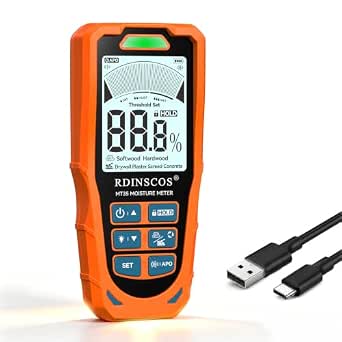 | Best for Readable Alerts in Dim Bathrooms | Model: MT35 | Measurement method: Pinless, non-destructive | Detection depth: 19 mm | VIEW ON AMAZON | See Our Full Breakdown |
| RDINSCOS Pinless Moisture Meter for Wood & Wall |  | Best for Simple Read-and-Hold Checks | Model: MT28C | Measurement method: Pinless | Detection depth: Up to 19 mm | VIEW ON AMAZON | See Our Full Breakdown |
| Protimeter SurveyMaster Dual-Function Moisture Meter (BLD5375) |  | Best Premium Choice for Follow-Up Verification | Model: BLD5375 | Measurement modes: Pin and non-invasive | Compatible materials: Wood, drywall, concrete, and fiberglass boat hulls | VIEW ON AMAZON | See Our Full Breakdown |
| LASELION MS03 2-in-1 Pin and Pinless Moisture Meter |  | Best Dual-Method Pick | Measurement modes: Pin and pinless | Materials: Wood, drywall, plaster, concrete, cardboard, and other building materials | Wood moisture range: 0–75% | VIEW ON AMAZON | See Our Full Breakdown |
| PREXISO 7-in-1 Pin-Type Wood Moisture Meter |  | Best for Detailed Pin Readings | Model: PMX-57A | Measurement type: Pin-type | Calibration scales: 7 | VIEW ON AMAZON | See Our Full Breakdown |
| RDINSCOS MT35 Rechargeable Pinless Moisture Meter |  | Best Rechargeable Wall Scanner | Model: MT35 | Measurement type: Pinless | Detection depth: Up to 19 mm | VIEW ON AMAZON | See Our Full Breakdown |
| General Tools MMD4E Digital Pin-Type Moisture Meter |  | Best for Simple Moisture Alerts | Measurement range, wood: 5–50% | Measurement range, building materials: 1.5–33% | Sensor type: 8 mm stainless-steel pins | VIEW ON AMAZON | See Our Full Breakdown |
| Povlen Pinless Digital Moisture Meter for Wood, Drywall, and Masonry |  | Best Compact Pinless Pick | Model: MT510-Y | Measurement modes: Softwood, hardwood, wall, masonry | Measurement accuracy: ±4% | VIEW ON AMAZON | See Our Full Breakdown |
| moisture meter for bathroom wall | Model | Display |
|---|---|---|
| LASELION MS04 Pinless Moisture | MS04 | — |
| General Tools MMD7NP Digital P | — | 2-inch diagonal backlit LCD |
| Klein Tools ET140 Pinless Mois | — | Reverse-contrast display with nine LED bars |
| Pinless Digital Moisture Meter | — | Three-color LCD |
| General Tools MM8 Pinless Mois | — | Backlit LCD with three-color LED bar graph |
| AEGTEST AWT-380 Rechargeable P | AWT-380 | Color |
| Pinless Digital Moisture Meter | — | — |
| RDINSCOS Rechargeable Pinless | MT35 | — |
| RDINSCOS Pinless Moisture Mete | MT28C | Color LCD backlight |
| Protimeter SurveyMaster Dual-F | BLD5375 | — |
| LASELION MS03 2-in-1 Pin and P | — | — |
| PREXISO 7-in-1 Pin-Type Wood M | PMX-57A | — |
| RDINSCOS MT35 Rechargeable Pin | MT35 | — |
| General Tools MMD4E Digital Pi | — | Backlit LCD with 0.3-inch digits |
| Povlen Pinless Digital Moistur | MT510-Y | Color LCD screen with analog bar |
More Details on Our Top Picks
LASELION MS04 Pinless Moisture Meter with Ball Probe
The MS04’s ball probe gives it a different strength from flat-contact meters: it can roll over a broader patch and reach awkward corners around tubs, vanities, and trim without puncturing the finish. Its 5–40 mm sensing depth may help reveal moisture below the surface, a useful clue when a bathroom wall looks dry but a leak is suspected. Compared with the Klein Tools ET140, which offers a clearer specified maximum depth of 3/4 inch and a nine-bar indicator, the MS04 does not provide detailed accuracy or calibration information. Its customizable alarms can help flag elevated readings, but I would treat those as prompts to investigate rather than proof of a leak. Choose it for non-invasive area checks; skip it if you need documented measurement precision.
Pros:- Pinless sensing avoids puncturing painted or tiled-adjacent surfaces.
- Ball probe can cover an area and reach corners more readily than a small flat sensor.
- Specified sensing depth spans 5–40 mm.
- Customizable alarms can flag elevated readings for follow-up.
Cons:- No detailed accuracy or calibration specifications are provided.
- The product data does not specify material-specific measurement ranges.
- Alarm thresholds flag readings but do not identify the source of moisture.
Best for: Homeowners checking finished bathroom walls, corners, and other surfaces where probe holes would be unwelcome.
Not ideal for: Inspectors who need published accuracy or calibration details to support precise comparisons or formal reporting.
- Model:MS04
- Measurement type:Pinless, non-destructive
- Probe:Ball probe
- Measuring depth:5–40 mm
- Weight:210 g
- Power:3 AAA batteries included
- Included components:Moisture meter, user manual, 3 AAA batteries, carrying case
Our verdict“Pick the MS04 for non-destructive scanning of bathroom-wall corners and broader areas, but choose a meter with clearer measurement documentation if precision is your priority.”
General Tools MMD7NP Digital Pinless Moisture Meter
For bathroom-wall checks where a quick visual or audible cue matters, the MMD7NP pairs a backlit LCD with a three-color LED bar and sound alert. That combination makes it easier to notice a change while scanning a wall, including in dimmer bathroom corners. It reads up to 3/4 inch deep, matching the stated depth of the Klein Tools ET140, but its wallboard, drywall, and masonry results are relative readings rather than material moisture percentages. That distinction matters: it is better for comparing one spot with another than for treating a number as an exact moisture content. Compared with the General Tools MM8, it lacks a stated hold function, though it still provides low-battery and out-of-range warnings. I’d choose it for straightforward spot checks, not formal moisture documentation.
Pros:- Pinless sensing avoids leaving holes in finished walls.
- Reads up to 3/4 inch deep.
- Backlit LCD, color LED bar, and audible alert provide several ways to notice readings.
- Low-battery and out-of-range warnings help identify conditions that may affect use.
Cons:- Drywall and masonry readings are relative, not moisture percentages.
- Requires a 9V battery.
- Product data does not list a hold function for retaining a reading.
Best for: DIY homeowners who want visible and audible cues while comparing suspected damp patches with drier areas of bathroom drywall or masonry.
Not ideal for: Buyers who need exact moisture percentages for drywall or masonry, or who prefer not to keep a 9V battery on hand.
- Measurement depth:Up to 3/4 inch (19 mm)
- Softwood range:0–53%
- Hardwood range:0–35%
- Other materials:Relative readings for wallboard, drywall, and masonry
- Display:2-inch diagonal backlit LCD
- Indicators:Three-color LED bar graph and audible alert
- Power:9V battery
Our verdict“Choose the MMD7NP for easy-to-notice bathroom-wall alerts and comparative checks, rather than exact drywall or masonry moisture figures.”
Klein Tools ET140 Pinless Moisture Meter
The Klein Tools ET140 is a practical choice for checking bathroom drywall because its electromagnetic sensor works without pins and has a stated reach of up to 3/4 inch. Its reverse-contrast display and nine-bar indicator give more visual gradation than the simpler three-color display on the MT28, which can help when comparing several locations around a suspected leak. An audible alert adds another cue, while automatic power-off limits battery drain between checks. The tradeoff is that the ET140 is calibrated for drywall, masonry, hardwood, and softwood; it is not a universal material tester. Like the General Tools MMD7NP, its wall readings are relative rather than a direct drywall moisture percentage. I’d favor it for methodical spot comparisons, but not for buyers who need broad material coverage or pin-based confirmation.
Pros:- Pinless electromagnetic sensing avoids surface punctures.
- Detects up to 3/4 inch deep.
- Nine-bar indicator and reverse-contrast display provide detailed visual feedback.
- Audible alert and automatic power-off support convenient spot checks.
Cons:- Calibration is limited to drywall, masonry, hardwood, and softwood.
- Wall-material readings are relative rather than exact moisture percentages.
- Uses a 9V battery.
Best for: Homeowners and maintenance workers comparing suspected damp areas across drywall or masonry with clear visual feedback.
Not ideal for: Buyers checking materials outside drywall, masonry, hardwood, and softwood, or anyone requiring direct moisture percentages for wall materials.
- Detection depth:Up to 3/4 inch (19 mm)
- Detection method:Pinless electromagnetic field
- Compatible materials:Drywall, masonry, hardwood, and softwood
- Display:Reverse-contrast display with nine LED bars
- Special features:Audible alert and automatic power-off
- Power source:9V battery
- Weight:7 ounces
- Dimensions:6 × 2.5 × 1 inches
Our verdict“Choose the ET140 for clear, repeatable comparisons across common bathroom-wall materials, but skip it if you need a meter calibrated for a wider range of surfaces.”
Pinless Digital Moisture Meter for Walls, Floors, Wood, and Masonry
The MT28 suits DIYers who want one pinless meter for bathroom walls and other household surfaces, including floors, wood, and masonry. Its sensing depth reaches 0.75 inches, and the three-color LCD, audible alarm, and hold function give a useful set of cues when checking several spots. The hold feature is a practical difference from the General Tools MMD7NP, whose listed features do not include reading retention. Against the Klein Tools ET140, the MT28’s appeal is its stated use across a broad mix of surfaces, though the product data offers less detail about material-specific ranges and calibration. Metal pipes, wiring, and steel studs can interfere with readings, so a high result near bathroom plumbing needs careful interpretation. This is a flexible home-checking tool, not a way to pinpoint a leak by itself.
Pros:- Pinless design avoids punctures and marks on finished surfaces.
- Listed for walls, wood, masonry, floors, and furniture.
- Three-color display and audible alarm make changes easier to notice.
- Hold function can retain a reading while moving the meter.
Cons:- Metal pipes, wiring, and steel studs can interfere with readings.
- Maximum sensing depth is 0.75 inches.
- Product data does not provide material-specific ranges or calibration details.
Best for: DIY renovators who want to scan bathroom walls alongside floors, furniture, wood, and masonry without making marks.
Not ideal for: Users scanning walls with likely concealed pipes, wiring, or steel studs, or buyers who require detailed material-specific ranges.
- Item model:MT28
- Sensing depth:Up to 0.75 inches
- Measurement method:Pinless
- Display:Three-color LCD
- Additional features:Audible alarm and hold function
- Power source:Battery powered; 9V battery included
- Item weight:7 ounces
- Included components:Moisture meter, 9V battery, user manual
Our verdict“Pick the MT28 for versatile, non-invasive DIY checks across household surfaces, but interpret readings cautiously around concealed metal and plumbing.”
General Tools MM8 Pinless Moisture Meter for Wood and Building Materials
The General Tools MM8 adds a hold function to the familiar combination of pinless sensing, backlit display, color-coded alerts, and audible alarms. For bathroom-wall checks, that can make it easier to retain a reading while repositioning the meter or noting a suspect spot. Its 3/4-inch detection depth is in the same range as the MMD7NP and Klein ET140, but the MM8 also lists a low-battery alert and operating conditions, which help clarify its use. The limitation is shared with the MMD7NP: drywall and masonry readings are relative, while the stated percentage ranges apply to wood. That makes it more useful for comparing damp-looking wall sections than declaring an exact drywall moisture level. I’d choose it over the simpler MMD7NP when reading retention matters, but not for precise wall-material percentages.
Pros:- Pinless detection helps preserve finished wall surfaces.
- Detects up to 3/4 inch deep.
- Hold function, backlit LCD, and color-coded alerts aid spot comparisons.
- Audible, out-of-range, and low-battery alerts provide useful status cues.
Cons:- Drywall and masonry readings are relative rather than percentage measurements.
- Requires a 9V alkaline battery.
- Wood-focused percentage ranges do not provide an exact bathroom-wall moisture value.
Best for: Home inspectors and DIYers who want to compare bathroom-wall readings and retain a value while moving between spots.
Not ideal for: Buyers who need exact drywall or masonry moisture percentages, or who want to avoid a 9V battery.
- Measurement type:Pinless, non-marring moisture detection
- Detection depth:Up to 3/4 inch (19 mm)
- Softwood range:0–53%
- Hardwood range:0–35%
- Other materials:Relative readings for drywall and masonry
- Display:Backlit LCD with three-color LED bar graph
- Alerts:Audible and out-of-range alarms; low-battery alert
- Operating conditions:32–104 °F; 5–95% humidity
- Dimensions and weight:2.8 × 6.3 inches; 5.44 ounces
Our verdict“Choose the MM8 over the MMD7NP if retaining readings matters, but treat its drywall and masonry results as comparative clues rather than exact percentages.”
AEGTEST AWT-380 Rechargeable Pinless Moisture Meter
For checking bathroom drywall or masonry without leaving marks, the AEGTEST AWT-380 combines a pinless sensor with quick readings and useful alert controls. Its stated detection depth reaches 20 mm, just beyond the RDINSCOS MT35’s 19 mm, though neither depth can confirm moisture deeper inside a wall assembly. The color display, max hold, and data storage help when comparing multiple spots, while adjustable sound and visual alarms can flag readings during a room-by-room scan. USB-C recharging avoids disposable batteries, but it also means keeping the meter charged before an inspection. Compared with the simpler Pinless Digital Moisture Meter for Wood and Walls, the AWT-380 offers more documented readout and data features; its tradeoff is a limited sensing depth and reliance on a rechargeable battery.
Pros:- Pinless measurement avoids holes in finished bathroom walls.
- Works across drywall, masonry, wood, walls, and floors.
- Color display, max hold, and data storage support comparing locations.
- USB-C charging and adjustable visual and audible alarms.
Cons:- Detection depth is limited to 20 mm, so deeper moisture may go undetected.
- Rechargeable battery needs charging before use.
- At 9.9 oz, it is heavier than a minimal handheld checker.
Best for: Homeowners checking several bathroom wall areas who want pinless readings, adjustable alerts, and a way to retain measurements.
Not ideal for: Buyers who need to probe deep wall cavities or prefer a meter that can be used without monitoring battery charge.
- Model:AWT-380
- Measurement type:Pinless, non-destructive
- Measuring depth:Up to 0.79 in (20 mm)
- Reading speed:About 1 second
- Display:Color
- Battery:Rechargeable lithium-ion, USB-C
- Data features:Max hold and data storage
- Weight:9.9 oz
- Warranty:36-month after-sale service
Our verdict“Choose the AWT-380 for feature-rich, non-invasive bathroom wall checks, but not for investigating moisture beyond its shallow sensing range.”
Pinless Digital Moisture Meter for Wood and Walls
This meter’s clearest bathroom-wall advantage is its built-in LED flashlight, which can help when checking behind a toilet, beneath a sink, or in a dim utility area. Its pinless sensor measures wood, masonry, concrete, and other surfaces, so it suits a preliminary scan without puncturing paint or drywall. Unlike the AEGTEST AWT-380, the listed details do not specify a measurement depth, display type, data storage, or adjustable alerts; buyers get a simpler feature set with less information for comparing readings. The flashlight is practical, but metal surfaces may interfere, so nearby pipes, fasteners, or metal-backed materials can complicate results. I’d treat this as a basic spot-check tool rather than a meter for documenting a moisture investigation.
Pros:- Pinless sensing avoids making holes in finished walls.
- Works on wood, masonry, concrete, and other surfaces.
- Built-in LED flashlight aids checks in dark areas.
- Can help identify possible moisture problems early.
Cons:- Metal surfaces may interfere with readings.
- Product details do not state detection depth or reading speed.
- No listed data-storage or adjustable-alarm features for tracking readings.
Best for: DIYers who want a straightforward pinless spot-checker with a light for inspecting dim bathroom corners and surfaces.
Not ideal for: Home inspectors who need specified detection depth, stored readings, or dependable measurements near metal fixtures and pipes.
- Measurement method:Pinless, non-destructive sensor
- Compatible surfaces:Wood, masonry, concrete, and more
- Additional feature:Built-in LED flashlight
Our verdict“Pick this model for simple, flashlight-assisted bathroom spot checks, but choose the AEGTEST AWT-380 if you want more documented measurement and data features.”
RDINSCOS Rechargeable Pinless Moisture Meter for Drywall
The RDINSCOS MT35 is a good fit for scanning bathroom drywall when a clear screen and easy-to-notice alerts matter more than extra measurement depth. Its 2.9-inch backlit display is larger than the screen details provided for the AEGTEST AWT-380, and customizable LED and buzzer thresholds can make it easier to spot areas that merit a closer look. It detects up to 19 mm, close to the AEGTEST’s 20 mm, so neither is a tool for confirming dampness deep inside a wall. The rechargeable 1200 mAh battery is listed for up to eight hours, a useful planning detail for inspections, but it requires charging. Compared with the non-rechargeable details listed for the RDINSCOS MT28C, the MT35 offers a stated battery runtime and a larger screen; it is still limited by its shallow pinless sensing range.
Pros:- Pinless detection works across drywall, plaster, wood, and concrete.
- Large 2.9-inch backlit screen is easy to read in low light.
- Customizable LED and buzzer alerts help flag chosen thresholds.
- USB-rechargeable 1200 mAh battery offers up to eight hours of use.
Cons:- Detection depth is limited to 19 mm.
- Rechargeable battery requires charging between inspections.
- The listed information does not specify reading speed or data storage.
Best for: DIY renovators and home inspectors who scan drywall or plaster in dim rooms and want configurable audible and visual alerts.
Not ideal for: Buyers investigating deep wall moisture or anyone who prefers a meter powered by replaceable batteries.
- Model:MT35
- Measurement method:Pinless, non-destructive
- Detection depth:19 mm
- Screen:2.9-inch backlit
- Battery:1200 mAh lithium-polymer, USB rechargeable
- Battery life:Up to 8 hours
- Alerts:Customizable LED and buzzer
- Warranty:2 years
Our verdict“Choose the MT35 for a large readable screen and configurable alerts during shallow bathroom-wall scans, not for tracing moisture deep behind the surface.”
RDINSCOS Pinless Moisture Meter for Wood & Wall
The RDINSCOS MT28C keeps bathroom moisture checks straightforward: scan without pins, read the color LCD backlight, then use the HOLD button to keep a measurement visible while recording it. That makes it a more basic option than the rechargeable MT35, which adds a large screen and customizable alerts, but the MT28C may suit buyers who mainly need to compare a few wall locations. Its stated reach is up to 19 mm, so it can indicate surface-area differences rather than verify dampness deep in a wall. The listing also says it is limited to wood mode, with other materials requiring manual comparison, which reduces confidence when checking bathroom drywall or masonry. Battery information is unclear: it may require a 9V battery, so I’d confirm what is supplied before relying on it.
Pros:- Pinless scanning avoids puncturing finished walls.
- Color LCD backlight aids reading in dim bathroom areas.
- HOLD button keeps a reading visible for recording.
- Up to 19 mm scanning depth supports shallow comparative checks.
Cons:- Listed as limited to wood mode, with other materials requiring manual comparison.
- Battery type is unclear and may require a separate 9V battery.
- Its 19 mm sensing depth cannot confirm moisture deeper in a wall.
Best for: DIY homeowners who want a simple pinless scanner with a backlit readout and hold function for comparing bathroom wall spots.
Not ideal for: Buyers who need clearly specified modes for drywall and masonry, configurable alerts, or fully clear battery information.
- Model:MT28C
- Measurement method:Pinless
- Detection depth:Up to 19 mm
- Display:Color LCD backlight
- Controls:HOLD button
- Battery:Not specified; listing indicates it may require a 9V battery
- Temperature accuracy:±1 °C
- Weight:160 g
- Warranty:2 years
Our verdict“Choose the MT28C for basic, held readings on bathroom surfaces, but favor the MT35 if you want clearer material versatility and adjustable alerts.”
Protimeter SurveyMaster Dual-Function Moisture Meter (BLD5375)
For a bathroom wall check that may lead to a closer investigation, the Protimeter SurveyMaster stands apart by combining non-invasive scanning with pin measurement. The pinless mode can help locate a suspicious area without marking the finish; pins can then provide a more direct reading where the surface can be probed. Bluetooth adds timestamped records through the Protimeter Connect app, giving this model a documentation advantage over the pinless AEGTEST AWT-380 and RDINSCOS MT35. It also lists automatic calibration checks and field calibration for non-invasive mode. The cost of that flexibility is a heavier, larger instrument, and pins are not appropriate for every finished bathroom surface. Its compatible materials include drywall, concrete, and wood, but no pinless detection depth is specified in the supplied details.
Pros:- Pin and non-invasive modes support scanning and follow-up checks.
- Bluetooth can save and download timestamped readings through the app.
- Automatic calibration checks and field calibration are listed.
- Includes a case, HD MC probe, and wood calibration chart.
Cons:- Pin measurements can leave marks and may not suit finished bathroom walls.
- At 1.32 pounds and 9 x 6 x 3 inches, it is larger and heavier than simpler handheld meters.
- The supplied details do not specify the non-invasive detection depth.
Best for: Inspectors and serious renovators who need to locate suspect bathroom wall areas, follow up with pin readings, and save timestamped records.
Not ideal for: Casual homeowners who only want a compact pinless checker or cannot accept probe marks on finished surfaces.
- Model:BLD5375
- Measurement modes:Pin and non-invasive
- Compatible materials:Wood, drywall, concrete, and fiberglass boat hulls
- Connectivity:Bluetooth; timestamped readings via Protimeter Connect app
- Calibration:Automatic checks and field calibration for non-invasive mode
- Power source:Alkaline battery
- Weight:1.32 pounds
- Dimensions:9 x 6 x 3 inches
- Warranty:Two years
Our verdict“Choose the SurveyMaster for documented inspections that may need both scanning and probe verification, but skip it for quick, mark-free household checks.”
LASELION MS03 2-in-1 Pin and Pinless Moisture Meter
The MS03 is the most flexible choice here for checking a bathroom wall: pinless mode screens without puncturing the finish, while pin mode can help investigate a suspicious spot more directly. Its building-material range reaches 25%, and it covers drywall, plaster, and concrete, making it more wall-focused than the PREXISO PMX-57A, which relies on pins. The tradeoff is that switching methods does not make every reading definitive; treat results as comparative clues, especially across different materials. The stated ±4%RH accuracy and pinless-only manual calibration are limitations for buyers seeking tightly controlled measurements. A flashlight and ambient temperature display add practical context, but the MS03 is best for homeowners who want one meter for initial non-invasive checks and occasional follow-up probing.
Pros:- Pinless and pin modes support surface screening and follow-up checks
- Measures drywall, plaster, concrete, and other building materials
- Flashlight and ambient temperature display aid checks in dim spaces
- Manual pinless calibration and hold function are included
Cons:- Listed accuracy is ±4%RH
- Manual calibration is available only in pinless mode
- Pin readings can mark finished bathroom surfaces
Best for: Homeowners who want to scan painted bathroom walls without damage and have a pin mode available for follow-up checks.
Not ideal for: Buyers who need highly precise moisture readings or want calibration adjustments in both measurement modes.
- Measurement modes:Pin and pinless
- Materials:Wood, drywall, plaster, concrete, cardboard, and other building materials
- Wood moisture range:0–75%
- Building-material moisture range:0–25%
- Accuracy:±4%RH
- Features:LCD, hold function, flashlight, ambient temperature display, manual pinless calibration
- Auto power-off:After 2 minutes of inactivity
Our verdict“Choose the MS03 if you want non-invasive wall screening plus a pin option for investigating selected areas.”
PREXISO 7-in-1 Pin-Type Wood Moisture Meter
The PREXISO PMX-57A favors probe-based readings and selectable measurement summaries over damage-free wall scanning. Its seven calibration scales and single-point, average, maximum, and minimum modes can help a DIYer compare readings across a damp-looking area, but the stainless-steel pins must enter the surface. That makes it less suitable for finished bathroom walls than the RDINSCOS MT35 or Povlen MT510-Y, both of which use pinless sensing. The PREXISO does add ambient temperature and humidity readings, useful environmental context when checking a bathroom, though those readings do not replace a wall moisture assessment. Its stated moisture range extends to 57%, but the listed upper temperature range is only 32 °F, an unusual limitation to verify before relying on it outside cold conditions.
Pros:- Seven calibration scales cover multiple material types
- Single-point, average, maximum, and minimum modes support comparisons
- Measures ambient temperature and humidity
- Backlit LCD, hold function, and automatic power-off
Cons:- Pin probes penetrate the material and can leave marks
- Listed upper temperature range is only 32 °F
- Pin-type readings are less suited to intact finished wall surfaces
Best for: DIYers checking unfinished drywall, exposed plaster, or other surfaces where small probe marks are acceptable and repeat readings matter.
Not ideal for: People checking painted, tiled, or otherwise finished bathroom walls who want to avoid punctures.
- Model:PMX-57A
- Measurement type:Pin-type
- Calibration scales:7
- Moisture range:0–57%
- Measurement modes:Single-point, multi-point average, maximum, and minimum
- Additional measurements:Ambient temperature and humidity
- Operating humidity:30–80%
- Dimensions:3.3 in W × 14.7 in H
Our verdict“Pick the PREXISO for probe-based spot comparisons on surfaces where pinholes are acceptable, not for pristine finished walls.”
RDINSCOS MT35 Rechargeable Pinless Moisture Meter
For routine bathroom-wall screening, the MT35 puts the emphasis on non-invasive checks and rechargeable convenience. Its pinless sensor is specified to detect moisture up to 19 mm deep, so it can screen beneath the immediate surface without leaving probe holes. Six material modes cover drywall, plaster, screed, concrete, and two wood types; that range is more explicit than the Povlen MT510-Y’s four broad modes, though neither spec alone guarantees a precise diagnosis. The MT35’s display, indicator alerts, and HOLD function make it easier to compare spots as you scan. Its main limitation is that readings depend on full sensor contact and should be compared on the same material. It is a screening tool, not a precise wood meter outside Wood mode, so buyers seeking follow-up pin readings may prefer the dual-method LASELION MS03.
Pros:- Pinless sensing avoids damaging finished walls
- Detection depth specified up to 19 mm
- Six material modes include drywall, plaster, screed, and concrete
- Rechargeable 1200 mAh battery with display alerts and HOLD function
Cons:- Readings require full sensor contact and should be compared on the same material
- Not intended for precise wood readings outside Wood mode
- No pin mode for probing a selected area
Best for: Homeowners who regularly scan drywall, plaster, or concrete and prefer a rechargeable meter that will not puncture finished surfaces.
Not ideal for: Buyers who need pin-based confirmation, highly precise wood readings outside Wood mode, or readings without firm sensor contact.
- Model:MT35
- Measurement type:Pinless
- Detection depth:Up to 19 mm
- Material modes:Softwood, hardwood, drywall, plaster, screed, and concrete
- Battery capacity:1200 mAh
- Battery type:Lithium Polymer
- Weight:7 ounces
- Included components:Moisture meter, user manual, Type-C
Our verdict“Choose the MT35 for rechargeable, non-invasive screening across common bathroom wall materials.”
General Tools MMD4E Digital Pin-Type Moisture Meter
The MMD4E is a straightforward choice when a buyer wants clear low, medium, and high alerts rather than several sensing modes. Its backlit display, hold button, and audible and visual warnings make it simple to record and interpret a probe reading. It measures drywall and other building materials, with a stated building-material range of 1.5–33%, but its stainless-steel pins need to penetrate the wall. That is a meaningful drawback for a painted or tiled bathroom; the pinless Povlen MT510-Y or RDINSCOS MT35 is a better fit for scanning intact finishes. The included cap doubles as a calibration checker, adding a useful maintenance reference. Still, its ranges do not cover every material, and the meter offers no pinless option for damage-free preliminary checks.
Pros:- Low, medium, and high moisture alerts provide quick reading cues
- Backlit LCD and hold button help with dim rooms and note-taking
- Measures drywall, concrete, wood, and other building materials
- Protective cap doubles as a calibration checker
Cons:- Eight-millimeter pins penetrate the wall and can leave marks
- Listed measurement ranges do not cover every material
- No pinless mode for preliminary scans of finished surfaces
Best for: Homeowners or maintenance staff who need an uncomplicated pin meter for accessible, unfinished wall areas and appreciate threshold alerts.
Not ideal for: Anyone checking delicate finished walls or looking for non-invasive scanning before probing.
- Measurement range, wood:5–50%
- Measurement range, building materials:1.5–33%
- Sensor type:8 mm stainless-steel pins
- Display:Backlit LCD with 0.3-inch digits
- Power:9 V alkaline battery
- Temperature range:32 °F to 60 °C
- Temperature reading accuracy:±2 °F
- Included accessories:Protective cap that doubles as a calibration checker
Our verdict“Choose the MMD4E for simple alerted probe readings on surfaces where pin marks are not a concern.”
Povlen Pinless Digital Moisture Meter for Wood, Drywall, and Masonry
The Povlen MT510-Y keeps bathroom-wall checks non-invasive and easy to read, pairing four material modes with a color LCD, analog bar, and audible and visual alerts. Its dedicated wall and masonry settings make it a more direct match for bathroom surfaces than the General Tools MMD4E, which uses pins and can mark a finished wall. It is also lighter at 5.6 ounces than the RDINSCOS MT35, though the RDINSCOS lists more material modes and a detection depth. Povlen’s stated ±4% accuracy is a limitation for buyers expecting fine-grained certainty; use readings to compare spots on compatible surfaces, not as a stand-alone diagnosis. It runs on three included AAA batteries rather than a rechargeable pack, so the MT35 may suit frequent users better.
Pros:- Pinless sensing avoids holes and scratches on finished walls
- Dedicated softwood, hardwood, wall, and masonry modes
- Color LCD with analog bar and audible and visual alerts
- Compact 5.6-ounce design with hold function
Cons:- Listed measurement accuracy is ±4%
- Uses three AAA batteries rather than a rechargeable battery
- No detection depth is specified in the product data
Best for: Homeowners who want a compact, simple pinless meter for comparing wall and masonry readings without damaging the finish.
Not ideal for: Frequent users who prefer rechargeable power, or buyers who need a stated detection depth and more material-specific modes.
- Model:MT510-Y
- Measurement modes:Softwood, hardwood, wall, masonry
- Measurement accuracy:±4%
- Display:Color LCD screen with analog bar
- Power source:3 included AAA alkaline batteries
- Weight:5.6 ounces
- Dimensions:6.81 × 2.87 × 1.06 inches
- Material:ABS
Our verdict“Pick the Povlen for compact, damage-free wall and masonry comparisons, while frequent users may prefer the rechargeable RDINSCOS MT35.”

How We Picked
I ranked these meters for the job implied by the search: checking bathroom walls, where tile, paint, drywall, plaster, and masonry can all affect what a reading means. I gave more weight to non-invasive operation for routine scanning, then compared whether each tool offers useful material coverage, clear operation, practical power, and a measurement approach that fits finished interiors. A bathroom-wall reading is a screening signal, not proof of a leak or a substitute for checking plumbing, ventilation, and wall condition.
The order reflects the balance between wall-friendly use and the information each tool can provide. General-purpose pinless meters lead because they fit common non-destructive checks; dual-function and specialized models earn a place when their added capability serves a clear need. Pin meters rank lower for everyday finished-wall scanning, though they can be better for localized measurements. Where product names or listed details do not establish a clear advantage, I avoid treating a feature claim as proof of superior accuracy.
Factors to Consider When Choosing Moisture Meter For Bathroom Walls
Choosing a meter for a bathroom is less about chasing the largest feature list and more about matching its reading method to the surface you can access. I’d decide what you need to learn—whether a damp area may be present, whether a particular spot differs from nearby dry wall, or whether a repair area is ready for the next step—before choosing a tool.
Choose Pinless Scanning for Finished Walls
A pinless meter is usually the less disruptive first choice for painted drywall or other intact finishes because it can scan without leaving probe holes. Its readings represent a sensed area beneath the contact point, so they are useful for comparing one patch with nearby areas rather than identifying a leak by themselves. Surface irregularities, wall thickness, metal, pipes, and changes in material can affect readings. A common mistake is treating a high number as proof of water intrusion without checking whether the wall construction changes nearby. Scan a small grid and compare like surfaces at similar heights. If the finish is tile or the wall build-up is unknown, interpret results with extra care rather than assuming the meter sees through every layer reliably.
Use Pins When a Localized Reading Matters More
Pin meters make direct contact at probe points, which can help when you need a focused check in an accessible material or a repair area. The tradeoff is visible punctures, an issue on painted walls, wallpaper, and finished trim. Pins also measure where they touch, so a single spot may not represent the wider wall. In a bathroom, consider whether the surface is safe to probe and whether hidden services could sit behind it before inserting probes. Buyers often mistake a pin meter’s specific reading for a more complete picture; it is still a local measurement with material-dependent interpretation. Choose this approach when targeted contact readings matter more than preserving the finish.
Match the Meter to the Wall Material
Bathroom walls can combine tile, grout, cement board, drywall, plaster, and framing, and a meter’s scale may not mean the same thing across them. Check the product’s supported materials and read its instructions before relying on a displayed percentage or alert. Some meters are designed mainly around wood readings, while others list building materials or offer modes intended for non-wood surfaces. A frequent buying error is assuming that a wood moisture percentage transfers directly to drywall or masonry. For a useful check, compare readings on the same material and finish, then use building context—staining, odor, bubbling paint, or a known leak—to guide the next step. When materials change across the scan, treat abrupt differences as clues to investigate, not automatic diagnoses.
Look Beyond the Number to Readability and Alerts
A display you can read in a dim bathroom and controls you can operate without guesswork can matter more than a long feature list. Backlighting, audible alerts, hold functions, and clear material modes may make repeat checks easier, but the alert threshold still depends on the meter and the surface. Before buying, check how the manufacturer explains its scale and whether it distinguishes relative readings from material-specific values. Do not compare numbers from different models as if they shared one calibration. For tracking a suspect area, record the location, surface, and conditions alongside each reading. This makes repeat checks more meaningful than relying on a single beep or color indicator.
Decide Whether Dual-Function Capability Is Worth It
A dual-function meter combines non-invasive scanning with probe measurements, which can be useful when you need to survey a wall and then inspect a particular accessible spot. The added flexibility can reduce the need to own separate tools, but it also means more modes and more ways to misread a result. For occasional homeowner checks, a simple pinless meter may be easier to use consistently. A contractor or property manager who checks varied materials may have a stronger reason to pay for two measurement methods. Decide whether you will actually use both modes and whether puncturing the wall is acceptable. Added capability only helps when the method fits the surface and the reading is interpreted correctly.
Treat Power and Accessories as Practical, Not Decisive
Rechargeable models can reduce battery changes, while replaceable-battery designs may be easier to keep ready if a meter is used infrequently. Neither power approach makes a measurement more accurate by itself. Check charging or battery requirements, included probes if relevant, protective storage, and how easily the sensing face can be kept clean. A bathroom tool may sit unused between checks, so convenience at the moment of use matters more than a power feature you rarely notice. Also inspect the stated measurement depth and contact-area guidance; a compact body may be easier to handle near corners, while a larger sensing face can cover more area per pass. Pick the setup that supports repeatable checks in the spaces you actually need to inspect.
Frequently Asked Questions
Can a moisture meter tell me whether a bathroom wall has a leak?
A meter can flag an area that reads differently from comparable nearby surfaces, but it cannot identify the source of moisture by itself. Plumbing leaks, condensation, poor ventilation, and water entering through a failed seal can all leave dampness. Compare readings across the same wall material and look for visible signs such as staining, peeling paint, softened drywall, or musty odor. If readings stay elevated or damage is spreading, investigate the source rather than repeatedly scanning the same spot. A plumber or building professional may be needed to confirm the cause.
Will a pinless meter work through bathroom tile?
Do not assume that a pinless meter will provide a reliable moisture reading through every tile installation. Tile, adhesive, backer board, wall thickness, and nearby metal can affect what the sensor detects and how the result should be interpreted. Check the meter’s instructions for supported materials and sensing depth before using it on a tiled wall. If the tool is not specified for that construction, readings may be more useful as relative comparisons than as a moisture percentage. A suspicious reading should be checked alongside grout condition, adjacent drywall, and signs of water damage.
Should I buy a pinless or pin-type meter for painted drywall?
For routine checks on finished painted drywall, a pinless meter is usually the more suitable starting point because it avoids puncturing the surface. A pin-type meter can provide a localized reading, but its probes leave small holes and only sample the spots they contact. If the wall is already open for repair, probes may be more acceptable; on an intact bathroom wall, scanning is often less disruptive. A dual-function model makes sense if you expect to use both approaches. In every case, compare similar areas and follow the instructions for drywall rather than relying on a number without context.
Can I compare readings from two different moisture meter models?
Usually, you should not treat readings from different models as directly interchangeable. Models may use different sensing methods, material settings, scales, and calibration assumptions, so the same wall can produce different displayed values. For monitoring a suspect area, use the same meter, mode, surface type, and general measurement points each time. Record changes in conditions, such as a repair or improved ventilation, alongside the readings. If you need a decision about hidden damage, use the meter as one piece of evidence rather than relying on a cross-model comparison.
When is a dual-function meter worth choosing over a pinless-only model?
A dual-function meter is useful when you want to scan a larger area without damage and also take a more localized probe reading where punctures are acceptable. That flexibility can suit maintenance professionals or homeowners dealing with several wall materials and repair stages. For occasional checks of intact bathroom walls, a pinless-only tool may be simpler and easier to use consistently. Before paying for both modes, check that the probe method and material settings suit the tasks you expect to perform. If you will not use the pins, their presence may add complexity without helping your usual checks.
Conclusion
For most bathroom-wall screening, I’d choose the General Tools MMD7NP as the best overall fit because its pinless approach suits finished surfaces and routine comparison checks. For best value in a straightforward pinless format, consider the Klein Tools ET140, while beginners who want a simple non-invasive starting point can also focus on these familiar-style options and follow the material guidance closely. The Protimeter SurveyMaster is my best premium-style pick for buyers who will use both pin and non-invasive methods. For targeted checks where small probe marks are acceptable, look at the General Tools MMD4E or PREXISO 7-in-1; for rechargeable convenience, compare the AEGTEST AWT-380 and RDINSCOS models by their listed modes and materials. Whatever you choose, treat readings as screening information and investigate persistent moisture at its source.
Fall yard work Picks
leaf blowers
As an affiliate, we earn on qualifying purchases.