A plumbing inspection camera endoscope can help locate a blockage or inspect a pipe without opening a wall, but the right choice depends on how far the camera must travel and how much control you need. My best overall pick is the DEPSTECH DS520, whose 50-foot cable and triple-lens design offer a useful balance of reach and viewing flexibility. For long sewer runs, the Kcapyn 100 ft model is the standout for its extended cable, while the Acoath articulating camera suits short, tight inspections where steering matters more than reach. The main tradeoffs are cable length versus control, handheld simplicity versus a dedicated screen, and general-purpose probes versus equipment built for long drains. Read on for the full breakdown and help matching a camera to your plumbing jobs.

Get home appliances delivered free with Prime
- Fast, free delivery on millions of items
- Prime Video, Amazon Music and more included
- Member-only deals all year
Complete the kit


Key Takeaways
- The 50-foot DEPSTECH DS520 is the most balanced choice in this lineup: it offers more reach than short semi-rigid probes without committing to a 100-foot sewer cable.
- Two 100-foot models target long sewer runs, but their extended reach is useful only if the cable can be fed and recovered safely in the pipe conditions at hand.
- Triple-lens designs prioritize alternate viewing angles, while dual-lens models add a second view without the same emphasis on a three-camera layout.
- The Acoath’s two-way articulation is a control-first feature; its 5-foot length makes it a poor substitute for a drain camera when the inspection point is far away.
- Most of the lineup uses a 5-inch screen or a dedicated screen-based setup, while short semi-rigid probes favor close-up access and easier positioning over long-distance reach.
| DEPSTECH Triple Lens Inspection Endoscope Camera with Light, 5″ IPS Screen |  | Best for Multi-Angle Detail | Screen: 5-inch IPS | Video resolution: 1080p | Still resolution: 2 MP | VIEW ON AMAZON | See Our Full Breakdown |
| DEPSTECH DS520 Triple-Lens Endoscope Camera with 50-Foot Cable and 5-Inch Screen |  | Best for Long-Reach Plumbing Checks | Cable length: 50 ft | Viewing system: Triple lens with front and dual side views | Screen: 5-inch IPS | VIEW ON AMAZON | See Our Full Breakdown |
| Kcapyn 100 ft Sewer Inspection Camera with 1080p Waterproof Lens and 5-Inch Screen |  | Best for Deep Sewer Runs | Cable length: 100 ft (30 m) | Camera resolution: 1080p | Lens diameter: 17 mm | VIEW ON AMAZON | See Our Full Breakdown |
| Kinpthy 1920P Dual-Lens Endoscope Camera with 16.4 ft Semi-Rigid Cable |  | Best Phone-Connected Pick | Capture resolution: 1920 × 1440 | Sensor resolution: 2 MP | Probe diameter: 7.9 mm | VIEW ON AMAZON | See Our Full Breakdown |
| 1080P HD Dual-Lens Endoscope Camera with 5-Inch Screen and 16.4-Foot Waterproof Probe | 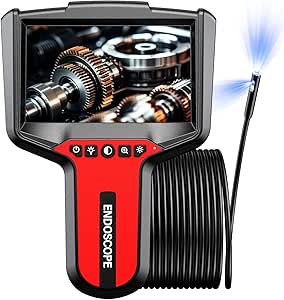 | Best for Simple Live Viewing | Screen: 5 inches | Resolution: 1080p | Viewing system: Dual front and side lenses | VIEW ON AMAZON | See Our Full Breakdown |
| 100 ft Sewer Inspection Camera with 23 mm 1080p Probe |  | Best for Long-Run Sewer Inspections | Cable length: 100 ft (30 m) | Camera resolution: AHD 1080p | Camera head diameter: 23 mm | VIEW ON AMAZON | See Our Full Breakdown |
| DEPSTECH 50 ft Endoscope Camera with 5-Inch IPS Screen and Triple Lens |  | Best for Versatile Mid-Range Inspections | Cable length: 50 ft | Camera resolution: 1080p | Camera lenses: Triple lens | VIEW ON AMAZON | See Our Full Breakdown |
| Acoath Two-Way Articulating Dual-Lens Borescope Camera, 5 ft |  | Best for Short, Precise Access | Cable length: 5 ft | Articulation: 210° | Camera: Dual lens: 70° main lens and 60° side lens | VIEW ON AMAZON | See Our Full Breakdown |
| plumbing inspection camera endoscope | Cable length | Water resistance | Screen | Storage |
|---|---|---|---|---|
| DEPSTECH Triple Lens Inspectio | 16.5 ft (4.9 m) | IP67 probe | 5-inch IPS | — |
| DEPSTECH DS520 Triple-Lens End | 50 ft | IP67 | 5-inch IPS | 32 GB TF card included |
| Kcapyn 100 ft Sewer Inspection | 100 ft (30 m) | IP68 | 5 inches | 32 GB SD card included |
| Kinpthy 1920P Dual-Lens Endosc | 16.4 ft | IP67; underwater up to 3.28 ft for 1 hour | — | — |
| 1080P HD Dual-Lens Endoscope C | — | IP67 | 5 inches | — |
| 100 ft Sewer Inspection Camera | 100 ft (30 m) | — | — | 32 GB TF card included |
| DEPSTECH 50 ft Endoscope Camer | 50 ft | IP67 | — | 32 GB SD card included |
| Acoath Two-Way Articulating Du | 5 ft | IP67 | 4.3-inch IPS | Built-in 32 GB TF card |
More Details on Our Top Picks
DEPSTECH Triple Lens Inspection Endoscope Camera with Light, 5″ IPS Screen
The DS620’s main advantage for plumbing checks is its three viewing angles: switching lenses can reveal a pipe wall or fitting without repeatedly shifting the probe. Its 16.5-foot semi-rigid cable is suited to nearby drains and accessible pipe runs, but it cannot reach as far as the 50-foot DEPSTECH DS520, much less the 100-foot Kcapyn sewer camera. A 5-inch IPS screen keeps the live image independent of a phone, and 1080p video recording gives it a documentation advantage over the 1080P HD Dual-Lens Endoscope, which does not record. The tradeoffs are a relatively short stated runtime of 2–3 hours and a bulky screen body; a microSD card is also needed for media storage and is not included. I’d choose it for close-range inspections where quick angle changes matter more than deep reach.
Pros:- Three lenses provide front and side views without needing to reposition the probe for every angle.
- Records 1080p video and 2 MP photos for documenting pipe conditions.
- 5-inch IPS display supports direct viewing without a phone or app.
- IP67 probe rating and ten LEDs suit dark, damp inspection areas.
Cons:- The 16.5-foot cable is too short for many long drain or sewer runs.
- Stated continuous battery life is only 2–3 hours.
- MicroSD card is not included, and the built-in screen adds bulk.
Best for: Plumbers and maintenance workers checking nearby traps, fittings, or short pipe runs who want a standalone screen, multiple viewing angles, and recorded footage.
Not ideal for: Buyers tracing long sewer lines or working far from an access point; the 16.5-foot cable falls short of the DEPSTECH DS520 and Kcapyn 100-foot options.
- Screen:5-inch IPS
- Video resolution:1080p
- Still resolution:2 MP
- Cable length:16.5 ft (4.9 m)
- Viewing system:Triple lens
- Lighting:10 LEDs
- Water resistance:IP67 probe
- Battery life:2–3 hours continuous use
- Connectivity:USB Type-C
Our verdict“Choose the DS620 for recorded, multi-angle checks close to an access point, but pick a longer-cable model for deep lines.”
DEPSTECH DS520 Triple-Lens Endoscope Camera with 50-Foot Cable and 5-Inch Screen
Among the handheld-screen options here, the DS520 is the more practical choice when an inspection needs to travel well beyond a nearby trap: its 50-foot semi-rigid cable gives it substantially more reach than the DS620’s 16.5-foot lead. Triple lenses and split-screen viewing help compare front and side views while the probe is in a pipe, and the 5-inch display avoids relying on a phone. Its included 32 GB card means it is ready to store footage, unlike the DS620, which requires a separately purchased microSD card. The longer cable also makes this a more specialized tool to handle and guide, and its manual focus means users need to work within the stated 0.6–3.9-inch focus range for a clear image. Four hours of listed battery life is useful, though it still calls for planning on longer jobs. I’d favor it for reach over compact handling.
Pros:- 50-foot semi-rigid cable reaches farther than the DS620’s 16.5-foot cable.
- Triple lenses and split-screen viewing provide multiple perspectives during inspection.
- Includes a 32 GB TF card for storing media.
- IP67 rating and included hook and magnet support wet-area and retrieval tasks.
Cons:- Manual focus requires attention to the stated 0.6–3.9-inch focus range.
- A 50-foot cable can be cumbersome to guide in short or confined inspections.
- Listed battery life is four hours, which may require recharging for extended work.
Best for: Plumbing technicians inspecting extended drain runs who want a long cable, multiple camera angles, and a built-in display with included storage.
Not ideal for: Homeowners doing occasional checks in cramped spaces or buyers prioritizing a compact setup; the 50-foot cable is more than many short inspections need.
- Cable length:50 ft
- Viewing system:Triple lens with front and dual side views
- Screen:5-inch IPS
- Video resolution:1080p
- Still resolution:2 MP
- Water resistance:IP67
- Storage:32 GB TF card included
- Battery:2600 mAh; listed runtime 4 hours
- Focus range:0.6–3.9 inches; manual focus
Our verdict“Pick the DS520 when a 50-foot reach and on-screen multi-angle viewing matter more than a compact, simple setup.”
Kcapyn 100 ft Sewer Inspection Camera with 1080p Waterproof Lens and 5-Inch Screen
The Kcapyn is the lineup’s clearest fit for long sewer and pipeline inspections, with a 100-foot cable that reaches twice as far as the DEPSTECH DS520 and far beyond the DS620. Distance markings help track how far the probe has traveled, which makes it easier to relate a visible issue to its approximate location along the run. The IP68 camera, six LEDs, and 5-inch live-view screen suit damp pipe work, while the included 32 GB card supports recording without an extra storage purchase. This is a different class of setup from the handheld endoscopes: at 3.51 kg, with an integrated toolbox, it is less convenient to carry around for quick checks. The listed still resolution is 2 MP, so buyers seeking especially detailed still images should not assume that the 1080p video description means higher-resolution photos. I’d choose it for reach and location tracking, not portability.
Pros:- 100-foot cable reaches farther than the 50-foot DEPSTECH DS520.
- Distance markings help estimate where an obstruction or defect lies along the pipe.
- IP68 camera rating and six LEDs support inspection in damp, dark pipelines.
- 5-inch screen and included 32 GB SD card support live viewing and recording.
Cons:- At 3.51 kg, the camera and toolbox are less convenient to carry than handheld endoscopes.
- Still image resolution is 2 MP, limiting detail in captured photos.
- The 100-foot cable is unnecessary bulk for short fixture or trap inspections.
Best for: Drain specialists and property-maintenance crews diagnosing long sewer or pipeline runs who need a marked cable, live screen, and included recording storage.
Not ideal for: Buyers doing short household checks or needing a lightweight, pocketable tool; its 100-foot cable and 3.51 kg weight make it a more substantial kit.
- Cable length:100 ft (30 m)
- Camera resolution:1080p
- Lens diameter:17 mm
- Water resistance:IP68
- Screen:5 inches
- Lighting:6 LEDs
- Storage:32 GB SD card included
- Still resolution:2 MP
- Weight:3.51 kg
Our verdict“Choose the Kcapyn for long sewer runs where cable reach and distance markings outweigh portability.”
Kinpthy 1920P Dual-Lens Endoscope Camera with 16.4 ft Semi-Rigid Cable
The Kinpthy takes a phone-connected approach rather than adding a dedicated monitor: it works with compatible iOS and Android devices and includes connectors for Lightning, USB-C, and Android ports. That keeps the kit focused on a 7.9 mm probe and a 16.4-foot semi-rigid cable, a useful combination for reaching tight spaces near pipes and fittings. Its stated 1920 × 1440 capture resolution exceeds the 1080p video listed for the DEPSTECH DS620 and DS520, though it does not offer their standalone 5-inch screens. The dual lenses provide front and side views, and IP67 protection is specified for immersion up to 3.28 feet for one hour—not unrestricted underwater use. The product data also warns that some Android phones may display slightly blurry images, so compatibility and image behavior deserve attention before choosing it. I’d pick this over the DS620 when using a phone is preferable to carrying a separate screen.
Pros:- 7.9 mm probe fits access points where a larger camera head may not.
- Dual lenses provide front and side views without switching to a separate camera.
- 1920 × 1440 capture resolution is higher than the listed 1080p video on the DEPSTECH DS520.
- Includes Lightning, Type-C, and Android connectors for compatible devices.
Cons:- Requires a compatible phone rather than offering a dedicated inspection screen.
- Some Android models may display slightly blurry images.
- Specified underwater use is limited to 3.28 feet for one hour.
Best for: Phone-equipped homeowners and technicians who want a slim probe, dual views, and a cable for inspecting nearby pipes, vehicles, or concealed spaces.
Not ideal for: Buyers who need a dedicated monitor, a long sewer-reach cable, or predictable image behavior across all Android phones.
- Capture resolution:1920 × 1440
- Sensor resolution:2 MP
- Probe diameter:7.9 mm
- Cable length:16.4 ft
- Water resistance:IP67; underwater up to 3.28 ft for 1 hour
- Lighting:8 adjustable LEDs
- Compatibility:iOS 9.0+ and Android 7+
- Battery life:3.5 hours
- Video formats:MP4 and MOV
Our verdict“Choose the Kinpthy for a compact, phone-based inspection kit, but skip it if you need a standalone screen or long sewer reach.”
1080P HD Dual-Lens Endoscope Camera with 5-Inch Screen and 16.4-Foot Waterproof Probe
This camera is the straightforward choice for buyers who want to see inside a pipe without managing a phone connection, app, or recording workflow. Its 5-inch screen and front-and-side lenses make live inspection simple, while the 16.4-foot semi-rigid probe covers short runs and nearby access points. Compared with the DEPSTECH DS620, it gives up triple-lens viewing and photo and video capture; unlike the Kinpthy, it does not rely on a compatible phone. That simplicity suits quick checks, but it also means there is no footage to share with a customer or keep for later comparison. The fixed-focus range of 1.2–4 inches limits how much control the operator has over sharpness, and its 2000 mAh battery is smaller than the DS520’s 2600 mAh battery. I’d select it for live-only troubleshooting, not jobs that need documentation.
Pros:- 5-inch screen provides live viewing without a phone or app.
- Dual front and side lenses offer two inspection angles.
- 16.4-foot semi-rigid, IP67-rated probe suits nearby damp inspection areas.
- Standalone operation avoids Wi-Fi and phone compatibility requirements.
Cons:- Does not take photos or record video, unlike the DEPSTECH DS620 and DS520.
- Fixed focus limits adjustment for objects outside the stated 1.2–4-inch range.
- 16.4-foot probe is not suited to long sewer runs.
Best for: Homeowners and maintenance staff who need a self-contained screen for live checks of nearby drains, pipes, engines, or ducts and do not need saved footage.
Not ideal for: Plumbers who must document findings, share inspection footage, or inspect long sewer runs; it cannot record and its probe is only 16.4 feet.
- Screen:5 inches
- Resolution:1080p
- Viewing system:Dual front and side lenses
- Probe length:16.4 ft
- Water resistance:IP67
- Lighting:8 adjustable LEDs
- Focus range:1.2–4 inches; fixed focus
- Battery:2000 mAh; listed runtime 3–4 hours
- Photo and video capture:Not supported
Our verdict“Pick this model for quick, live-only checks with a dedicated screen, and choose a record-capable camera when documentation matters.”
100 ft Sewer Inspection Camera with 23 mm 1080p Probe
For inspecting long drain runs, the 100-foot fiberglass cable gives this model more reach than the DEPSTECH 50 ft Endoscope Camera, reducing the need to reposition the unit during a job. Its 23 mm IP68 probe and 12 adjustable LEDs suit larger pipes and wet inspection conditions, while depth markers can help track how far the camera has traveled. Recording to the included 32 GB card is useful when I need to review footage after pulling the probe back. The tradeoff is portability: at 7.81 lb, it is a more substantial setup than a short-reach borescope, and its 4.3-inch monitor offers less viewing area than DEPSTECH’s 5-inch screen. I’d choose it for reach and runtime, not for compact storage or close-up screen review.
Pros:- 100 ft cable with depth markers reaches farther into long pipe runs than the 50 ft DEPSTECH model.
- IP68-rated 23 mm probe with 12 adjustable LEDs is suited to wet, poorly lit inspections.
- Records photos and video to an included 32 GB card for later review.
- 8500 mAh battery is rated for up to 10 hours of use.
Cons:- The 4.3-inch monitor is smaller than the 5-inch screen on the DEPSTECH 50 ft model.
- The 23 mm camera head may be too large for narrow pipes or tight bends.
- At 7.81 lb, the kit is less convenient to carry than a compact borescope.
Best for: Plumbers and drain technicians inspecting long sewer or drain lines who want onboard recording and extended battery runtime.
Not ideal for: DIYers checking short household obstructions or buyers who need a lightweight setup and a larger screen for reviewing fine detail.
- Cable length:100 ft (30 m)
- Camera resolution:AHD 1080p
- Camera head diameter:23 mm
- Camera angle:145°
- Display:4.3-inch IPS monitor with sun visor
- Storage:32 GB TF card included
- Battery runtime:Up to 10 hours
Our verdict“Choose this model when reaching far into sewer lines and recording a long inspection matter more than screen size and portability.”
DEPSTECH 50 ft Endoscope Camera with 5-Inch IPS Screen and Triple Lens
The 50-foot semi-rigid cable gives this DEPSTECH more reach than short handheld borescopes, while its 7.9 mm triple-lens camera can show front and side views in spaces where a larger sewer probe may not fit. That makes it a flexible choice for tracing a blockage or checking pipe walls without stepping up to the 23 mm head on the 100 ft Sewer Inspection Camera. The 5-inch IPS screen is also more comfortable for live viewing than that model’s 4.3-inch display. The tradeoff is endurance: its battery is rated for up to four hours, well below the 100-foot camera’s stated runtime. DEPSTECH also lists IP67 water resistance, so I’d favor it for varied inspection tasks rather than treating it as the more specialized long-run sewer setup.
Pros:- 50 ft semi-rigid cable reaches farther than compact handheld inspection cameras.
- Triple-lens 7.9 mm camera supports front and side views in narrow spaces.
- 5-inch IPS screen provides a larger viewing area than the 4.3-inch monitor on the 100 ft sewer camera.
- Includes a 32 GB memory card and carrying case.
Cons:- Up to four hours of battery life is limited beside the 100 ft sewer camera’s stated 10-hour runtime.
- IP67 water resistance is a lower rating than the IP68 probe on the 100 ft sewer camera.
- The long cable may need a puller for easier maneuvering.
Best for: Home inspectors and maintenance professionals who need a slim camera, multiple viewing angles, and enough cable for moderately long access runs.
Not ideal for: Technicians handling lengthy sewer jobs who need all-day runtime or the reach of a 100 ft cable.
- Cable length:50 ft
- Camera resolution:1080p
- Camera lenses:Triple lens
- Camera diameter:7.9 mm
- Display:5-inch IPS screen
- Water resistance:IP67
- Battery life:Up to 4 hours
- Storage:32 GB SD card included
Our verdict“Pick this DEPSTECH for a slim, multi-view camera and a large screen when 50 feet of reach is enough.”
Acoath Two-Way Articulating Dual-Lens Borescope Camera, 5 ft
Unlike the 50 ft DEPSTECH or the 100 ft sewer camera, the Acoath is built for short-range positioning, not sending a probe deep down a drain. Its 210° articulation lets me steer the 5-foot cable toward a specific surface, and the dual lenses provide main and side views that can reveal details around corners. A built-in 4.3-inch screen and 32 GB card keep viewing and recording self-contained, without relying on a phone app. The IP67 rating supports wet inspection settings, but the limited cable length rules it out for most long sewer runs. Its listed 2-megapixel still-image resolution is another constraint for buyers who need highly detailed saved images. I’d choose it for targeted access behind fixtures or equipment, not as a substitute for a drain camera with substantial cable reach.
Pros:- 210° articulation helps direct the camera around nearby obstacles.
- Dual lenses provide main and side views for checking surfaces from different angles.
- Built-in screen and 32 GB card allow standalone viewing and recording.
- IP67 rating and included protective accessories support practical inspection work.
Cons:- The 5 ft cable cannot reach far into sewer or drain lines like the 50 ft DEPSTECH or 100 ft sewer camera.
- Listed still-image resolution is 2 megapixels.
- The 4.3-inch screen is smaller than the 5-inch display on the DEPSTECH 50 ft model.
Best for: Plumbers and maintenance workers inspecting nearby pipe sections, fixture cavities, or equipment where controlled probe direction matters more than reach.
Not ideal for: Drain technicians who need to inspect long sewer lines or buyers who require high-resolution still images for documentation.
- Cable length:5 ft
- Articulation:210°
- Camera:Dual lens: 70° main lens and 60° side lens
- Video resolution:1080p
- Screen:4.3-inch IPS
- Probe diameter:0.33 in
- Water resistance:IP67
- Storage:Built-in 32 GB TF card
Our verdict“Choose the Acoath for precise, close-range inspections where articulation and dual views matter more than cable reach.”

How We Picked
I ranked these cameras by how well their stated design fits real plumbing inspection tasks, not by headline resolution alone. Cable reach and probe type mattered most because a short semi-rigid cable is suited to nearby access points, while a 50- or 100-foot cable is aimed at deeper runs. I also weighed lens layout, screen format, and steering: multiple viewing angles may reduce repositioning, a dedicated screen can simplify work without a phone, and articulation can help aim around nearby bends.
The ranking favors useful balance and task fit. That puts the 50-foot DEPSTECH DS520 ahead as a general plumbing choice, with long-cable sewer models ranked for jobs that genuinely need their reach and short probes placed lower for drain-wide inspections. Product details provided here do not establish cable stiffness, image performance in dark or dirty water, recording options, or service support, so I do not treat those as proven advantages. Buyers should verify those details and the camera’s suitability for the pipe conditions they expect to inspect.
| plumbing inspection camera endoscope | Water resistance |
|---|---|
| DEPSTECH Triple Lens Inspectio | IP67 probe |
| DEPSTECH DS520 Triple-Lens End | IP67 |
| Kcapyn 100 ft Sewer Inspection | IP68 |
| Kinpthy 1920P Dual-Lens Endosc | IP67; underwater up to 3.28 ft for 1 hour |
| 1080P HD Dual-Lens Endoscope C | IP67 |
| 100 ft Sewer Inspection Camera | — |
| DEPSTECH 50 ft Endoscope Camer | IP67 |
| Acoath Two-Way Articulating Du | IP67 |
Factors to Consider When Choosing Plumbing Inspection Camera Endoscope
Before choosing a plumbing camera, start with the inspection route rather than the feature list. Reach, cable behavior, and access geometry determine whether the camera can reach the problem and return safely; lens count and screen features matter after that. These broader checks can help prevent buying a capable camera that does not fit your actual drain work.
Match Cable Length to the Inspection Route
Measure the likely path from the access point to the area you need to inspect, and allow for bends rather than counting only the straight-line distance. A long cable can reach farther, but unused cable also needs space for feeding, storage, and retrieval. More reach does not automatically mean more control, particularly in small or sharply curved pipes. Avoid choosing a 100-foot model simply because it has the largest number; a shorter cable may be easier to manage for nearby clogs. If your jobs vary, check whether the cable can be fed gradually without kinking. Plan how you will clean and contain a soiled cable when it comes back out.
Choose a Probe That Suits the Pipe and Access Point
Probe diameter and flexibility affect whether the camera can pass through an opening and negotiate the pipe route. A slim or semi-rigid probe can suit close access and controlled positioning, but it may not behave like a purpose-built long sewer cable. A larger sewer probe may be better aligned with long runs, yet the opening and pipe geometry must accommodate it. Check the probe dimensions against the smallest access point you expect to use, not just the main drain. Do not force a probe through a bend or obstruction; resistance can damage equipment or make retrieval difficult. Pipe size, material, and existing damage all affect how safely a camera can travel.
Treat Lens Count as a Viewing Choice, Not a Quality Guarantee
Extra lenses can provide alternate angles, which may help inspect a pipe wall or check around an obstruction without withdrawing the camera. They do not guarantee sharper images or a wider useful view, so look for the field of view and image controls in the full product specifications. Lens arrangement matters more than the number alone when a particular job requires seeing forward, sideways, or both. A single forward view may be enough to locate a simple blockage, while alternate views can help when orientation is hard to judge. Ask whether the camera can switch views during inspection and whether each lens has suitable lighting. Avoid paying for extra camera angles if your work rarely uses them.
Decide Whether a Dedicated Screen Fits Your Workflow
A built-in screen keeps the viewing setup together and avoids relying on a separate phone during a wet or dirty job. Screen size is only one part of usability: brightness, controls, battery life, and visibility in the work area also matter. Check how the system handles recording and file transfer if you need to document pipe conditions for a client or revisit findings later. Product names that mention a screen do not by themselves confirm recording features or storage capacity. A phone-connected setup may be lighter, but it adds compatibility and battery questions. Choose the display arrangement you can operate while feeding and retrieving the cable.
Weigh Articulation Against Cable Reach
Articulation helps direct a camera head toward a nearby branch or feature, but it does not replace a long cable for reaching deep into a drain. A short articulating borescope can be a better fit for localized inspections behind fixtures or within accessible cavities. Steering and reach solve different problems, so identify whether distance or camera-head orientation is your main obstacle. Tight bends may still challenge an articulating head, and the product’s stated steering range should be checked before purchase. Long sewer cameras often prioritize distance over fine aiming. If both capabilities matter, confirm the model’s actual cable length and articulation rather than assuming one feature implies the other.
Check Maintenance, Retrieval, and Job Documentation
Plumbing cameras work in dirty environments, so cable cleaning and safe storage are part of the purchase decision. Look for clear instructions on cleaning the probe and cable, protecting connectors, and drying components before storage. Waterproof claims need a defined rating and scope; confirm whether they apply to the camera head, cable, or entire system. For repeated professional inspections, recording, timestamps, and easy file export may matter more than a small resolution difference. For occasional household use, simple controls and reliable retrieval may be more valuable than advanced documentation. Never assume a camera can be left submerged or used in every liquid just because its lens is described as waterproof.
Frequently Asked Questions
Is a 50-foot camera enough for most household drain inspections?
It can cover many inspections from a nearby cleanout, but the required distance depends on where that access point sits and how the pipe route runs. Measure the likely path to the suspected problem, including bends and branches, before deciding. A 50-foot cable offers a middle ground between short inspection probes and 100-foot sewer models. Longer reach is useful only when the cable can pass through the pipe and be retrieved without excessive force. If you routinely inspect long sewer laterals, a longer model may be a better fit.
Should I choose a triple-lens camera over a dual-lens model?
Choose by the views you need, not by lens count alone. Multiple angles can make it easier to check pipe walls or understand the position of an obstruction, but they do not prove that the image is sharper or that the camera is easier to control. A dual-lens camera may be sufficient for straightforward forward inspection and can suit buyers who prioritize a simpler setup. Before buying, confirm which views are available, how they are selected, and whether lighting supports each view. If you mainly need to locate a blockage, reach and cable handling may matter more than an extra lens.
Can a short articulating borescope replace a sewer inspection camera?
Not for most long drain inspections. A short articulating tool is designed to steer its camera head around nearby features, while a sewer camera’s longer cable is intended to reach farther into a pipe. The Acoath’s 5-foot length makes it more appropriate for short, controlled checks than for tracing a distant blockage. Articulation can be useful when the inspection point is close but hard to aim at. If distance is the problem, prioritize cable length and suitable probe construction instead.
Does a waterproof camera mean I can use it in any drain or standing water?
No. Waterproofing can apply to specific parts of a camera and may have limits on depth, duration, and exposure. Check the stated protection rating and whether it covers the lens, probe, cable, and connectors before using the system in water. Also confirm whether the manufacturer permits use in wastewater or other contaminated liquids. Even a protected camera can be damaged by poor cable handling or by forcing the probe into a blockage. Clean and dry equipment according to its instructions after an inspection.
What should I prioritize if I need to show inspection results to a plumber or customer?
Prioritize confirmed recording capability, clear file export, and a display that is easy to view while working. A screen listed in the product name does not confirm that video can be saved, so check storage, recording format, and transfer options. Resolution labels alone do not tell you how readable footage will be in a dark, dirty pipe. A stable camera feed and useful lighting can make documentation easier to interpret. If the camera is for occasional troubleshooting rather than reports, simple controls and adequate reach may deserve more attention.
Conclusion
For the best overall, I’d choose the DEPSTECH DS520: its 50-foot cable and triple-lens setup balance useful reach with alternate views. The best value by task fit is the Kinpthy 16.4-foot dual-lens model for close-access inspections, provided you do not need sewer-length reach. For a best premium-style pick among these listed designs, the Kcapyn 100-foot camera is the option to examine when long runs are the priority; verify its cable handling and documentation features before committing. The best option for beginners is a screen-based 50-foot DEPSTECH model, since it avoids making a phone the center of the inspection setup. For specific needs, choose the Acoath when nearby steering matters, or one of the 100-foot sewer cameras when distance is the deciding factor. Match the tool to the pipe route first, then compare lens layout and display features.
Fall yard work Picks
leaf blowers
As an affiliate, we earn on qualifying purchases.