A smart humidity sensor for mold prevention can alert you to damp conditions before they become a recurring problem, but it cannot detect or remove mold by itself. My best overall pick is the Tapo T310 for straightforward monitoring, while the SwitchBot Wi-Fi Humidity Sensor 4-Pack with Matter-Enabled Hub 2 stands out for multi-room coverage and the Leviton DHS05-1LW for directly controlling a bathroom fan. The main tradeoffs are how many rooms you can monitor, whether alerts rely on a hub or cloud connection, and whether you need readings alone or automatic ventilation. Continue reading for the full breakdown of all 15 options and guidance on choosing a setup that fits your home.
Complete the kit


Key Takeaways
- The amazon.com/dp/B0C7FHR68M?tag=bestmoderntoilet-20&ascsubtag=dc-498233″ target=”_blank” rel=”nofollow sponsored noopener”>Tapo T310 is the clearest all-around choice for shoppers who want a simple room sensor rather than a specialized freezer kit, dedicated switch, or large multi-sensor system.
- Multi-room coverage changes the value equation: SwitchBot’s four sensors and hub, Govee’s three-packs, and X-Sense’s three sensors with a base station suit homes where humidity varies from room to room.
- A sensor is not the same as mold control. Leviton’s humidity-sensing fan switch can act on damp bathroom air, while most of the roundup mainly measures conditions and sends alerts.
- Hub and protocol compatibility divide the field. Zigbee models such as Aqara and THIRDREALITY make the most sense for buyers with a compatible hub; Wi-Fi and Bluetooth choices have different setup and remote-alert tradeoffs.
- Specialized features can narrow placement options: YoLink’s freezer focus and SONOFF’s IP65-rated design serve particular environments, while a general indoor sensor is usually easier to place across living spaces.
| Gaoducash TH01 WiFi Temperature and Humidity Sensor |  | Best for Simple Wi-Fi Alerts | Connectivity: 2.4 GHz Wi-Fi | App compatibility: Tuya Smart and Smart Life | Voice compatibility: Amazon Alexa; humidity queries only | VIEW ON AMAZON | See Our Full Breakdown |
| YoLink Freezer Thermometer and Hygrometer, 3-Pack (YS8007) |  | Best for Multiple Rooms and Long Battery Life | Pack size: 3 sensors | Connectivity: LoRa | Wireless range: Up to 2,034 feet in open air | VIEW ON AMAZON | See Our Full Breakdown |
| Tapo T310 Smart Temperature and Humidity Sensor | 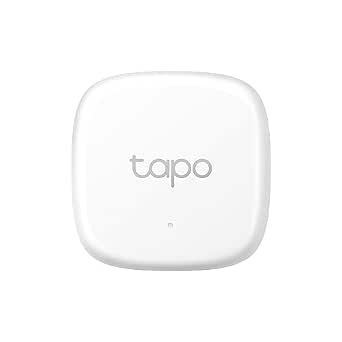 | Best for Fast Updates and Data Review | Measurements: Temperature and humidity | Temperature accuracy: ±0.54°F | Humidity accuracy: ±3% RH | VIEW ON AMAZON | See Our Full Breakdown |
| Aqara Zigbee Temperature and Humidity Sensor, 3-Pack |  | Best for Apple HomeKit Households | Pack size: 3 sensors | Connectivity: Zigbee | Measurements: Temperature, humidity, and atmospheric pressure | VIEW ON AMAZON | See Our Full Breakdown |
| AcuRite Smart Wi-Fi Indoor Comfort Meter (Model 17017M) |  | Best for an At-a-Glance Local Display | Connectivity: 2.4 GHz Wi-Fi | App: AcuRite NOW | Update interval: Every 5 minutes | VIEW ON AMAZON | See Our Full Breakdown |
| Leviton Decora Humidity Sensor and Fan Control Switch, Single Pole, 1/4 HP, White (DHS05-1LW) |  | Best for Automatic Bathroom Ventilation | Model: DHS05-1LW | Switch type: Relay | Circuit: Single pole, 1-way | VIEW ON AMAZON | See Our Full Breakdown |
| Govee Smart Bluetooth Thermometer and Hygrometer, 3-Pack |  | Best Value for Multiroom Spot Checks | Model: H5074 | Pack size: 3 sensors | Connectivity: Bluetooth; not Wi-Fi | VIEW ON AMAZON | See Our Full Breakdown |
| SwitchBot Wi-Fi Humidity Sensor 4-Pack with Matter-Enabled Hub 2 |  | Best for Outdoor and Dew-Point Monitoring | Included components: 3 thermometers, 1 Hub Mini Matter, user manual, 6 AAA batteries, 3 lanyards | Water and dust resistance: IP65 | Operating humidity: 0–100% RH | VIEW ON AMAZON | See Our Full Breakdown |
| GoveeLife WiFi Thermometer and Hygrometer, 5-in-1, Large LCD, 3-Pack with Gateway | 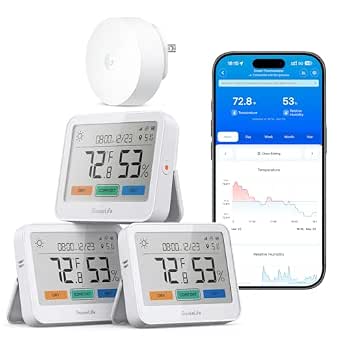 | Best for At-a-Glance Room Monitoring | Model: H5220 | Included items: 3 monitors and gateway | Display: 3.7-inch digital LCD | VIEW ON AMAZON | See Our Full Breakdown |
| THIRDREALITY Zigbee Temperature and Humidity Sensor Lite |  | Best for Existing Zigbee Smart Homes | Connectivity: Zigbee | Temperature accuracy: ±0.3°C from -15°C to 50°C | Humidity accuracy: ±2% from 0% to 100% | VIEW ON AMAZON | See Our Full Breakdown |
| Amazon Smart Air Quality Monitor |  | Best for Alexa-Based Prevention Routines | Sensors: Temperature, humidity, carbon monoxide, PM2.5, and VOCs | Connectivity: 2.4 GHz Wi-Fi and Bluetooth LE 4.2 | Dimensions: 65 × 65 × 45 mm | VIEW ON AMAZON | See Our Full Breakdown |
| X-Sense Smart Wi-Fi Temperature and Humidity Monitor with 3 Sensors and Base Station |  | Best for Multi-Room Moisture Tracking | Model: STH0B31 | Sensors included: 3 | Temperature accuracy: ±0.36°F (±0.2°C) | VIEW ON AMAZON | See Our Full Breakdown |
| GoveeLife 2.0 WiFi Hygrometer Thermometer with Gateway, 3 Mini Sensors | 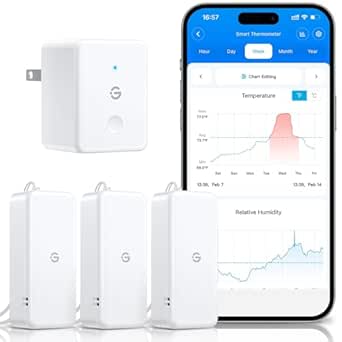 | Best for Fast Alerts and Long-Term Records | Model: H5151, H5110 | Included components: WiFi gateway, 3 thermo-hygrometers, 6 AAA batteries, 3 lanyards, and user manual | Temperature accuracy: ±0.54°F / ±0.3°C | VIEW ON AMAZON | See Our Full Breakdown |
| Ring Temperature and Humidity Sensor |  | Best for Ring and Sidewalk Households | Device dimensions: 2.76 × 1.01 inches (70 × 25.6 mm) | Power: 2 AA alkaline batteries included | Approximate battery life: Up to 5 years | VIEW ON AMAZON | See Our Full Breakdown |
| SONOFF SNZB-02WD IP65 Zigbee LCD Temperature and Humidity Sensor |  | Best for Humid or Splash-Prone Areas | Model: SNZB-02WD | Connectivity: Zigbee | Display: LCD | VIEW ON AMAZON | See Our Full Breakdown |
| smart humidity sensor for mold prevention | Connectivity | Temperature accuracy |
|---|---|---|
| Gaoducash TH01 WiFi Temperatur | 2.4 GHz Wi-Fi | — |
| YoLink Freezer Thermometer and | LoRa | ±0.36°F from 0°C to 54°C; ±0.72°F from -20°C to 0°C |
| Tapo T310 Smart Temperature an | Sub-1G wireless to hub; requires a 2.4 GHz Wi-Fi network | ±0.54°F |
| Aqara Zigbee Temperature and H | Zigbee | — |
| AcuRite Smart Wi-Fi Indoor Com | 2.4 GHz Wi-Fi | ±2°F |
| Leviton Decora Humidity Sensor | — | — |
| Govee Smart Bluetooth Thermome | Bluetooth; not Wi-Fi | ±0.54°F |
| SwitchBot Wi-Fi Humidity Senso | — | ±0.36°F |
| GoveeLife WiFi Thermometer and | Wi-Fi and Bluetooth | — |
| THIRDREALITY Zigbee Temperatur | Zigbee | ±0.3°C from -15°C to 50°C |
| Amazon Smart Air Quality Monit | 2.4 GHz Wi-Fi and Bluetooth LE 4.2 | — |
| X-Sense Smart Wi-Fi Temperatur | — | ±0.36°F (±0.2°C) |
| GoveeLife 2.0 WiFi Hygrometer | — | ±0.54°F / ±0.3°C |
| Ring Temperature and Humidity | Amazon Sidewalk | ±1°F (±0.8°C) |
| SONOFF SNZB-02WD IP65 Zigbee L | Zigbee | Listed as 0.5°C and ±0.1°C |
More Details on Our Top Picks
Gaoducash TH01 WiFi Temperature and Humidity Sensor
For a single room where I want humidity alerts without adding a hub, the Gaoducash TH01 is the most direct option here. It connects to 2.4 GHz Wi-Fi and sends threshold alerts through Tuya Smart or Smart Life, so a rising reading can prompt action before damp conditions persist. Its history and graphs also help me spot recurring humidity patterns rather than relying on one glance. Compared with the Tapo T310, the TH01 connects directly to Wi-Fi instead of requiring a separate hub, but Tapo supplies a stated two-second update interval and up to two years of data export. The Gaoducash tradeoff is app dependence: Alexa can report humidity, but full readings and features live in the companion app. I’d choose it for straightforward remote monitoring, not for someone who wants a display of all readings through voice control.
Pros:- Connects directly to 2.4 GHz Wi-Fi, with no separate hub listed as required
- Tuya Smart and Smart Life provide remote monitoring and threshold alerts
- Historical data and graphs can reveal recurring humidity patterns
- Compact body supports flexible placement or wall mounting
Cons:- Requires a 2.4 GHz Wi-Fi network
- Alexa displays humidity only; full readings and features require the companion app
Best for: Renters or homeowners who want app-based humidity threshold alerts in one indoor room without buying a dedicated sensor hub.
Not ideal for: Buyers who need readings and controls in Alexa without opening another app, or who have only 5 GHz Wi-Fi.
- Connectivity:2.4 GHz Wi-Fi
- App compatibility:Tuya Smart and Smart Life
- Voice compatibility:Amazon Alexa; humidity queries only
- Power:2 AAA batteries, included
- Display:Digital
- Response time:500 milliseconds
- Temperature range:Up to 60 °C
- Length:7.1 cm
Our verdict“Choose the TH01 for direct Wi-Fi humidity alerts and app history in a single room, provided you are comfortable using Tuya Smart or Smart Life for full readings.”
YoLink Freezer Thermometer and Hygrometer, 3-Pack (YS8007)
When I want to watch several spaces without depending on a sensor’s Wi-Fi reach, the YoLink three-pack offers the strongest coverage story in this group. Its LoRa connection has a stated open-air range of up to 2,034 feet, and each sensor is rated for up to five years on two AA batteries. That combination suits detached areas or multiple rooms where changing batteries often would be inconvenient. The catch is the separate YoLink hub, which adds a required piece of equipment; the Aqara three-pack also needs its own hub, but adds atmospheric-pressure readings and lists Apple HomeKit compatibility. YoLink’s alerts and app history are relevant to mold prevention, though Alexa support is limited to temperature queries, not humidity. I’d favor it for coverage and endurance, not for a hub-free setup or voice access to humidity.
Pros:- Three sensors let me monitor separate locations
- LoRa wireless connection has a stated open-air range of up to 2,034 feet
- Battery life is rated for up to five years per sensor
- Customizable temperature and humidity alerts with app history
Cons:- Requires a YoLink hub sold separately
- Alexa supports temperature queries only, not humidity queries or routines
Best for: Homeowners monitoring several indoor or outdoor locations, especially spaces far from the main Wi-Fi router, who value long battery life.
Not ideal for: People who want a hub-free sensor, Alexa humidity queries, or a system that can trigger Alexa routines from sensor readings.
- Pack size:3 sensors
- Connectivity:LoRa
- Wireless range:Up to 2,034 feet in open air
- Temperature range:-4°F to 129°F (-20°C to 54°C)
- Temperature accuracy:±0.36°F from 0°C to 54°C; ±0.72°F from -20°C to 0°C
- Humidity range and accuracy:0% to 100%; ±3% from 10% to 90%
- Power and battery life:Two AA batteries per sensor; up to 5 years
- Hub requirement:YoLink hub required; sold separately
Our verdict“Pick YoLink for multi-location monitoring and long battery life if you accept the required hub and app-based humidity checks.”
Tapo T310 Smart Temperature and Humidity Sensor
The Tapo T310 is the data-focused choice for someone who wants to follow humidity changes closely and review longer-term patterns. Its readings update every two seconds, while the app offers summaries and up to two years of free data export—useful for checking whether a room repeatedly stays damp, rather than reacting to an isolated reading. A Swiss-made sensor and stated ±3% RH accuracy add useful measurement detail, but they do not remove the need to act on persistent moisture. Unlike the Gaoducash TH01, this model requires a Tapo H100 hub, so the direct-to-Wi-Fi simplicity of that alternative may suit a one-room setup better. The T310’s tradeoff is ecosystem dependence: the hub is sold separately, and sub-1G frequency compatibility varies by region. I’d pick it for frequent updates and record-keeping, not for a minimal setup.
Pros:- Readings update every two seconds
- App notifications and smart-home automation support timely responses
- Provides data summaries and up to two years of free data export
- CR2450 battery is included and rated for more than one year under normal use
Cons:- Requires a Tapo H100 hub sold separately
- Sub-1G frequency compatibility varies by region
Best for: Tapo users who want frequent humidity readings, app notifications, automation, and exported history to track recurring damp conditions.
Not ideal for: Buyers unwilling to add a Tapo H100 hub, or those who need compatibility with a specific regional sub-1G frequency before confirming support.
- Measurements:Temperature and humidity
- Temperature accuracy:±0.54°F
- Humidity accuracy:±3% RH
- Update interval:Every 2 seconds
- Connectivity:Sub-1G wireless to hub; requires a 2.4 GHz Wi-Fi network
- Required hub:Tapo H100, sold separately
- Battery:1 CR2450, included; rated for more than 1 year under normal use
- Data export:Up to 2 years free data export
Our verdict“Choose the T310 if you want fast updates and exportable humidity history and already accept the cost and setup of a Tapo H100 hub.”
Aqara Zigbee Temperature and Humidity Sensor, 3-Pack
For a home already built around Aqara or Apple HomeKit, this Aqara three-pack makes it easier to place sensors in several rooms and tie readings to household automations. It tracks temperature, humidity, and atmospheric pressure, with app trends and alerts that can help identify rooms where moisture repeatedly rises. Compared with the YoLink three-pack, Aqara brings listed HomeKit compatibility and pressure readings, while YoLink emphasizes long-range LoRa coverage and up to five years of battery life. Neither is a hub-free pick: Aqara requires an Aqara Hub, and the sensors should remain within 10 meters of it. Third-party hubs and USB dongles are not officially supported, so this is a less flexible choice for mixed ecosystems. I’d choose Aqara when its hub and integrations fit the home, rather than as a standalone mold-monitoring purchase.
Pros:- Three sensors support monitoring in multiple indoor locations
- Measures atmospheric pressure as well as temperature and humidity
- Aqara app offers real-time data, trends, and alerts
- Works with Apple HomeKit, Alexa, and IFTTT through an Aqara Hub
Cons:- Requires a separately sold Aqara Hub
- Sensors should be within 10 meters (33 feet) of the hub
- Third-party hubs and USB dongles are not officially supported
Best for: Apple HomeKit or Aqara households that want to monitor humidity across three indoor locations and connect readings to compatible automations.
Not ideal for: Buyers without an Aqara Hub, users who need long-range placement away from the hub, or households relying on third-party Zigbee hubs.
- Pack size:3 sensors
- Connectivity:Zigbee
- Measurements:Temperature, humidity, and atmospheric pressure
- Response time:5 seconds
- Dimensions:1.42 x 1.42 x 0.35 inches
- Mounting:Wall mount
- Hub requirement:Aqara Hub required; third-party hubs not officially supported
- Compatibility:Apple HomeKit, Alexa, and IFTTT
Our verdict“Choose Aqara for multi-room humidity monitoring when you already use its hub and want the listed HomeKit integration.”
AcuRite Smart Wi-Fi Indoor Comfort Meter (Model 17017M)
The AcuRite 17017M suits a buyer who wants to read conditions on the device itself as well as receive app updates. Its backlit display and automatically synced clock make the small meter easier to check in a dim room, while 2.4 GHz Wi-Fi sends readings to the AcuRite NOW app every five minutes. That slower cadence is a clear contrast with the Tapo T310, which updates every two seconds and offers longer-term data export; AcuRite favors a simple local readout over that faster, more detailed tracking. Its compact 2.2-inch-square body can fit in places such as a humidor or printer enclosure, but temperature accuracy is listed at ±2°F, and the three AAA batteries are not included. I’d choose it for convenient spot checks and app alerts, not for the quickest response to changing humidity.
Pros:- Backlit digital display is easier to read at night
- Wi-Fi sends updates to the AcuRite NOW app every five minutes
- Automatically synced digital clock adds useful at-a-glance information
- Compact 2.2-inch-square design suits small indoor spaces
Cons:- Requires three AAA batteries, which are not included
- Limited to 2.4 GHz Wi-Fi
- Temperature reading accuracy is ±2°F, and no humidity accuracy figure is supplied
Best for: People who want a compact indoor meter with a readable local display and Wi-Fi app updates for a small room, enclosure, or storage space.
Not ideal for: Buyers who need rapid updates, stated humidity accuracy, or a monitoring system with supplied batteries and detailed historical export.
- Connectivity:2.4 GHz Wi-Fi
- App:AcuRite NOW
- Update interval:Every 5 minutes
- Display:Backlit digital display with automatically synced clock
- Power:3 AAA batteries, not included
- Temperature range:14°F to 140°F
- Temperature accuracy:±2°F
- Dimensions:2.2 x 2.2 inches
Our verdict“Pick the AcuRite for a compact, backlit local display with app monitoring, but choose the Tapo T310 if faster updates and exportable history matter more.”
Leviton Decora Humidity Sensor and Fan Control Switch, Single Pole, 1/4 HP, White (DHS05-1LW)
For mold prevention in a bathroom, automatic moisture removal can matter more than checking readings in an app. This Leviton switch senses humidity and turns a connected fan on or off, so it can respond to moisture without relying on someone to notice a problem. Its neutral-wire flexibility may also make it a practical choice in homes where wiring options are limited, and settings can be adjusted without taking off the faceplate. Compared with the Govee Smart Bluetooth Thermometer and Hygrometer, it does not give you readings or historical trends across several rooms; it acts directly on ventilation instead. That focus is also its limitation: it controls a fan rather than alerting you to damp conditions elsewhere, and the wallplate is sold separately. I’d choose it for a bathroom fan, not as a whole-home monitoring system.
Pros:- Automatically switches a connected fan based on humidity
- Can be installed with or without a neutral wire
- Settings adjust without tools or faceplate removal
- Designed for bathrooms, basements, laundry rooms, and spas
Cons:- Wallplate is sold separately
- Controls a fan rather than providing remote readings or humidity history
- Single-pole design does not cover every switching setup
Best for: Homeowners who want a bathroom or laundry-room fan to respond automatically to humidity without checking an app.
Not ideal for: Renters or anyone seeking multiroom readings, logged humidity trends, or alerts without changing a wall switch.
- Model:DHS05-1LW
- Switch type:Relay
- Circuit:Single pole, 1-way
- Operating voltage:120 V
- Wiring:Installs with or without a neutral wire
- Dimensions:4.13 x 1.73 x 1.38 in
- Warranty:5-year limited
Our verdict“Choose the Leviton when your main mold-prevention step is automatically ventilating one moisture-prone room.”
Govee Smart Bluetooth Thermometer and Hygrometer, 3-Pack
The three-sensor bundle makes it easier to check rooms where dampness tends to hide, such as a basement, closet, and bathroom, without buying a separate monitor for each. The Bluetooth app alerts can flag readings outside your chosen range, while stored readings and export options help you spot recurring humidity patterns rather than relying on a single glance. Compared with the SwitchBot set, this Govee kit does not include a Wi-Fi hub or claim outdoor protection, so it suits indoor spot checks more than connected, remote monitoring. Its 262-foot range applies only without obstacles; walls and floors can limit access, and there is no Wi-Fi connection. I’d pick it for nearby rooms and a modest setup, but skip it if you need alerts while away or dependable monitoring across a large home.
Pros:- Three compact sensors can cover multiple rooms
- App provides real-time readings and preset-range alerts
- Stores 20 days of readings and supports exporting up to two years of records
- Hanging holes allow flexible placement
Cons:- Bluetooth only; no Wi-Fi connectivity
- Specified range assumes there are no obstacles
- Humidity accuracy is ±3% RH
Best for: Households wanting to monitor several nearby indoor rooms and review humidity trends in the Govee app over Bluetooth.
Not ideal for: People who need Wi-Fi alerts away from home, outdoor-rated sensors, or reliable coverage through multiple walls and floors.
- Model:H5074
- Pack size:3 sensors
- Connectivity:Bluetooth; not Wi-Fi
- Bluetooth range:262 ft without obstacles
- Temperature accuracy:±0.54°F
- Humidity accuracy:±3% RH
- Onboard storage:20 days
- Data export:Up to 2 years via app
Our verdict“Choose this Govee pack for affordable multiroom humidity checks when Bluetooth range is sufficient.”
SwitchBot Wi-Fi Humidity Sensor 4-Pack with Matter-Enabled Hub 2
Among these options, the SwitchBot set offers the clearest route to monitoring humidity beyond ordinary indoor rooms: its sensors are IP65-rated and report dew point and VPD as well as temperature and relative humidity. Those added measurements can help a homeowner understand conditions that may contribute to condensation, while four-second refreshes and smart alerts make changes easier to catch. Compared with the Govee Bluetooth 3-pack, this kit includes a hub for Wi-Fi connectivity and is built for indoor or outdoor placement; it is a stronger fit for connected monitoring, though it depends on that hub. One detail needs checking before purchase: despite the “4-pack” title, the supplied contents list three thermometers and one hub. It also offers three sensors rather than GoveeLife’s three monitors with visible LCDs, so it’s better for app-led monitoring than at-a-glance room checks.
Pros:- IP65 rating suits indoor and outdoor placement
- Tracks humidity, temperature, dew point, and VPD
- Readings refresh every four seconds and support smart alerts
- Includes a Matter-enabled hub for Wi-Fi connectivity
Cons:- Listed contents include three thermometers, despite the 4-pack title
- Wi-Fi connectivity requires the included hub
- Tabletop mounting may not suit every placement
Best for: Smart-home owners who want hub-connected humidity monitoring across indoor and outdoor areas, including dew-point tracking.
Not ideal for: Buyers who want four actual sensors, a standalone Wi-Fi sensor without a hub, or a large display on each monitor.
- Included components:3 thermometers, 1 Hub Mini Matter, user manual, 6 AAA batteries, 3 lanyards
- Water and dust resistance:IP65
- Operating humidity:0–100% RH
- Upper temperature range:140°F
- Temperature accuracy:±0.36°F
- Humidity accuracy:±1.8% RH
- Data refresh rate:Every 4 seconds
- Compatibility:Alexa
Our verdict“Choose SwitchBot if outdoor-ready sensors and dew-point data matter more than having four sensors or built-in displays.”
GoveeLife WiFi Thermometer and Hygrometer, 5-in-1, Large LCD, 3-Pack with Gateway
For someone who wants humidity visible without opening an app, GoveeLife stands apart with a 3.7-inch LCD on each monitor and a color-coded comfort indicator. The gateway adds Wi-Fi access and supports alerts through the app, email, and a buzzer, while the two-second refresh rate helps the readings keep pace with changing room conditions. Compared with the Govee Bluetooth 3-pack, this is more convenient for remote alerts and everyday glance checks, but it also depends on a gateway for Wi-Fi and local weather information. Using the gateway shortens the stated battery life to one year, versus up to two years on Bluetooth. Its comfort display can make a damp room easier to notice, but it does not automatically run a fan like the Leviton switch. I’d favor it for visible monitoring across rooms, not hands-off moisture control.
Pros:- Large LCD with a color-coded comfort indicator
- Custom alerts through the app, email, and gateway buzzer
- Two-second reading refresh rate
- Gateway offers up to 1,640 feet of open-air range
Cons:- Wi-Fi and local weather features require the gateway
- Stated battery life drops to one year with gateway use
- Provides monitoring and alerts but does not control ventilation
Best for: Households that want readable humidity displays in multiple rooms plus Wi-Fi alerts and gateway-based coverage.
Not ideal for: Buyers who want automatic fan control, do not want to use a gateway, or prioritize the longest battery life while connected.
- Model:H5220
- Included items:3 monitors and gateway
- Display:3.7-inch digital LCD
- Connectivity:Wi-Fi and Bluetooth
- Temperature range:-4°F to 140°F
- Humidity range:0% to 99% RH
- Refresh rate:2 seconds
- Battery life:Up to 2 years on Bluetooth or 1 year with gateway
Our verdict“Pick GoveeLife when visible readings and multiple alert routes matter more than automatic fan operation.”
THIRDREALITY Zigbee Temperature and Humidity Sensor Lite
This compact sensor makes the most sense when a compatible Zigbee hub is already part of the home. It reports humidity and temperature to supported smart-home apps, where readings can drive climate alerts and automation routines; adhesive backing also makes it easier to place near a trouble spot such as a basement wall or laundry area. Its stated ±2% humidity accuracy and five-second response time give it a defined monitoring role, while two included AAA batteries are rated for at least two years of normal use. Compared with the GoveeLife gateway kit, THIRDREALITY avoids adding its own gateway but relies on a hub you supply. That makes it a leaner add-on for an established Zigbee setup, not the simplest standalone choice. Alexa’s app can display temperature but not humidity, a meaningful limitation for this mold-prevention use.
Pros:- Supports climate alerts and smart-home automation
- Stated humidity accuracy of ±2% across 0–100%
- Two included AAA batteries rated for at least two years of normal use
- Compact body and adhesive backing allow flexible indoor placement
Cons:- Requires a compatible Zigbee hub, sold separately
- Alexa app can display temperature but not humidity
- Indoor use only
Best for: Smart-home owners with a compatible Zigbee hub who want a small sensor to trigger humidity alerts or routines.
Not ideal for: People without a Zigbee hub, or Alexa users who expect humidity readings to appear in the Alexa app.
- Connectivity:Zigbee
- Temperature accuracy:±0.3°C from -15°C to 50°C
- Humidity accuracy:±2% from 0% to 100%
- Response time:5 seconds
- Power source:2 included AAA batteries
- Battery life:At least 2 years of normal use
- Usage:Indoor
- Length:2.21 inches
Our verdict“Choose THIRDREALITY as a compact humidity-sensing add-on if your Zigbee hub already supports it.”
Amazon Smart Air Quality Monitor
The Amazon Smart Air Quality Monitor makes the most sense for an Alexa household that wants humidity readings to trigger a response, not just sit in an app. Alongside temperature and humidity, it tracks carbon monoxide, PM2.5, and VOCs, so it gives broader air-quality context than the humidity-focused X-Sense monitor. Alexa alerts and compatible routines can prompt a connected fan or other device when readings change, which may help you react to damp conditions. The tradeoff is that the product does not itself diagnose mold or specify a mold-risk threshold; you need to choose how to act on its readings. Its smart features also depend on the Alexa app and compatible Echo devices, making it less suitable than the GoveeLife system for buyers who want a sensor-and-gateway setup centered on remote humidity tracking.
Pros:- Tracks humidity and temperature alongside carbon monoxide, PM2.5, and VOCs.
- Can send phone alerts and Echo announcements when air quality changes.
- Humidity and temperature readings can trigger compatible Alexa routines.
- Small monitor includes its power adapter and Micro-USB cable.
Cons:- Smart features require the Alexa app and compatible Alexa devices.
- Does not provide a dedicated mold-risk assessment or specified humidity alert threshold.
- Designed for indoor use only.
Best for: Alexa households that want humidity readings alongside broader air-quality monitoring and the option to automate compatible devices.
Not ideal for: Buyers without Alexa devices, or anyone seeking a dedicated multi-room humidity system with detailed humidity history and export tools.
- Sensors:Temperature, humidity, carbon monoxide, PM2.5, and VOCs
- Connectivity:2.4 GHz Wi-Fi and Bluetooth LE 4.2
- Dimensions:65 × 65 × 45 mm
- Weight:120 g without cable or adapter
- Power:5 W adapter; 5.0 V, 1 A output
- Compatibility:Echo devices and Alexa app version 2021.16 or later
- Operating conditions:0°C to 40°C; 0% to 80% humidity
- Included:Monitor, Micro-USB cable, power adapter, and quick start guide
Our verdict“Choose this if Alexa routines and broader air-quality readings matter more than dedicated humidity history or multi-sensor coverage.”
X-Sense Smart Wi-Fi Temperature and Humidity Monitor with 3 Sensors and Base Station
For checking several rooms where dampness may go unnoticed, the X-Sense three-sensor system puts useful humidity context ahead of broad air-quality readings. It tracks dew point and VPD as well as temperature and humidity, and its app alerts can flag readings outside a range you set. Historical graphs and data export help you spot recurring patterns, such as a basement that stays humid after rain. Compared with the Amazon Smart Air Quality Monitor, it is more purpose-built for tracking moisture across locations, but it does not add carbon monoxide or particle readings. The base station’s stated coverage and support for additional devices suit larger setups; the tradeoff is reliance on AAA batteries and unclear requirements for Wi-Fi and app access in the supplied description.
Pros:- Three sensors allow monitoring across multiple rooms.
- Tracks dew point and VPD in addition to temperature and humidity.
- App alerts, historical graphs, and data export support ongoing moisture checks.
- Base station supports up to 50 devices, including up to 10 thermo-hygrometers.
Cons:- Sensors use replaceable AAA batteries rather than a wired power supply.
- The supplied product information does not clarify Wi-Fi or app subscription requirements.
- Does not measure air-quality factors such as VOCs or PM2.5.
Best for: Homeowners monitoring multiple damp-prone areas, such as a basement, bathroom, and laundry room, who want alerts and historical records.
Not ideal for: Buyers who want one simple Alexa-integrated air-quality monitor, or who need clear confirmation of network and app requirements before buying.
- Model:STH0B31
- Sensors included:3
- Temperature accuracy:±0.36°F (±0.2°C)
- Humidity accuracy:±2% RH
- Wireless coverage:Up to 1,700 ft (500 m)
- Device capacity:Up to 50 devices per base station, including up to 10 thermo-hygrometers
- Battery:3 replaceable AAA batteries, 1200 mAh
- Battery life and stated lifespan:Up to 1 year battery life; stated 5-year lifespan
Our verdict“Pick X-Sense for multi-room humidity trends and alerts, provided its network and app requirements fit your setup.”
GoveeLife 2.0 WiFi Hygrometer Thermometer with Gateway, 3 Mini Sensors
The GoveeLife 2.0 suits buyers who want to see humidity changes quickly and keep a record of whether a room repeatedly crosses their chosen limits. Readings refresh every two seconds, with app and email alerts plus up to two years of exportable data. That history gives it an edge over the Amazon Smart Air Quality Monitor for tracing recurring damp spells, while the included three compact sensors cover more than one location without buying into a larger system immediately. Its stated humidity accuracy is ±3% RH, less precise than the X-Sense monitor’s ±2% RH listing. The gateway also makes placement flexible, but setup depends on a 2.4 GHz Wi-Fi network and the sensors work only with specified GoveeLife gateway models.
Pros:- Three compact sensors and a gateway support monitoring several locations.
- Readings refresh every two seconds, with app and email alerts for preset limits.
- Data export covers up to two years of records.
- Gateway supports up to 10 sensors.
Cons:- Works with 2.4 GHz Wi-Fi only.
- Compatible only with gateway models H5151 or H5042.
- Listed humidity accuracy of ±3% RH is less precise than the X-Sense monitor’s ±2% RH.
Best for: People who want quick remote alerts and exportable humidity records from several rooms, such as renters tracking a recurring damp patch.
Not ideal for: Households using only 5 GHz Wi-Fi or buyers who want a sensor that connects without a compatible GoveeLife gateway.
- Model:H5151, H5110
- Included components:WiFi gateway, 3 thermo-hygrometers, 6 AAA batteries, 3 lanyards, and user manual
- Temperature accuracy:±0.54°F / ±0.3°C
- Humidity accuracy:±3% RH
- Data refresh rate:Every 2 seconds
- Data history:20-day trend charts; export data from the past 2 years
- Battery life:Up to 2 years
- Wi-Fi and capacity:2.4 GHz only; up to 10 sensors per gateway
Our verdict“Choose GoveeLife if fast alerts and long-term exportable records matter more than flexible gateway compatibility or the tighter listed humidity accuracy of X-Sense.”
Ring Temperature and Humidity Sensor
The Ring Temperature and Humidity Sensor is a straightforward fit for Ring users who want to watch a basement, attic, or crawl space without adding a separate base station. It uses Amazon Sidewalk to connect and can send alerts about moisture changes, making it simpler in hardware than the gateway-based GoveeLife and X-Sense kits. That simplicity comes with a significant dependence on Sidewalk coverage, which may vary where the sensor is placed. Its listed humidity accuracy is ±7%, looser than the other detailed humidity accuracy figures in this group, so I would treat readings as general monitoring rather than precise environmental measurement. The advertised battery life of up to five years may reduce maintenance, but the sensor is indoor-only and its information is not intended for safety decisions.
Pros:- Connects through Amazon Sidewalk without a separate base station.
- Can send alerts about temperature and moisture changes.
- Included AA batteries have an advertised life of up to five years.
- Operating conditions extend from -4°F to 140°F.
Cons:- Requires Amazon Sidewalk, and coverage can vary by location.
- Listed humidity accuracy is ±7%, limiting precision for close threshold monitoring.
- Indoor use only; readings are for general information, not safety decisions.
Best for: Ring or Amazon Sidewalk households monitoring a hard-to-reach indoor space that needs basic temperature and humidity alerts.
Not ideal for: Buyers without reliable Sidewalk coverage or those who need tighter humidity accuracy, exported history, or a dedicated multi-sensor gateway.
- Device dimensions:2.76 × 1.01 inches (70 × 25.6 mm)
- Power:2 AA alkaline batteries included
- Approximate battery life:Up to 5 years
- Connectivity:Amazon Sidewalk
- Operating conditions:-4°F to 140°F (-20°C to 60°C)
- Temperature range:14°F to 120°F (-10°C to 49°C)
- Temperature accuracy:±1°F (±0.8°C)
- Humidity accuracy and use:±7%; indoor only
Our verdict“Choose Ring for basic moisture-change alerts in a Sidewalk-covered home, but pick X-Sense or GoveeLife for stronger humidity tracking and records.”
SONOFF SNZB-02WD IP65 Zigbee LCD Temperature and Humidity Sensor
For a laundry area, enclosed utility space, or other humid spot, the SONOFF SNZB-02WD stands apart with an IP65 rating, a breathable membrane, and a local LCD that shows readings without opening an app. The display is useful for a quick check, while app charts and export give more context than the Ring sensor’s basic moisture alerts. Its stated operating humidity reaches 100%, making it a better fit for damp-prone environments than the Alexa monitor, whose operating humidity is listed up to 80%. But this is not a standalone Wi-Fi device: it requires a Zigbee connection, so it makes sense only if you already have a compatible setup. The supplied information also lists temperature accuracy figures in two different ways, and no humidity accuracy is specified.
Pros:- IP65 rating and breathable membrane suit humid and splash-prone environments.
- LCD shows current readings locally as well as in the app.
- App supports chart viewing and data export.
- Magnetic or hanging installation offers placement flexibility.
Cons:- Requires a Zigbee connection rather than connecting directly over Wi-Fi.
- Product information does not specify humidity accuracy.
- Temperature accuracy information is presented with two different figures.
Best for: Smart-home owners with a compatible Zigbee setup who need a readable sensor for a humid or splash-prone indoor area.
Not ideal for: Buyers without a Zigbee hub or who need clearly stated humidity accuracy and a Wi-Fi-only setup.
- Model:SNZB-02WD
- Connectivity:Zigbee
- Display:LCD
- Operating humidity:0–100%
- Temperature range:Up to 60°C
- Temperature accuracy:Listed as 0.5°C and ±0.1°C
- Mounting and dimensions:Wall mount, magnetic or hanging; 2.3 in W × 0.86 in H
Our verdict“Choose SONOFF if you have Zigbee and need local readings in a damp area; skip it if you need a self-contained Wi-Fi sensor or clearly specified humidity precision.”

How We Picked
I ranked these products by how well their sensing and alert setup supports practical moisture monitoring: whether readings can be checked conveniently, whether alerts can reach the user in time to investigate, and whether multiple sensors can cover rooms with different conditions. I also weighed setup requirements, hub or app dependence, smart-home compatibility, display and placement options, and whether a device can do more than report humidity, such as control a fan.
The order favors useful, flexible monitoring for typical homes over niche strengths. A multi-room kit can outrank a single sensor for coverage, but only when its hub and connectivity fit the buyer’s setup. Specialized choices remain in the roundup for clear use cases, though a freezer-oriented model or a wired fan switch is less suitable as a general-purpose sensor. None of these devices can diagnose mold or replace fixing leaks, improving ventilation, or managing moisture at its source.
Factors to Consider When Choosing Smart Humidity Sensor For Mold Prevention
Choosing a sensor is only one part of preventing dampness from going unnoticed. I’d match the hardware to the rooms at risk, the kind of alert you’ll actually see, and the steps you can take when humidity rises.
Measure the rooms where moisture collects
A single reading from a hallway cannot tell you what is happening in a basement corner, a bathroom, or a closet against an exterior wall. Start by listing the locations with past condensation, poor airflow, plumbing, or cold surfaces, then decide whether you need one sensor or a set. Avoid placing a sensor directly beside a shower, radiator, open window, or humidifier unless that is the specific condition you want to measure. A reading near a moisture source may not represent the wider room. For suspected cold spots, place a sensor near the area but not pressed against the wall. Multiple readings help reveal differences; they do not identify the cause of those differences.
Choose alerts you can act on
App notifications help only if they reach you and you know what to do next. Check whether the product supports adjustable humidity thresholds, alert delays, and alerts when a sensor goes offline, since brief spikes and lost connections call for different responses. A display can help someone in the room notice a change, while remote alerts are more useful for travel or spaces you rarely enter. Think through your response before setting thresholds: you might run an exhaust fan, inspect for a leak, or increase ventilation. Avoid treating one universal threshold as a mold guarantee, because temperature, duration, airflow, and surface conditions also matter. Pick a setup that makes follow-up practical rather than simply producing more notifications.
Check connectivity before buying a multi-sensor kit
Wi-Fi, Bluetooth, Zigbee, and hub-based systems differ in setup and how readings reach your phone. A Bluetooth sensor may be convenient nearby but may need a gateway for dependable remote access; Zigbee models generally require a compatible hub. Wi-Fi kits can simplify direct connection for some households, yet the network, app, and cloud services still shape the experience. Before choosing a protocol, check compatibility with the smart-home platform you already use and confirm how alerts behave if internet access drops. A multi-pack is less useful if its sensors cannot connect reliably from the rooms you want to monitor. Favor a system you can maintain over one with features you will not use.
Decide whether monitoring or automatic control matters more
Most humidity sensors report conditions; they do not lower humidity on their own. If you want a bathroom fan to respond to moisture, a fan-control switch is a different kind of purchase from a battery-powered room monitor. Confirm that any wired control suits the existing fan, electrical setup, and installation needs before treating it as a simple replacement. For other rooms, an alert may be enough if you can run a dehumidifier or address ventilation yourself. Automation can reduce missed opportunities to act, but it cannot fix a leak, blocked vent, or building-envelope problem. Choose monitoring for visibility and controls only when the connected device can address the source of moisture.
Plan for power, placement, and upkeep
Battery-powered sensors are easier to place than wired controls, but their batteries and connection status need occasional attention. A screen makes local checks easier and can add size or restrict placement; a compact sensor may fit a shelf or cabinet but depend more heavily on an app. If a sensor will be used in a damp or splash-prone area, check its stated environmental protection rather than assuming all humidity devices are suited to wet locations. Keep the sensor accessible enough to replace batteries and verify it still works. Do not place electronics where they can be directly splashed unless the product is designed for that exposure. For a long-term setup, ease of maintenance matters as much as the initial feature list.
Treat readings as clues, not a mold diagnosis
Humidity readings describe the air near a sensor, not moisture trapped inside a wall or beneath flooring. A room can show a moderate reading while a cold surface still collects condensation, and a brief high reading does not prove mold is growing. Use sensor history to spot repeated patterns, such as humidity staying elevated after showers or rising during particular weather. Pair those clues with visible condensation, musty odors, and checks for plumbing or roof leaks. If you find mold or suspect hidden water damage, a sensor cannot assess the affected materials or replace professional advice. The best setup supports earlier investigation; it does not certify a room as mold-free.
Frequently Asked Questions
Can a smart humidity sensor tell me whether mold is already growing?
No. These devices measure conditions such as relative humidity and temperature; they do not identify mold, inspect building materials, or detect moisture hidden inside walls. A sustained or recurring rise can point to a room that deserves closer attention, especially when paired with condensation, a musty smell, or a known leak. Use the reading as a prompt to investigate the source, not as a mold test. For visible growth or suspected hidden damage, arrange an appropriate inspection rather than relying on an app reading.
Do I need several sensors, or is one enough for a home?
One sensor may be enough for a single problem room that you can monitor consistently. It cannot show whether a basement, bathroom, and bedroom have different humidity patterns, so homes with several risk areas benefit from separate readings. Start with the space most likely to have persistent dampness, then add sensors if you need to compare rooms or monitor areas you rarely visit. A multi-pack is useful only if the sensors can connect from their intended locations and the app presents readings clearly. Avoid buying more sensors than you can realistically check or act on.
Should I choose a Wi-Fi sensor or a Zigbee or Bluetooth model?
The right connection depends on your network and how you want to receive alerts. Wi-Fi can avoid a separate smart-home hub for some products, while Zigbee models often depend on a compatible hub and may fit better into an existing smart-home setup. Bluetooth can work well for nearby checks, but remote monitoring may require a gateway. Before buying, check whether the exact model supports your platform and whether it can notify you when you are away. Also consider what happens during an internet or hub outage; a local display can remain useful even when remote access is unavailable.
Is a humidity-sensing fan switch a better choice than a sensor?
It is better when your main goal is to respond to moisture in a bathroom and the switch is compatible with your fan and wiring. A regular sensor gives you information but may leave you responsible for turning ventilation on yourself. A fan switch can link detection with an action, though it will not help much in a room without a compatible fan or fix a leak. For bedrooms, basements, closets, and other spaces, a monitor with alerts may be more flexible. Decide whether you need automatic ventilation in one room or a broader picture of conditions throughout the home.
Can I rely on a low humidity reading to rule out a mold problem?
No. A sensor samples the air near its placement, while damp materials and cold surfaces can have different conditions. Readings may also miss a short-lived event if you do not check history or if the sensor is poorly located. Look for repeated patterns and inspect areas with condensation, odors, stains, or a history of water intrusion. If symptoms or visible damage persist despite ordinary readings, investigate the building conditions rather than moving the sensor until it shows a more reassuring number. A low reading is useful context, not proof that mold or hidden moisture is absent.
Conclusion
For most buyers seeking everyday room monitoring, I’d choose the Tapo T310 as the best overall starting point. The best value for multi-room coverage depends on how many locations you need to watch: compare the Govee three-packs with SwitchBot’s four-sensor kit, and pick the one whose connectivity fits your home. For a premium, broader monitoring setup, consider the X-Sense system with its sensors and base station; beginners who prefer a familiar, direct setup may find a Wi-Fi or Bluetooth option easier than a Zigbee kit that needs a separate hub. If your specific need is automatic bathroom ventilation, choose the Leviton humidity-sensing fan control after checking electrical and fan compatibility; for a damp or splash-prone location, examine the SONOFF IP65 option’s suitability. Whichever you select, use alerts to investigate recurring moisture and correct its cause—no sensor alone prevents mold.