A whole house carbon filter system treats water at the point it enters your home, helping reduce chlorine taste and odor at multiple taps. My best overall pick is the iSpring WGB32B for its three-stage layout and broad household fit, while the LiquaGen catalytic carbon and KDF system stands out for buyers targeting specific contaminants and the Waterdrop WHF21-PG for a simpler two-stage setup. The main tradeoffs are treatment scope, flow capacity, installation demands, and how often you need to replace media or cartridges. A carbon system is not automatically a solution for every water problem, so matching its certified claims to a water test matters. Continue reading for the full comparison, buying criteria, and recommendations by household need.

Get home appliances delivered free with Prime
- Fast, free delivery on millions of items
- Prime Video, Amazon Music and more included
- Member-only deals all year
Complete the kit



Key Takeaways
- The iSpring WGB32B ranks first for broad fit: its three-stage arrangement gives buyers more filtration stages than the simpler two-stage iSpring WGB21B, though it still needs space and periodic cartridge changes.
- Tank systems and cartridge systems suit different routines: the LiquaGen and Fleck-valve carbon tank options use a media-tank format, while most other picks rely on replaceable filter cartridges.
- More stages do not automatically mean better treatment: the Waterdrop WHF3T-PG adds a third stage, but buyers should compare the stated contaminant claims and flow needs rather than count stages alone.
- Compact, established-brand picks trade breadth for simpler ownership: the 3M Aqua-Pure AP904 and A. O. Smith AO-WH-Filter may suit buyers prioritizing a more straightforward whole-house carbon setup over multi-stage configurations.
- Water source and plumbing demands should guide the shortlist: private-well users may need treatment beyond carbon, while households with high simultaneous water use should verify rated flow and connection requirements before choosing.
| iSpring WGB32B Commercial-Grade Whole House Water Filter System |  | Best Overall for High Flow | Filtration stages: 3 | Filter types: 5-micron sediment filter and two coconut-shell carbon block filters | Maximum flow rate: 15 GPM | VIEW ON AMAZON | See Our Full Breakdown |
| Healthy Spring Clean Home Whole House Water Filter System | 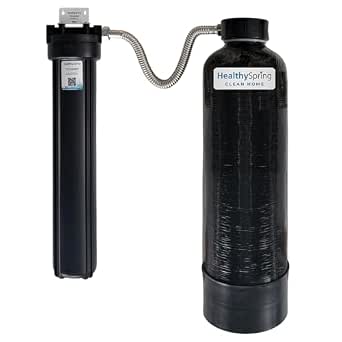 | Best for Chloramine Reduction | Model: HSCH8IO | Media: Catalytic carbon and sediment filtration | Pre-filter: 20-inch, 27-micron | VIEW ON AMAZON | See Our Full Breakdown |
| LiquaGen Whole House Water Filtration System with Catalytic Carbon and KDF 55, 10 x 54 in |  | Best for Larger Homes and Automatic Backwashing | Media: Catalytic carbon and KDF 55 | Tank size: 10 × 54 inches | Recommended home size: 4–6 bathrooms | VIEW ON AMAZON | See Our Full Breakdown |
| Waterdrop WHF21-PG 2-Stage Whole House Water Filter System |  | Best Compact Cartridge System | Filtration stages: 2 | Filter types: PP sediment and GAC activated carbon | Maximum flow rate: 15 GPM | VIEW ON AMAZON | See Our Full Breakdown |
| A. O. Smith AO-WH-Filter Whole House Water Filter System |  | Best Low-Maintenance Carbon Filter | Model: AO-WH-Filter | Purification method: Activated carbon | Chlorine reduction: 96.9% | VIEW ON AMAZON | See Our Full Breakdown |
| iSpring WGB21B 2-Stage Whole House Water Filtration System | 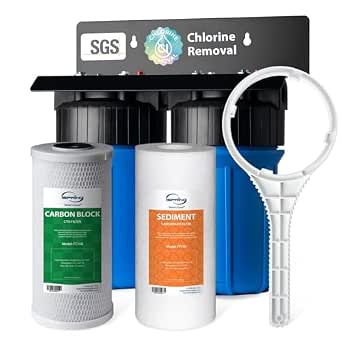 | Best Two-Stage Pick for Family Homes | Filtration stages: 2 | Filter media: 5-micron polypropylene sediment filter and coconut-shell carbon block | Capacity: Up to 50,000 gallons | VIEW ON AMAZON | See Our Full Breakdown |
| Waterdrop WHF3T-PG 3-Stage Whole House Water Filter System, 5 Micron |  | Best Multi-Stage Cartridge Option | Listed filtration stages: 3-stage system; product description also claims 7-stage filtration | Filtration media: Sediment, activated carbon, and KDF | Capacity: Up to 100,000 gallons | VIEW ON AMAZON | See Our Full Breakdown |
| WaterBoss WB-WH-FILTER Whole House Water Filter System, 600,000-Gallon Capacity |  | Best Long-Life Carbon Filter | Filtration method: Activated carbon | Chlorine reduction: Up to 96.9% | Certification: NSF/ANSI Standard 42 | VIEW ON AMAZON | See Our Full Breakdown |
| 3M Aqua-Pure AP904 Whole House Water Filtration System |  | Best for High Flow and Easy Cartridge Changes | Filter media: Activated carbon block and non-woven pleat media | Filter capacity: Up to 100,000 gallons | Recommended replacement: Every 12 months | VIEW ON AMAZON | See Our Full Breakdown |
| Carbon Tank Whole-House Filter System, 1.5 cu. ft. with Fleck 5600 Valve |  | Best Backwashing Tank for Broader Carbon Treatment | Tank capacity: 1.5 cu. ft. | Control valve: Fleck 5600 automatic backwash | Treatment flow rate: 8–12 GPM | VIEW ON AMAZON | See Our Full Breakdown |
| whole house carbon filter system | Maximum flow rate | Dimensions | Capacity | Operating pressure |
|---|---|---|---|---|
| iSpring WGB32B Commercial-Grad | 15 GPM | 24.5 × 8 × 28 inches | 100,000 gallons | 25–80 psi |
| Healthy Spring Clean Home Whol | 7 GPM | 16 × 12 × 29 inches | — | — |
| LiquaGen Whole House Water Fil | 12 GPM | — | — | — |
| Waterdrop WHF21-PG 2-Stage Who | 15 GPM | 14.37 × 7.48 × 15.55 inches | 50,000 gallons | 25–90 psi |
| A. O. Smith AO-WH-Filter Whole | 7 GPM | 30.2 × 9.5 × 9.4 inches | — | 20–100 psi |
| iSpring WGB21B 2-Stage Whole H | 15 GPM | 26 × 19 × 11 inches | Up to 50,000 gallons | Up to 80 psi |
| Waterdrop WHF3T-PG 3-Stage Who | 15 GPM | — | Up to 100,000 gallons | — |
| WaterBoss WB-WH-FILTER Whole H | 14 GPM | 8.75 × 8.75 × 27 inches | Up to 600,000 gallons | 20–100 psi |
| 3M Aqua-Pure AP904 Whole House | 20 GPM | — | — | — |
| Carbon Tank Whole-House Filter | — | — | — | — |
More Details on Our Top Picks
iSpring WGB32B Commercial-Grade Whole House Water Filter System
The iSpring WGB32B is my strongest fit for households that want broad chlorine and sediment filtration without a low flow ceiling. Its three-stage cartridge setup pairs a 5-micron sediment filter with two coconut-shell carbon blocks, and the stated capacity is 100,000 gallons. At up to 15 GPM with 1-inch connections, it has more flow headroom than the Healthy Spring Clean Home and A. O. Smith systems, both rated at 7 GPM. That difference may matter when several fixtures run at once. The tradeoff is more frequent cartridge attention than those higher-capacity tank systems, plus a larger installation footprint. I’d choose it for a busy home on municipal water, but skip it if you want long media intervals or treatment for hardness and dissolved solids.
Pros:- 15 GPM maximum flow and 1-inch ports suit homes with simultaneous water use.
- Three stages combine 5-micron sediment filtration with two carbon block filters.
- Rated for 100,000 gallons, with a stated one-year filter life.
- Individually wrapped cartridges and a housing wrench are included.
Cons:- Cartridge replacement is more involved and likely more frequent than with the 600,000-gallon tank systems.
- The 24.5 × 8 × 28-inch assembly needs dedicated installation space.
- Does not reduce TDS or soften water.
Best for: Households on municipal water that need strong flow for several bathrooms and want cartridge-based sediment and chlorine treatment.
Not ideal for: Buyers seeking water softening, TDS reduction, or long intervals between media replacements; this system does not remove TDS and its stated capacity is lower than several tank options.
- Filtration stages:3
- Filter types:5-micron sediment filter and two coconut-shell carbon block filters
- Maximum flow rate:15 GPM
- Capacity:100,000 gallons
- Inlet/outlet:1-inch NPT
- Operating pressure:25–80 psi
- Temperature range:40–100 °F
- Dimensions:24.5 × 8 × 28 inches
- Included components:System, three filters, housing wrench, and user manual
Our verdict“Choose the iSpring WGB32B if high flow and staged cartridge filtration matter more than long media life or dissolved-solids treatment.”
Healthy Spring Clean Home Whole House Water Filter System
The Healthy Spring Clean Home is aimed at buyers whose municipal supply has chloramine as well as chlorine. Its catalytic carbon media is described as reducing both, while the 20-inch, 27-micron sediment pre-filter catches larger particles before they reach the media. The claimed capacity of up to 600,000 gallons is far beyond the iSpring WGB32B’s 100,000-gallon rating, but flow is the constraint: at 7 GPM, this system offers less headroom for simultaneous showers and appliances than the iSpring’s 15 GPM. It also includes an extra replacement filter, and the media is replaceable rather than requiring a whole new tank. I’d favor it for a moderate-flow home focused on chloramine taste and odor, not a high-demand household.
Pros:- Catalytic carbon is specified for reducing chlorine and chloramines.
- Includes a 20-inch, 27-micron sediment pre-filter and an extra replacement filter.
- Replaceable media avoids replacing the entire system.
- Rated for up to 600,000 gallons under typical conditions.
Cons:- 7 GPM maximum flow may limit performance when multiple fixtures run together.
- Actual media life depends on source-water conditions and household use.
- The provided product details do not specify a reduction percentage or test standard.
Best for: Homeowners on chloraminated municipal water who want catalytic carbon, a sediment pre-filter, and replaceable media with a high stated capacity.
Not ideal for: Large households with several bathrooms in frequent use; its 7 GPM maximum flow is substantially lower than the iSpring WGB32B’s 15 GPM.
- Model:HSCH8IO
- Media:Catalytic carbon and sediment filtration
- Pre-filter:20-inch, 27-micron
- Filter capacity:Up to 600,000 gallons
- Maximum flow rate:7 GPM
- Container type:Fiberglass tank
- Dimensions:16 × 12 × 29 inches
- Included components:Extra replacement filter
Our verdict“Pick this system for chloramine-focused treatment and long stated media capacity if your household can work within its 7 GPM flow limit.”
LiquaGen Whole House Water Filtration System with Catalytic Carbon and KDF 55, 10 x 54 in
For a 4–6 bathroom home, the LiquaGen takes a different approach from cartridge systems such as the Waterdrop WHF21-PG: it uses a media tank with programmable backwashing rather than relying on frequent cartridge changes. Catalytic carbon and KDF 55 are listed for reducing chlorine, chloramine, PFAS, sediment, and VOCs, while the stated service life reaches 10 years or 1 million gallons. Its 12 GPM maximum flow is more generous than the 7 GPM Healthy Spring and A. O. Smith options, though below the 15 GPM ratings of the iSpring and Waterdrop WHF21-PG. The tank arrives preloaded and includes a metal bypass valve, but connecting it to the main line is a more involved installation. The supplied description also gives no test results to support its broad contaminant claims.
Pros:- Catalytic carbon and KDF 55 media are specified for a broad set of municipal-water contaminants.
- Programmable automatic backwashing helps maintain media performance.
- Preloaded tank and 1-inch metal bypass valve are included.
- Designed for 4–6 bathrooms, with a stated 12 GPM flow rate and long service life.
Cons:- Requires connection to the home’s main water line and may call for professional installation.
- The product information provided does not include test results for its PFAS, VOC, or other reduction claims.
- The 10 × 54-inch tank needs more vertical and plumbing space than compact cartridge systems.
Best for: Owners of 4–6 bathroom homes who want a backwashing media tank and are prepared for main-line plumbing installation.
Not ideal for: Renters, DIY beginners avoiding plumbing work, or buyers who need independently documented contaminant reduction results before choosing a system.
- Media:Catalytic carbon and KDF 55
- Tank size:10 × 54 inches
- Recommended home size:4–6 bathrooms
- Maximum flow rate:12 GPM
- Stated filter life:Up to 10 years or 1 million gallons
- Tank material:Fiberglass-reinforced plastic
- Backwashing:Programmable automatic backwash valve
- Bypass valve:1-inch metal
Our verdict“Choose the LiquaGen for a larger home that wants automated backwashing and tank-style media, provided the installation and unverified reduction claims suit your needs.”
Waterdrop WHF21-PG 2-Stage Whole House Water Filter System
The Waterdrop WHF21-PG suits buyers who want a straightforward sediment-and-carbon setup in a smaller package. Its two-stage design combines a 5-micron PP sediment cartridge with coconut-shell GAC, and its 15 GPM maximum flow matches the iSpring WGB32B. At 14.37 × 7.48 × 15.55 inches, it is more compact than the iSpring assembly, but it gives up capacity: the Waterdrop is rated for 50,000 gallons versus 100,000 for the iSpring. Its GAC cartridge may last up to six months, while the sediment cartridge is listed for replacement every 3–6 months, so this is not a low-maintenance tank alternative like the A. O. Smith. I’d pick it for municipal water and limited space, while buyers needing longer service intervals should compare the larger-capacity systems.
Pros:- Compact 14.37 × 7.48 × 15.55-inch housing fits tighter utility areas than the iSpring WGB32B.
- 15 GPM maximum flow supports whole-house use.
- Two stages combine 5-micron sediment filtration and coconut-shell GAC.
- Includes a wrench, with cartridges listed as tested to NSF/ANSI 42 and NSF/ANSI 372 standards.
Cons:- 50,000-gallon capacity is lower than the iSpring WGB32B’s 100,000-gallon rating.
- The sediment cartridge is listed for replacement every 3–6 months, adding ongoing maintenance.
- Manufacturer recommends use with municipal water.
Best for: Homeowners on municipal water who want a compact, high-flow cartridge system for reducing sediment, chlorine, and odors.
Not ideal for: People who want infrequent filter changes or need treatment beyond the listed cartridge targets; the PP cartridge may need replacement every 3–6 months.
- Filtration stages:2
- Filter types:PP sediment and GAC activated carbon
- Maximum flow rate:15 GPM
- Capacity:50,000 gallons
- Filter life:GAC up to 6 months; PP 3–6 months
- Inlet/outlet:1 inch
- Operating pressure:25–90 psi
- Dimensions:14.37 × 7.48 × 15.55 inches
Our verdict“Choose the Waterdrop WHF21-PG when compact size and 15 GPM flow matter more than extended cartridge life.”
A. O. Smith AO-WH-Filter Whole House Water Filter System
The A. O. Smith AO-WH-Filter prioritizes simple chlorine taste-and-odor treatment over broad contaminant coverage. Its activated carbon filter is rated for 96.9% chlorine reduction, and the stated life is up to six years or 600,000 gallons with no backflushing, drainage, or water waste. That makes it less hands-on than the Waterdrop WHF21-PG, whose cartridges are listed for replacement every 3–6 months. The compromise is capacity at the tap: its 7 GPM maximum is less than half the 15 GPM listed for the iSpring WGB32B, so homes with simultaneous high water demand should compare those systems closely. It also does not soften water or reduce TDS, sulfur, or iron. I’d choose it for uncomplicated chlorine reduction, not as an all-purpose treatment solution.
Pros:- Rated to reduce 96.9% of chlorine taste and odor.
- Stated filter life is up to six years or 600,000 gallons.
- Requires no backflushing, drainage, or water waste.
- Includes a shut-off valve, nipple, and hose adapter.
Cons:- 7 GPM maximum flow is lower than the iSpring WGB32B and Waterdrop WHF21-PG.
- Does not soften water or reduce TDS, sulfur, or iron.
- Installation may require additional tools.
Best for: Households seeking a low-maintenance carbon filter for chlorine taste and odor, with no backwashing or drainage and a long stated service life.
Not ideal for: Large or high-demand households needing higher flow, or anyone seeking hardness, TDS, sulfur, or iron reduction.
- Model:AO-WH-Filter
- Purification method:Activated carbon
- Chlorine reduction:96.9%
- Certification:NSF/ANSI 42
- Filter life:Up to 6 years or 600,000 gallons
- Maximum flow rate:7 GPM
- Operating pressure:20–100 psi
- Connections:3/4-inch NPT
- Dimensions:30.2 × 9.5 × 9.4 inches
Our verdict“Pick the A. O. Smith for long-life, low-maintenance chlorine reduction if 7 GPM is enough and you do not need softening or broader contaminant treatment.”
iSpring WGB21B 2-Stage Whole House Water Filtration System
The iSpring WGB21B pairs a 5-micron sediment filter with a coconut-shell carbon block, so it targets grit and rust before reducing chlorine and VOCs. Its stated 50,000-gallon capacity and 15 GPM flow rate suit a family seeking point-of-entry carbon treatment without a powered control head. Compared with the 3M Aqua-Pure AP904, it offers two replaceable stages rather than a single quick-change cartridge, but the 3M has a higher stated flow rate and adds scale reduction. This iSpring also retains minerals; it is not a TDS-reduction system, so it will not address dissolved salts. The tradeoff is space: at 26 by 19 by 11 inches, it needs a roomy installation area, and its filters call for regular replacement.
Pros:- Two stages separate sediment capture from carbon treatment.
- Rated for up to 50,000 gallons and a 15 GPM flow rate.
- Retains healthy minerals rather than targeting TDS.
- Includes an installation bracket and filter wrench; no power connection is needed.
Cons:- Does not reduce total dissolved solids.
- Its listed dimensions require substantial installation clearance.
- Filter replacement is required about every 12 months.
Best for: Families wanting sediment and chlorine filtration at the main water line while keeping naturally occurring minerals and avoiding an electrically powered system.
Not ideal for: Homes with limited space near the main line or buyers seeking TDS reduction, scale treatment, or a compact cartridge-change setup.
- Filtration stages:2
- Filter media:5-micron polypropylene sediment filter and coconut-shell carbon block
- Capacity:Up to 50,000 gallons
- Filter life:Up to 12 months
- Maximum flow rate:15 GPM
- Inlet and outlet:1 inch
- Operating pressure:Up to 80 psi
- Dimensions:26 × 19 × 11 inches
Our verdict“Choose the WGB21B if you want a mineral-retaining, two-stage carbon system for a family home and have room for its larger housing.”
Waterdrop WHF3T-PG 3-Stage Whole House Water Filter System, 5 Micron
The Waterdrop WHF3T-PG uses sediment, activated carbon, and KDF filtration, making it a choice for households that want several treatment media in one whole-house unit. The supplied cartridges and installation hardware make setup more straightforward than the Carbon Tank Whole-House Filter with Fleck 5600, which uses a larger backwashing tank and control valve. Waterdrop lists 15 GPM flow and a 100,000-gallon capacity, though actual cartridge life depends on incoming water quality. There is a data wrinkle: the listing describes a three-stage system but also claims seven-stage filtration, so I would verify the exact configuration before purchase. Its 40°F minimum operating temperature also rules out unprotected spaces that can get colder, and NSF/ANSI 372 is a materials standard, not proof of contaminant-reduction performance.
Pros:- Combines sediment, activated carbon, and KDF media.
- Listed maximum flow rate of 15 GPM with 1-inch connections.
- Includes three cartridges, a wrench, and installation hardware.
- Designed for both well and municipal water.
Cons:- The description conflicts on whether filtration is three or seven stages.
- Cartridge life varies with source-water quality.
- Its stated operating range starts at 40°F, limiting cold-location installations.
Best for: Homeowners on municipal or well water who want supplied sediment, carbon, and KDF cartridges in a multi-stage whole-house setup.
Not ideal for: Buyers needing clear, independently stated filtration claims, a system for freezing-prone spaces, or a backwashing carbon tank.
- Listed filtration stages:3-stage system; product description also claims 7-stage filtration
- Filtration media:Sediment, activated carbon, and KDF
- Capacity:Up to 100,000 gallons
- Filter life:Advertised up to 12 months; varies with water quality
- Maximum flow rate:15 GPM
- Inlet and outlet:1 inch
- Operating temperature:40–100°F
- Certification:NSF/ANSI 372
Our verdict“Pick the WHF3T-PG if you want a supplied multi-media cartridge system and can confirm the stage configuration and fit for your water.”
WaterBoss WB-WH-FILTER Whole House Water Filter System, 600,000-Gallon Capacity
The WaterBoss WB-WH-FILTER is the clearest fit here for buyers who want a long interval between carbon-filter replacements: it is rated for 600,000 gallons or six years. Its activated carbon is aimed at chlorine, taste, and odor, with a stated reduction of up to 96.9% and NSF/ANSI 42 certification. Compared with the iSpring WGB21B, WaterBoss favors a single long-life tank over two replaceable stages, while iSpring adds a dedicated sediment cartridge. WaterBoss supports up to 14 GPM, slightly below several cartridge alternatives, and recommends a pre-filter, which adds equipment and maintenance. It is a focused carbon choice, not a broad contaminant-treatment system; buyers should match the stated chlorine-related claims to their water report rather than assume it treats every concern.
Pros:- Rated for up to 600,000 gallons and six years of filter life.
- NSF/ANSI Standard 42 certified.
- States up to 96.9% reduction of chlorine, taste, and odor.
- Filters water for the whole home with a compact 8.75-inch tank width.
Cons:- A pre-filter is recommended, adding another component to maintain.
- Maximum listed flow rate is 14 GPM, below the 3M Aqua-Pure AP904’s 20 GPM.
- Its stated treatment focus is narrower than multi-stage systems with dedicated sediment filtration.
Best for: Homeowners seeking a certified chlorine, taste, and odor reduction system with a long stated service interval and enough room for a point-of-entry tank.
Not ideal for: Households needing dedicated sediment stages, higher flow than 14 GPM, or treatment beyond the product’s stated carbon claims.
- Filtration method:Activated carbon
- Chlorine reduction:Up to 96.9%
- Certification:NSF/ANSI Standard 42
- Capacity:Up to 600,000 gallons
- Filter life:Up to 6 years
- Maximum flow rate:14 GPM
- Operating pressure:20–100 psi
- Dimensions:8.75 × 8.75 × 27 inches
Our verdict“Choose WaterBoss if long service intervals and certified chlorine-related reduction matter more than multi-stage treatment or maximum flow.”
3M Aqua-Pure AP904 Whole House Water Filtration System
The 3M Aqua-Pure AP904 stands apart for a listed 20 GPM flow rate and a Sanitary Quick Change cartridge that replaces without tools. Its carbon block and non-woven pleat media target chlorine taste and odor, sediment, and scale, giving it a broader stated role than the carbon-focused WaterBoss WB-WH-FILTER. The stainless-steel head and connections also make this a strong fit where a durable point-of-entry assembly matters. The tradeoff is a 100,000-gallon capacity with a recommended annual cartridge change, far shorter than WaterBoss’s stated six-year interval. Installation may call for a plumbing professional, so the convenient cartridge swap does not necessarily make the initial setup a DIY job. Its NSF/ANSI 42 and 372 testing should not be read as certification for every reduction claim.
Pros:- Listed maximum flow rate of 20 GPM.
- Sanitary Quick Change cartridge supports tool-free replacement.
- Targets sediment, chlorine taste and odor, and scale.
- 304 stainless-steel head and 1-inch stainless-steel connections.
Cons:- Recommended cartridge replacement is about every 12 months.
- Capacity is 100,000 gallons, well below the WaterBoss system’s stated capacity.
- Initial installation may require a plumbing professional.
Best for: Households with high simultaneous water demand that want strong stated flow, scale reduction, and tool-free annual cartridge changes.
Not ideal for: Buyers prioritizing the longest interval between replacements or those who need a simple installation without plumbing help.
- Filter media:Activated carbon block and non-woven pleat media
- Filter capacity:Up to 100,000 gallons
- Recommended replacement:Every 12 months
- Maximum flow rate:20 GPM
- Connections:1-inch stainless steel inlet and outlet
- Head material:304 stainless steel
- Testing:Tested to NSF/ANSI Standards 42 and 372
- Installation type:Point-of-entry whole-house system
Our verdict“Choose the AP904 if household flow and straightforward cartridge changes outweigh annual replacement and installation demands.”
Carbon Tank Whole-House Filter System, 1.5 cu. ft. with Fleck 5600 Valve
This 1.5 cu. ft. carbon tank is the most involved option in this group, but it also offers a different maintenance approach: an automatic Fleck 5600 backwash valve cleans the media rather than relying on small annual cartridges. The coconut-shell carbon is described as reducing chlorine, chloramines, pesticides, sediment, tastes, and odors. That makes it a broader treatment proposition than the WaterBoss WB-WH-FILTER, whose stated focus is chlorine, taste, and odor, though WaterBoss has a far higher stated capacity and a six-year service interval. This tank’s treatment flow is listed at 8–12 GPM, so it may be a poor match for homes with heavy concurrent demand. It ships in separate boxes and needs more planning for installation than cartridge units; buyers should also confirm the claimed contaminant reductions against their water needs.
Pros:- Coconut-shell carbon is described for chlorine, chloramines, pesticides, sediment, tastes, and odors.
- Automatic Fleck 5600 backwashing helps clean the filter media.
- Includes a stainless-steel bypass valve for servicing.
- Includes a 10-year tank warranty and 5-year valve warranty.
Cons:- Listed treatment flow of 8–12 GPM is lower than the 3M Aqua-Pure AP904.
- Separate-box shipping and tank setup make installation less straightforward than cartridge systems.
- The product data does not provide a gallon capacity or filter-life interval.
Best for: Homeowners who want a backwashing carbon tank, have space for a larger point-of-entry setup, and need a system described for chloramines as well as chlorine.
Not ideal for: High-demand households needing flow above 12 GPM, buyers seeking a compact DIY cartridge system, or anyone unable to manage a more involved tank installation.
- Tank capacity:1.5 cu. ft.
- Control valve:Fleck 5600 automatic backwash
- Treatment flow rate:8–12 GPM
- Filter media:Coconut-shell activated carbon
- Included components:Tank, riser tube, control head, media, and stainless-steel bypass valve
- Valve warranty:5 years
- Tank warranty:10 years
Our verdict“Pick this tank if you want automatic backwashing and the stated broader carbon-treatment scope, and your home’s flow needs fit its 8–12 GPM range.”

How We Picked
I ranked these systems by how well their treatment design matches whole-house use, how clearly the product format supports ongoing ownership, and how much flexibility a buyer gets for different household needs. I compared stage count and media type, stated capacity or service-life details where provided, installation format, and the likely maintenance burden. I gave more weight to a credible fit for common municipal-water concerns than to a long feature list by itself.
The order reflects practical differences rather than a claim that one filter removes every contaminant. The iSpring WGB32B leads as a broadly adaptable cartridge system; the LiquaGen tank model earns a distinct place for buyers seeking catalytic carbon and KDF media; and the Waterdrop and other cartridge systems offer alternatives with different stage counts and upkeep. Models with a narrower use case rank lower for general buyers, not because they are inherently poor choices. I would verify current specifications, certifications, flow limits, and replacement media availability before purchase.
| whole house carbon filter system | Filter life |
|---|---|
| iSpring WGB32B Commercial-Grad | — |
| Healthy Spring Clean Home Whol | — |
| LiquaGen Whole House Water Fil | — |
| Waterdrop WHF21-PG 2-Stage Who | GAC up to 6 months; PP 3–6 months |
| A. O. Smith AO-WH-Filter Whole | Up to 6 years or 600,000 gallons |
| iSpring WGB21B 2-Stage Whole H | Up to 12 months |
| Waterdrop WHF3T-PG 3-Stage Who | Advertised up to 12 months; varies with water quality |
| WaterBoss WB-WH-FILTER Whole H | Up to 6 years |
| 3M Aqua-Pure AP904 Whole House | — |
| Carbon Tank Whole-House Filter | — |
Factors to Consider When Choosing Whole House Carbon Filter System
Choosing a whole-house carbon filter starts with the water you have and the result you want—not the number of stages on the product page. These factors can help you narrow the field before comparing particular models.
1. Start With a Water Test and a Specific Goal
Municipal water and private-well water can call for very different treatment plans. A municipal report can help identify disinfectants such as chlorine, while a laboratory test is a better starting point for a private well. Carbon is commonly used for taste, odor, and certain chemical reduction claims, but it does not make water safe from every biological or inorganic contaminant. Match the test results to the exact reduction claims and certifications for the filter you are considering. A common mistake is buying a whole-house carbon system to address hardness, iron, or bacteria without checking whether it is designed for that job. If your concern falls outside the product’s stated scope, plan for a separate treatment stage or a different system.
2. Compare Treatment Claims, Not Stage Counts
A two-stage system can be a better match than a three-stage one when its media and claims fit your water issue. Extra stages may add sediment protection or another treatment media, but they can also add replacement parts and make maintenance less simple. Read which contaminants a system claims to reduce and whether those claims have independent certification. Pay attention to the exact model and cartridge combination, since certification for one component may not cover the complete system. Avoid assuming that words such as “commercial-grade” or “whole house” describe a tested reduction level. Choose based on documented performance for your concern, then use stage count as a secondary comparison.
3. Size for Peak Flow, Not Just Household Size
A filter may serve a home adequately during light use but restrict pressure when showers, laundry, and kitchen taps run together. Check the rated flow and pressure limits against the plumbing and the number of fixtures likely to be used at once. Larger homes and households with high simultaneous demand should pay close attention to connection size and the manufacturer’s flow guidance. A bigger media tank is not automatically the right answer if its valve or plumbing connections do not match the installation. Ask an installer to assess pressure loss if the system will serve a complex or high-demand home. This check can prevent a filter choice from becoming a daily comfort issue.
4. Choose a Maintenance Format You Will Keep Up With
Cartridge systems generally require scheduled cartridge replacement, while media-tank systems follow a different service and media-replacement routine. Neither format is maintenance-free, and the practical workload depends on the water’s sediment load and the manufacturer’s schedule. Before buying, confirm that replacement cartridges or media are available and identify what tools or plumbing access servicing requires. A low-maintenance promise can be misleading if the system’s service interval is unclear or replacement parts are hard to source. If you prefer a predictable DIY task, a cartridge setup may be easier to understand; if you prefer a tank format, verify the valve and service requirements first. Build maintenance into the ownership decision rather than treating it as an afterthought.
5. Check Installation Space and Plumbing Compatibility
Whole-house filters are installed on the main water line, so location affects access, freeze protection, drainage needs, and room for future service. Multi-canister systems can require vertical clearance to remove housings, while large media tanks need a stable footprint and suitable clearance around the control valve. Check pipe diameter, connection type, and whether a bypass valve is included or needs to be added. A bypass makes service easier and can help keep water available while the unit is offline, but it does not replace correct installation. Buyers should also confirm whether local plumbing rules call for a licensed installer. A system that fits the treatment goal but not the available space is the wrong system for that home.
6. Know When to Pay More—and When Not To
Paying more can make sense when it buys a media type suited to a measured contaminant, greater capacity for household demand, or a service design that fits your maintenance preferences. It is less useful to pay for extra stages or a larger system without evidence that your water or flow needs call for them. Compare the total ownership picture: installation, replacement cartridges or media, and service access all affect long-term value. A basic carbon unit may be sufficient for a taste-and-odor concern on treated municipal water, while a well-water household may need a tailored treatment train. Do not treat capacity figures as a direct prediction of service life; source-water conditions and usage can change the result. Spend on the verified need, not on the longest feature list.
Frequently Asked Questions
Can a whole-house carbon filter make untreated well water safe to drink?
Not by itself in every case. Carbon can reduce certain substances when the specific system is designed and tested for them, but it is not a universal treatment for bacteria, viruses, nitrates, hardness, or all metals. Start with a laboratory test and compare the findings with the filter’s exact certified reduction claims. A well may need disinfection, sediment treatment, or other equipment alongside carbon. If contamination is present, follow local health guidance before relying on a filtration system.
Should I choose a carbon tank or a cartridge-based system?
The choice depends on the treatment media, household flow, available space, and the maintenance routine you prefer. Cartridge systems such as the iSpring and Waterdrop options use replaceable elements, which makes the service task clear but requires keeping the correct cartridges on hand. Tank systems such as the LiquaGen and Fleck-valve pick use a media vessel and have different service needs. Compare the stated contaminant claims and flow requirements before choosing by format alone. Ask about media replacement intervals and parts access so the system remains practical after installation.
Will a whole-house carbon filter reduce water pressure?
Any filter can create some pressure loss, and the amount depends on the system’s design, flow rate, plumbing, and condition. A clogged cartridge or undersized unit can make the effect more noticeable, especially when several fixtures run at once. Check the manufacturer’s rated flow and pressure specifications against your household’s peak use rather than relying only on bedroom count. If pressure is already marginal, have a plumber review the installation and line size. Routine maintenance also helps prevent avoidable restriction.
Do I need a sediment prefilter before a whole-house carbon system?
A sediment prefilter can protect downstream carbon media or cartridges when water carries visible particles, rust, or silt. Whether it is necessary depends on the source water and the design of the chosen system; some options already include a sediment stage. A well-water test and inspection can help determine whether sediment is a recurring issue. Adding a prefilter without a reason creates another component to service, while skipping needed sediment protection may shorten the life of the carbon stage. Follow the system manufacturer’s installation guidance and test your water before adding stages.
How can I tell whether a filter’s contaminant claims are trustworthy?
Look for independent certification that names the exact system or filter configuration and the specific contaminant reduction being claimed. A general statement about carbon, a marketing label, or certification of a single component does not prove that every system configuration performs the same way. Check the certification organization’s listing and confirm that the model number matches. Also compare the rated service conditions with your water quality and household use. When the claim is unclear, contact the manufacturer for the performance data rather than assuming the system addresses your concern.
Conclusion
For most buyers seeking a versatile cartridge setup, I would start with the iSpring WGB32B as best overall; its three-stage design makes it a stronger broad-use starting point than the simpler WGB21B. The Waterdrop WHF21-PG is my value-oriented pick for households that want a two-stage format without the added complexity of a third stage, while the Waterdrop WHF3T-PG suits buyers who specifically want a three-stage configuration. For buyers prioritizing a tank format and catalytic carbon with KDF media, the LiquaGen is the premium-style choice in this lineup; verify that its claims match your water and that its footprint works. Beginners who want a more straightforward brand-name option can compare the A. O. Smith AO-WH-Filter and 3M Aqua-Pure AP904. If your needs center on a large media tank or a particular valve setup, consider the Fleck 5600 carbon tank system. Before ordering any pick, confirm water-test results, flow needs, fit, and replacement-part availability.
Cold & flu season Picks
humidifiers
As an affiliate, we earn on qualifying purchases.