A whole house water filter system treats water where it enters your home, so filtered water can reach multiple taps and appliances. My best overall pick is the HQUA WF3-01, a three-stage option for households looking for broader filtration in one setup. The A. O. Smith AO-WH-Filter is a simpler alternative, while the iSpring WGB32BM is aimed at homes dealing with iron and manganese. The main tradeoff is choosing between targeted treatment, broader multi-stage filtration, and the space and upkeep a larger system brings. Read on for the full comparison and guidance on matching a system to your water and plumbing.

Get home appliances delivered free with Prime
- Fast, free delivery on millions of items
- Prime Video, Amazon Music and more included
- Member-only deals all year
Complete the kit



Key Takeaways
- The lineup splits by treatment goal: sediment-focused models such as the Culligan WH-S200-C and GE GXWH20T are simpler than multi-stage systems designed to address a wider range of concerns.
- Three stages do not mean the same thing across brands: HQUA WF3-01, iSpring WGB32BM, and iSpring WGB32B use different configurations, so buyers should check what each cartridge is intended to reduce.
- Iron and manganese call for a targeted choice: iSpring WGB32BM is the clearest fit in this group for those specific concerns, rather than a general-purpose filter.
- Automatic flushing and treatment add-ons change ownership needs: iSpring’s auto-flush option and Aquasana Rhino’s UV and salt-free scale control bring capabilities beyond basic cartridge filtration, along with more system complexity.
- Housing size affects installation as much as filtration: VEVOR’s 4.5 x 20-inch format and other multi-stage setups need more space than a compact sediment housing, so measure the installation area before choosing.
| HQUA WF3-01 3-Stage Whole House Water Filtration System | 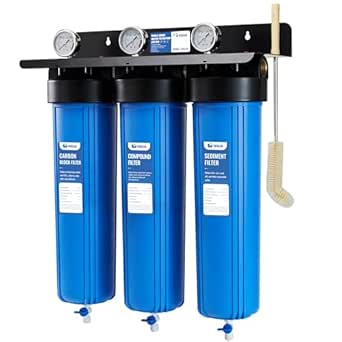 | Best for Broad, Monitored Filtration | Model: WF3-01 | Filtration stages: 3 | Filter dimensions: 20 × 5.5 inches each | VIEW ON AMAZON | See Our Full Breakdown |
| A. O. Smith AO-WH-Filter Whole House Water Filter System |  | Best for Long-Life Chlorine Reduction | Model: AO-WH-Filter | Purification method: Activated carbon | Chlorine reduction: 96.9% | VIEW ON AMAZON | See Our Full Breakdown |
| iSpring Ultimate Whole House Water Filter System with Auto-Flush Sediment Filter |  | Best for Scale and Sediment Management | Filtration capacity: Up to 250,000 gallons | Maximum flow rate: 15 GPM | Inlet/outlet size: 1 in NPT | VIEW ON AMAZON | See Our Full Breakdown |
| Waterdrop WHF21-PG 2-Stage Whole House Water Filter System |  | Best Compact Pick for Municipal Water | Filtration stages: 2-stage system; described as 5-stage filtration | Filter size: 10 × 4.5 inches | Maximum flow rate: 15 gpm | VIEW ON AMAZON | See Our Full Breakdown |
| VEVOR 3-Stage Whole House Water Filter System, 4.5 x 20 in |  | Best for High-Flow Three-Stage Filtration | Filtration stages: 3: sediment, KDF, and activated carbon | Cartridge size: 4.5 × 20 inches | Maximum flow rate: 15 GPM | VIEW ON AMAZON | See Our Full Breakdown |
| Culligan WH-S200-C Whole House Sediment Water Filter System with P5 Cartridge |  | Best for Basic Sediment Protection | Model: WH-S200-C | Included cartridge: P5 | Filtration method: Sedimentation | VIEW ON AMAZON | See Our Full Breakdown |
| Express Water Ultimate Protection 3-Stage Whole House Water Filter System |  | Best for High Flow and Multi-Stage Treatment | Model: WH300SCKP-S | Filtration stages: 3 | Pre-filter: Reusable 50-micron sediment filter | VIEW ON AMAZON | See Our Full Breakdown |
| iSpring WGB32BM 3-Stage Whole-House Water Filter System for Iron and Manganese |  | Best for Iron and Manganese | Model: WGB32BM | Filtration stages: 3 | Maximum iron reduction: 3.0 ppm | VIEW ON AMAZON | See Our Full Breakdown |
| GE Whole House Water Filtration System with Installation Kit – Model GXWH20T |  | Best Beginner-Friendly Installation Kit | Model: GXWH20T | Filtration purpose: Whole-house pre-filtration for sediment, rust, and other impurities | Plumbing connection: 3/4 inch | VIEW ON AMAZON | See Our Full Breakdown |
| iSpring WGB21B 2-Stage Whole House Water Filtration System, 50,000 Gallons | 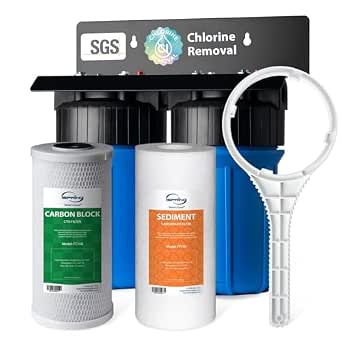 | Best for Simple Sediment and Chlorine Filtration | Filtration stages: 2 | Sediment filter: 5-micron polypropylene | Carbon filter: CTO carbon block | VIEW ON AMAZON | See Our Full Breakdown |
| Aquasana Rhino Whole House Water Filter System with UV, Salt-Free Scale Control, and Pro Kit |  | Best for Broad Treatment | Model: WH-1000-CS-UVS-B | Maximum flow rate: 14.6 gpm | Filtration media: Carbon and copper-zinc KDF | VIEW ON AMAZON | See Our Full Breakdown |
| iSpring WGB32B 3-Stage Whole House Water Filter System |  | Best for DIY Chlorine Reduction | Filtration stages: 3 | Filter types: 5-micron sediment filter and two CTO carbon block filters | Filter size: 20 × 4.5 inches | VIEW ON AMAZON | See Our Full Breakdown |
| whole house water filter system | Maximum flow rate | Model | Filtration stages | Capacity |
|---|---|---|---|---|
| HQUA WF3-01 3-Stage Whole Hous | 15 gpm | WF3-01 | 3 | 100,000 gallons |
| A. O. Smith AO-WH-Filter Whole | 7 gpm | AO-WH-Filter | — | 600,000 gallons |
| iSpring Ultimate Whole House W | 15 GPM | — | — | — |
| Waterdrop WHF21-PG 2-Stage Who | 15 gpm | — | 2-stage system; described as 5-stage filtration | 50,000 gallons |
| VEVOR 3-Stage Whole House Wate | 15 GPM | — | 3: sediment, KDF, and activated carbon | 100,000 gallons |
| Culligan WH-S200-C Whole House | 4 gpm | WH-S200-C | — | 16,000 gallons |
| Express Water Ultimate Protect | 17 gpm | WH300SCKP-S | 3 | Up to 100,000 gallons |
| iSpring WGB32BM 3-Stage Whole- | 15 gpm | WGB32BM | 3 | — |
| GE Whole House Water Filtratio | — | GXWH20T | — | — |
| iSpring WGB21B 2-Stage Whole H | 15 gpm | — | 2 | Up to 50,000 gallons |
| Aquasana Rhino Whole House Wat | 14.6 gpm | WH-1000-CS-UVS-B | — | — |
| iSpring WGB32B 3-Stage Whole H | 15 GPM | — | 3 | — |
More Details on Our Top Picks
HQUA WF3-01 3-Stage Whole House Water Filtration System
The HQUA WF3-01 is a fit for buyers who want several treatment stages and built-in reminders for upkeep. Its three-stage setup is described as reducing sediment, chlorine, heavy metals, odors, and other chemicals, while the pressure gauges and 180-day timers give you practical cues for checking system condition and filter changes. Its 15-gpm maximum flow rate matches the VEVOR system, but HQUA includes service valves, a housing brush, and pipe adapters that support maintenance and installation flexibility.
The tradeoff is physical: at 44 pounds with 20-inch filters and a 31-inch overall span, it needs a roomy installation location. Its listed installation type is under sink, so buyers should verify that the intended plumbing layout and space suit a whole-house application. Unlike the A. O. Smith carbon unit, this is not a simple, long-life single-filter approach; it requires periodic cartridge changes.
Pros:- Three stages are described as reducing sediment, chlorine, heavy metals, odors, and other chemicals.
- Pressure gauges and 180-day timers help track system condition and filter service intervals.
- Includes service valves, a housing brush, pressure relief and drain valves, and pipe fittings.
- Maximum flow rate is listed at 15 gpm.
Cons:- Large housings and a 44-pound weight call for substantial installation space and support.
- Filter cartridges need periodic replacement.
- Listed under-sink installation and large overall dimensions merit a careful fit check before purchase.
Best for: Homeowners seeking several filtration stages, visible pressure monitoring, and included maintenance accessories who have adequate installation space.
Not ideal for: People with a tight utility area or buyers who want a low-maintenance, long-life carbon filter with fewer cartridges to replace.
- Model:WF3-01
- Filtration stages:3
- Filter dimensions:20 × 5.5 inches each
- Overall dimensions:31 × 23 × 8 inches
- Maximum flow rate:15 gpm
- Operating pressure range:25–116 psi
- Capacity:100,000 gallons
- Purification methods:Carbon block and ion exchange
Our verdict“Choose the HQUA if you want multi-stage treatment with built-in maintenance cues and have room for its large housings.”
A. O. Smith AO-WH-Filter Whole House Water Filter System
The A. O. Smith AO-WH-Filter takes a simpler route than the HQUA WF3-01: its activated carbon filter focuses on chlorine taste and odor rather than offering several treatment stages. The stated chlorine reduction is 96.9%, and the unit is rated for up to 600,000 gallons or six years, which can mean fewer routine cartridge changes than systems such as the Waterdrop WHF21-PG. It filters water for drinking, cooking, bathing, and showering, and does not require backwashing, drainage, or water waste.
That simplicity comes with clear limits. Its 7-gpm maximum flow rate is lower than the 15-gpm ratings listed for HQUA and VEVOR. It also does not soften water or reduce TDS, sulfur, or iron, so it is a poor match when those are the main concerns. The 40–90 °F temperature range is another constraint to check against the installation location.
Pros:- Rated to reduce 96.9% of chlorine taste and odor.
- Capacity is listed as up to 600,000 gallons or six years.
- No backwashing, drain line, or water waste is required.
- Includes a shut-off valve, nipple, and hose adapter.
Cons:- Does not soften water or reduce TDS, sulfur, or iron.
- The 7-gpm maximum flow rate is lower than the 15-gpm HQUA and VEVOR systems.
- Installation may require additional tools.
Best for: Households on municipal water that mainly want whole-house chlorine taste and odor reduction with infrequent filter service.
Not ideal for: Buyers who need water softening, TDS, sulfur, or iron reduction, or households with high simultaneous water demand.
- Model:AO-WH-Filter
- Purification method:Activated carbon
- Chlorine reduction:96.9%
- Capacity:600,000 gallons
- Filter life:Up to 6 years
- Maximum flow rate:7 gpm
- Connection:3/4 in NPT
- Certification:NSF/ANSI 42
Our verdict“Pick the A. O. Smith for long-life chlorine reduction if its limited treatment scope and 7-gpm flow rating fit your home.”
iSpring Ultimate Whole House Water Filter System with Auto-Flush Sediment Filter
The iSpring Ultimate earns its place for households concerned about sediment, scale buildup, and corrosion alongside chlorine and listed metals. Its three stages combine sediment filtration, carbon filtration, and scale inhibition, while a reusable sediment filter with a touchscreen auto-flush module offers a different maintenance approach from the replaceable cartridges in the Waterdrop WHF21-PG. At up to 15 GPM, it also has a higher stated flow ceiling than the A. O. Smith AO-WH-Filter.
The distinction between scale control and softening matters: this system does not remove calcium or magnesium, and it does not remove total dissolved solids. Its 250,000-gallon capacity is also below the A. O. Smith’s stated 600,000 gallons. At 66.7 pounds and 25 × 22 × 17 inches, it demands sturdy, usable installation space; the one-year warranty is shorter than the A. O. Smith’s six-year limited warranty.
Pros:- Combines sediment filtration, carbon filtration, and scale inhibition.
- Described as reducing chlorine, lead, mercury, and other listed contaminants.
- Reusable sediment filter and touchscreen auto-flush module can reduce routine sediment cartridge handling.
- DIY installation and a maximum flow rate of 15 GPM are specified.
Cons:- Does not remove TDS or calcium and magnesium, so it is not a water softener.
- The 66.7-pound unit requires substantial space and secure support.
- One-year warranty is shorter than the six-year limited warranty listed for the A. O. Smith system.
Best for: Homeowners who want sediment and carbon filtration plus scale-inhibition support, with a reusable auto-flush sediment filter.
Not ideal for: People seeking softened water, TDS removal, a lightweight compact unit, or a longer stated warranty.
- Filtration capacity:Up to 250,000 gallons
- Maximum flow rate:15 GPM
- Inlet/outlet size:1 in NPT
- Cartridge size:20 × 4.5 inches
- Purification methods:Carbon block, sedimentation, and scale inhibition
- Maximum supported TDS:300 ppm
- Dimensions:25 × 22 × 17 inches
- Warranty:1 year
Our verdict“Choose the iSpring Ultimate if scale inhibition and reusable sediment flushing matter more than softening, TDS removal, or a compact footprint.”
Waterdrop WHF21-PG 2-Stage Whole House Water Filter System
The Waterdrop WHF21-PG is the most space-conscious choice here, with a 14.37 × 7.48 × 15.55-inch body that is far smaller than the HQUA WF3-01 or VEVOR three-stage systems. Its PP sediment and coconut-shell GAC filters target particles larger than 5 microns, chlorine, and issues affecting taste and odor. A 15-gpm maximum flow rate gives it the same listed flow ceiling as those larger units, while its wrench and power-free operation keep the setup relatively straightforward.
Compactness does not mean less maintenance: the GAC cartridge is listed for six months and the PP filter for three to six months, and capacity is 50,000 gallons, below the 100,000-gallon HQUA and VEVOR systems. The product is recommended for municipal water, so buyers with a different source should check suitability. Its testing and cartridge standards are also specific: SGS tested to NSF/ANSI 42, with cartridges meeting NSF/ANSI 372 lead-free standards.
Pros:- Compact dimensions suit tighter installation areas than the HQUA WF3-01 and VEVOR systems.
- Sediment and coconut-shell GAC stages target particles larger than 5 microns, chlorine, taste, and odor.
- Listed maximum flow rate is 15 gpm.
- Requires no power and includes a wrench for installation and filter replacement.
Cons:- The 50,000-gallon capacity is lower than the HQUA and VEVOR systems’ listed 100,000 gallons.
- Filter service intervals are relatively short: three to six months for PP and six months for GAC.
- Recommended for municipal water, which may limit fit for households using other sources.
Best for: Homeowners on municipal water who have limited installation space and want sediment and chlorine taste-and-odor filtration.
Not ideal for: Households seeking long cartridge intervals, a 100,000-gallon capacity, or a system recommended for non-municipal water sources.
- Filtration stages:2-stage system; described as 5-stage filtration
- Filter size:10 × 4.5 inches
- Maximum flow rate:15 gpm
- Capacity:50,000 gallons
- Filter life:GAC: 6 months; PP: 3–6 months
- Operating pressure range:25–90 psi
- Inlet/outlet:1 inch
- Dimensions:14.37 × 7.48 × 15.55 inches
Our verdict“Pick the Waterdrop when installation space is tight and municipal-water sediment and chlorine reduction are the main goals.”
VEVOR 3-Stage Whole House Water Filter System, 4.5 x 20 in
The VEVOR is a straightforward choice for buyers who prioritize three-stage treatment and a 15-gpm flow rating. Its sediment, KDF, and activated-carbon filters are described as targeting rust, sand, chlorine, heavy metals, and odors. That gives it a broader stage mix than the two-stage Waterdrop WHF21-PG, while its 100,000-gallon capacity is double Waterdrop’s listed capacity. The pressure gauge helps monitor system pressure, and the supplied wrench supports cartridge changes.
Those advantages come in a large package: the unit measures 22.6 × 9.8 × 31.5 inches and weighs 48.9 pounds. It can be wall-mounted or floor-standing, but either option needs room and suitable support. Its six-to-12-month filter life means recurring maintenance, unlike the A. O. Smith AO-WH-Filter’s stated life of up to six years. Buyers should also plan around the listed 1-inch NPT connections.
Pros:- Sediment, KDF, and activated-carbon stages target rust, sand, chlorine, heavy metals, and odors.
- Listed 15-GPM maximum flow rate matches the HQUA and Waterdrop systems.
- Capacity is listed at 100,000 gallons.
- Includes a pressure gauge and filter wrench, with wall-mounted or floor-standing installation options.
Cons:- Large dimensions and a 48.9-pound weight demand installation space and adequate support.
- Filters require replacement every six to 12 months.
- The 1-inch NPT connection size may not match every home’s existing plumbing without adaptation.
Best for: Households wanting a 15-gpm, three-stage system with a pressure gauge and space for a large wall-mounted or floor-standing unit.
Not ideal for: People with limited utility-room space or buyers who prefer long filter intervals and fewer cartridge changes.
- Filtration stages:3: sediment, KDF, and activated carbon
- Cartridge size:4.5 × 20 inches
- Maximum flow rate:15 GPM
- Capacity:100,000 gallons
- Filter life:6–12 months
- Connection size:1 in NPT
- Dimensions:22.6 × 9.8 × 31.5 inches
- Installation:Wall-mounted or floor-standing
Our verdict“Choose VEVOR for high-flow, three-stage filtration and a 100,000-gallon capacity if you can accommodate its large frame and recurring filter service.”
Culligan WH-S200-C Whole House Sediment Water Filter System with P5 Cartridge
I’d choose the Culligan WH-S200-C when the main goal is catching dirt, sand, and silt before they reach household plumbing and appliances. Its clear housing lets you see sediment buildup, while the bypass shut-off and pressure relief button make cartridge changes more manageable. Compared with the GE GXWH20T, Culligan includes a P5 cartridge and gives a stated flow rate, but its 4 gpm limit is a major constraint for homes running several fixtures at once. This is a sediment pre-filter, not a broad contaminant treatment system: it does not offer the chlorine, heavy-metal, or scale-focused stages found in the Express Water WH300SCKP-S. I’d skip it if you need high whole-home flow or filtration beyond sediment.
Pros:- Reduces dirt, sand, and silt throughout the home.
- Clear housing makes cartridge condition visible.
- Bypass shut-off and pressure relief button simplify cartridge changes.
- Includes a P5 cartridge and supports several compatible cartridge types.
Cons:- The 4 gpm maximum flow rate may restrict simultaneous household water use.
- Requires compatible replacement cartridges rather than a universal filter.
- Sediment filtration alone does not address chlorine, heavy metals, or scale.
Best for: Homeowners seeking a simple sediment filter to protect plumbing and appliances in a low-flow or modest-demand household.
Not ideal for: Large households that run multiple showers or water-using appliances at once, because the stated maximum flow is 4 gpm; also unsuitable as a stand-alone solution for chlorine or dissolved contaminants.
- Model:WH-S200-C
- Included cartridge:P5
- Filtration method:Sedimentation
- Maximum flow rate:4 gpm
- Inlet/outlet connections:3/4 inch
- Capacity:16,000 gallons
- Operating pressure:30–100 psi
- Dimensions:6.57 × 6.18 × 15.94 inches
- Compatible cartridges:P5, CW-F, CW-MF, S1A-D
Our verdict“Choose the Culligan for straightforward sediment protection and easy cartridge checks, but pick a higher-flow multi-stage system if your household needs broader treatment.”
Express Water Ultimate Protection 3-Stage Whole House Water Filter System
For buyers who want more than a sediment screen, I’d put the Express Water WH300SCKP-S on the shortlist. Its three stages combine a reusable 50-micron sediment pre-filter with treatment aimed at chlorine, heavy metals, and scale, and its stated 17 gpm flow rate gives it more headroom than the Culligan WH-S200-C or the iSpring WGB21B. Pressure gauges and quick-change cartridges also make upkeep easier to track. The tradeoff is physical: at 66 pounds and 29 × 8.5 × 30 inches, it needs a suitable installation area and a secure mounting plan. Its cartridge cycle is listed at six months, so I wouldn’t choose it for someone prioritizing long intervals between scheduled filter changes. The large capacity does not erase that maintenance schedule.
Pros:- Three stages target sediment, chlorine, heavy metals, and scale.
- Stated maximum flow rate of 17 gpm suits higher household demand.
- Reusable sediment pre-filter can reduce waste from frequent pre-filter replacements.
- Pressure gauges and quick-change cartridges help monitor and manage maintenance.
Cons:- Large, heavy assembly can make installation more demanding.
- Listed filter life cycle is six months, requiring regular cartridge attention.
- Its size and multi-stage setup may be more than a sediment-only household needs.
Best for: Households with higher simultaneous water demand that want sediment, chlorine, heavy-metal, and scale-focused filtration in one main-line system.
Not ideal for: Owners with limited utility-room space, a difficult installation location, or a preference for fewer scheduled cartridge changes.
- Model:WH300SCKP-S
- Filtration stages:3
- Pre-filter:Reusable 50-micron sediment filter
- Purification methods:Activated carbon, heavy metal, anti-scale
- Maximum flow rate:17 gpm
- Connection size:1 inch
- Capacity:Up to 100,000 gallons
- Filter life cycle:6 months
- Dimensions and weight:29 × 8.5 × 30 inches; 66 pounds
Our verdict“Pick Express Water when higher flow and several treatment goals justify its large footprint and six-month maintenance cycle.”
iSpring WGB32BM 3-Stage Whole-House Water Filter System for Iron and Manganese
The iSpring WGB32BM earns a distinct place here because it specifically targets iron and manganese, alongside sediment, chlorine, rust, and other contaminants. That makes it a better match than the iSpring WGB21B for households dealing with those metals, while its stated 15 gpm flow rate is far above the Culligan WH-S200-C’s 4 gpm ceiling. The three-stage setup has a stated capacity of 100,000 gallons and filter life of up to one year, reducing how often a buyer may need to plan routine changes. The key limitation is scope: it does not reduce total dissolved solids, so it is not a substitute for treatment aimed at dissolved salts. It also requires permanent installation on the main water line, making it less suited to renters or buyers seeking a temporary setup.
Pros:- Specifically targets iron and manganese as well as sediment, chlorine, and rust.
- Stated maximum flow rate of 15 gpm supports whole-home use.
- Stated 100,000-gallon capacity and filter life of up to one year.
- Includes three filters and a wrench for the initial setup.
Cons:- Does not reduce total dissolved solids.
- Requires permanent installation on the home’s main water supply line.
- Large built-in system needs space and a suitable installation location.
Best for: Homeowners whose water has iron or manganese concerns and who want whole-house treatment with substantial stated flow capacity.
Not ideal for: Renters, buyers who cannot install on the main line, or households seeking TDS reduction from a whole-house filter.
- Model:WGB32BM
- Filtration stages:3
- Maximum iron reduction:3.0 ppm
- Maximum manganese reduction:1.0 ppm
- Sediment filtration:Down to 5 microns
- Maximum flow rate:15 gpm
- Filter capacity:100,000 gallons
- Inlet/outlet:1-inch NPT
- Filter life:Up to 1 year
Our verdict“Choose the WGB32BM over the WGB21B when iron and manganese are the priority, but not when TDS reduction or a portable setup is needed.”
GE Whole House Water Filtration System with Installation Kit – Model GXWH20T
I’d favor the GE GXWH20T for buyers who want the installation hardware and maintenance reminders included in one package. Its kit has a mounting bracket, 3/4-inch plumbing connections, a pressure relief valve, a bypass valve, and a remote filter-change reminder light. That bypass is useful when changing a cartridge without shutting off household water. Compared with the Culligan WH-S200-C, GE offers a more complete installation kit and reminder feature, but the supplied information does not state a flow rate or capacity, making it harder to judge fit for high-demand homes. It is also a sediment pre-filtration system, not a multi-stage option like the Express Water WH300SCKP-S. Filters are sold separately and are listed for replacement roughly every three months, so ongoing cartridge needs should factor into the choice.
Pros:- Installation kit includes a mounting bracket and 3/4-inch plumbing connections.
- Three-position bypass allows filter changes without shutting off household water.
- Pressure relief valve supports filter servicing.
- Remote reminder light alerts users when a filter change is due.
Cons:- Compatible replacement filters are sold separately.
- Filters are described as needing replacement roughly every three months.
- The supplied product data does not provide a flow rate or capacity for comparison.
Best for: DIY-minded homeowners who want a sediment-focused main-line filter with a bypass, installation hardware, and a cartridge reminder.
Not ideal for: Buyers who want included filters, a stated high-flow rating, or treatment beyond sediment, rust, and other physical impurities.
- Model:GXWH20T
- Filtration purpose:Whole-house pre-filtration for sediment, rust, and other impurities
- Plumbing connection:3/4 inch
- Filter compatibility:FXWTC, FXUSC, FXWPC, FXWSC
- Filters included:No
- Installation kit:Pressure relief valve, bypass valve, mounting bracket, plumbing connection
- Filter-change reminder:Remote reminder light
- Listed replacement interval:Roughly every 3 months
- Item weight:3.6 pounds
Our verdict“Choose the GE GXWH20T for a ready-to-install sediment setup with a useful reminder, but look elsewhere for broader treatment or a documented flow rating.”
iSpring WGB21B 2-Stage Whole House Water Filtration System, 50,000 Gallons
The iSpring WGB21B is a straightforward two-stage choice for households focused on particles, chlorine, odors, and unpleasant tastes rather than specialty contaminants. Its 5-micron sediment filter pairs with a carbon block, giving it broader taste-and-odor coverage than the sediment-only Culligan WH-S200-C. The stated 15 gpm maximum flow rate and 1-inch ports also make it a more plausible fit for whole-home demand than Culligan’s 4 gpm limit. By comparison, the iSpring WGB32BM adds a third stage and targets iron and manganese, but the WGB21B keeps the treatment plan simpler. Its stated capacity is 50,000 gallons, and filter life is up to 12 months; buyers should still plan for periodic replacements. It does not reduce TDS, so dissolved-mineral removal is outside its role.
Pros:- Two stages address sediment, chlorine, odors, and bad tastes.
- Stated maximum flow rate of 15 gpm with 1-inch inlet and outlet ports.
- Filters have a stated capacity of up to 50,000 gallons and life of up to 12 months.
- Includes an installation set and retains dissolved minerals.
Cons:- Does not reduce total dissolved solids.
- Filter replacement is still required periodically.
- Does not provide the iron- and manganese-focused treatment of the iSpring WGB32BM.
Best for: Homeowners who want a relatively simple main-line system for sediment, chlorine, odors, and taste, with 1-inch connections and substantial stated flow.
Not ideal for: Households needing iron or manganese reduction, TDS reduction, or a sediment-only system with the lowest possible equipment complexity.
- Filtration stages:2
- Sediment filter:5-micron polypropylene
- Carbon filter:CTO carbon block
- Capacity:Up to 50,000 gallons
- Filter life:Up to 12 months
- Inlet/outlet:1 inch
- Maximum flow rate:15 gpm
- Operating pressure:Up to 80 psi
- Dimensions:26 × 19 × 11 inches
Our verdict“Pick the WGB21B for simpler whole-house sediment and chlorine treatment, and choose the WGB32BM instead if iron or manganese is a specific concern.”
Aquasana Rhino Whole House Water Filter System with UV, Salt-Free Scale Control, and Pro Kit
For households seeking more than chlorine and sediment reduction, the Aquasana Rhino combines carbon, copper-zinc KDF, salt-free scale control, post-filtration, and UV treatment. That wider treatment mix sets it apart from the iSpring WGB32B, which focuses on sediment and carbon filtration and does not include UV or scale control. The Rhino is rated for up to 1 million gallons and includes a bypass kit, so its design suits a long-term whole-home installation rather than frequent cartridge changes.
The tradeoffs are practical: UV treatment needs corded electricity, and scale control is best suited to water below 15 gpg hardness. Its 14.6 gpm maximum flow is also slightly below the iSpring’s 15 GPM. I’d choose this when the extra treatment stages matter more than a simpler, less equipment-heavy setup.
Pros:- Combines sediment, carbon, KDF, post-filtration, UV treatment, and salt-free scale control
- Rated for up to 1 million gallons or 10 years
- UV treatment adds a treatment stage absent from the iSpring WGB32B
- Salt-free scale control does not require backwashing
Cons:- UV treatment requires a corded electrical connection
- Salt-free scale control is best suited to water below 15 gpg hardness
- Maximum flow rate of 14.6 gpm is slightly lower than the iSpring WGB32B’s 15 GPM
Best for: Households seeking whole-home chlorine, sediment, scale, and UV treatment, with a water supply below 15 gpg hardness and access to power near the installation.
Not ideal for: Homes with harder water, no convenient electrical connection, or buyers who only need sediment and chlorine reduction without UV or scale-control equipment.
- Model:WH-1000-CS-UVS-B
- Maximum flow rate:14.6 gpm
- Filtration media:Carbon and copper-zinc KDF
- UV certification:NSF/ANSI Standard 55, Class B
- Chlorine reduction:Up to 97%
- Operating pressure:20–100 psi
- Dimensions:46 × 9 × 69 in
- Warranty:10-year limited warranty
Our verdict“Choose the Aquasana Rhino if you want multiple whole-home treatment stages, including UV and scale control, and can accommodate its power and water-hardness requirements.”
iSpring WGB32B 3-Stage Whole House Water Filter System
The iSpring WGB32B is a straightforward choice for DIY buyers who want whole-home sediment and chlorine filtration without adding UV equipment or scale-control media. Its 5-micron sediment filter and two coconut-shell carbon block filters target sediment, rust, chlorine, tastes, odors, and herbicides, while retaining minerals. Compared with the Aquasana Rhino, it has fewer treatment types and a much shorter rated capacity, but its 15 GPM maximum flow is slightly higher and the system is designed for DIY installation.
That simplicity comes with boundaries: it does not remove total dissolved solids, and its 100,000-gallon capacity means cartridge replacement arrives sooner than with the Rhino’s 1-million-gallon rating. The 1-inch NPT connections and included wrench support a hands-on setup, but buyers who want UV treatment, scale control, or professional-installation convenience should look elsewhere.
Pros:- Three-stage filtration targets sediment, rust, chlorine, tastes, odors, and herbicides
- Maximum flow rate of 15 GPM
- Retains healthy minerals rather than removing total dissolved solids
- Includes three filters and a housing wrench for DIY installation
Cons:- Does not remove total dissolved solids
- Rated capacity of 100,000 gallons is much lower than the Aquasana Rhino’s 1 million gallons
- DIY installation may not suit buyers who prefer a professionally installed system
Best for: DIY-focused households seeking whole-home reduction of chlorine, sediment, rust, tastes, and odors while retaining minerals.
Not ideal for: Buyers who need UV treatment, scale control, TDS reduction, or a system with a longer rated capacity than 100,000 gallons.
- Filtration stages:3
- Filter types:5-micron sediment filter and two CTO carbon block filters
- Filter size:20 × 4.5 inches
- Maximum flow rate:15 GPM
- Inlet/outlet:1-inch NPT
- Operating pressure:25–80 psi
- Dimensions:24.5 × 8 × 28 inches
- Warranty:1-year limited warranty
Our verdict“Choose the iSpring WGB32B for DIY whole-home chlorine and sediment filtration; pick the Aquasana Rhino instead if UV treatment, scale control, and a longer rated capacity matter more.”

How We Picked
I compared these systems by the problems they are designed to address, their filtration stages and configuration, maintenance demands, installation footprint, and how clearly their role fits a household water need. A system intended mainly for sediment should not be ranked as though it provides the same treatment as a multi-stage unit or a model with specialized media. I also weighed practical ownership factors such as cartridge access, flush features, and whether the system appears suited to a buyer who wants a simpler setup or broader treatment.
The ranking favors versatility and a clear fit for common whole-home needs, while giving specialized models credit when their focus is useful to a particular household. HQUA WF3-01 leads as a balanced multi-stage option; simpler systems rank well for straightforward sediment or entry-level filtration, not for breadth. Models with more stages or add-ons are not automatically better: buyers need to match treatment claims to a water test, available space, and the maintenance they are prepared to handle.
Factors to Consider When Choosing Whole House Water Filter System
Before choosing a system, I would start with the water problem rather than the number of stages or the most elaborate feature list. These broader checks can help prevent buying a filter that treats the wrong issue, restricts water flow, or becomes a maintenance burden.
Start With a Water Test, Not a Guess
A whole-house filter only helps with the contaminants its media is designed to reduce, so first identify what is in your water. A laboratory test can separate sediment, hardness, iron, and other concerns that may look or taste similar at the tap. Municipal water reports can offer a useful baseline, but they may not reflect changes inside your home’s plumbing or water at your specific address. Well-water owners generally have more reason to test regularly, since source conditions can change. Avoid buying a multi-stage system on the assumption that more cartridges cover every possible contaminant. Match the system’s documented treatment claims to the test results, and seek specialist advice for contaminants that require certified, targeted treatment.
Check Flow Rate and Plumbing Size
A filter sits on the main supply, so its flow capacity matters when several fixtures run at once. A unit that performs well for a small household may feel restrictive during simultaneous showers, laundry, or irrigation if it is undersized. Compare the system’s stated flow rate and connection size with your home’s plumbing and peak demand, not just the number of bathrooms. Larger cartridges can offer more media area, but their housings need room for installation and servicing. If you are unsure about pipe sizing or pressure, have a plumber review the setup before purchase. Do not assume that a whole-house label guarantees a comfortable flow in every home.
Separate Filtration From Water Softening
Filters and softeners solve different problems, even when a product bundles scale-related features with filtration. A sediment or carbon cartridge may reduce particles or certain taste and odor compounds, but it does not necessarily remove hardness minerals. Hard water can leave scale on fixtures and appliances, so households concerned about it should check whether a system actually treats hardness or only aims to manage scale. Salt-free scale-control media also should not be assumed to soften water in the same way as a salt-based ion-exchange system. Read the treatment description carefully and decide whether the goal is cleaner-feeling water, reduced scale buildup, or both. This distinction can prevent paying for a system that does not address the complaint you notice most.
Plan for Cartridge Changes and System Upkeep
Maintenance affects the real ownership experience as much as the initial configuration. Cartridge life depends on water quality and household use, so stated capacity figures are guides rather than guarantees for every home. Before choosing, check how replacement filters are sourced, how often the maker recommends changing them, and whether the housings are accessible without moving other equipment. Automatic flushing can reduce some routine work, but it adds components that may need setup and attention. A simple sediment filter may be easier to maintain, while a multi-stage unit can require several cartridges with different replacement schedules. Choose a system whose upkeep fits your habits, not one you will postpone servicing.
Measure the Installation Space and Allow for Service Access
Whole-house systems need space around the main water line, but the footprint listed on a product page is only part of the installation calculation. Leave clearance to remove housings or cartridges, reach shutoff valves, and manage any drain or electrical connections required by the chosen model. Large-format housings can reduce how often a cartridge needs attention in some conditions, but they may not fit a crowded utility area. Check the pipe material, connection compatibility, and whether the package includes the fittings needed for your installation. If plumbing work is outside your comfort zone, include professional installation in your decision. Buying a system that fits only when first mounted can make later maintenance unnecessarily difficult.
Know When to Pay for Specialized Treatment
Extra stages, UV treatment, or scale-control media are useful only when they address a verified need. A specialized iron-and-manganese system may make more sense for affected well water than a general-purpose unit with unrelated features. UV can be relevant when microbial treatment is part of the plan, but it has operating requirements and does not replace sediment filtration or chemical treatment. For a basic sediment problem, a simpler system may provide a better fit with fewer parts to maintain. Pay for broader treatment when your water test and household priorities support it, not just because the system has a longer feature list. For serious or regulated water concerns, verify applicable certifications and treatment limits before relying on any product.
Frequently Asked Questions
Can one whole-house filter remove every contaminant in my water?
No single system should be assumed to remove every contaminant. Filter media are designed for specific targets, and a sediment stage, carbon stage, iron-focused cartridge, and UV unit each address different concerns. Start with a water test, then compare its findings with the system’s published treatment claims and certifications. If a contaminant is not listed as treated, do not count on the system to reduce it. Some households may need more than one treatment method or a separate drinking-water filter at the kitchen sink.
Should I choose a two-stage or three-stage system?
Stage count alone does not tell you how well a system fits your water. Two well-matched stages can be a better choice than three stages that target problems you do not have. Check the purpose of each cartridge, its capacity, and whether the combined setup meets your household’s flow needs. More stages can add flexibility, but they also mean more replacement parts and maintenance decisions. Use your water test and the manufacturer’s treatment information to compare configurations rather than treating stage count as a performance score.
Will a whole-house filter soften hard water?
Usually, a standard whole-house filter does not remove hardness minerals in the way a conventional water softener does. Some products include salt-free scale-control media, but that is not the same as reducing calcium and magnesium in the water. If your main problem is scale, confirm exactly what the system claims to do and whether that outcome matches your expectations. A water test can identify hardness and help you decide whether a softener, scale-control device, or both may suit your home. Do not choose a filter solely because its description mentions scale without checking the treatment method.
Can I install a whole-house filter myself?
That depends on your plumbing experience, the system design, and local requirements. Installation generally involves cutting into the main water line, supporting the housings, and making leak-resistant connections; some models may also need a drain, power, or additional fittings. Mistakes can cause leaks or reduce water service to the home, so a plumber is a sensible choice if you are uncertain. Check the instructions and included installation kit before buying, since the package may not cover every pipe type or fitting. Also plan for shutoff access and enough clearance to change filters later.
Do I need a whole-house system if I only want better drinking water?
Not necessarily. If your concern is limited to the water you drink and cook with, an under-sink or countertop system may provide a more direct fit and require less whole-home plumbing work. A whole-house system makes more sense when you want treatment at multiple taps or are addressing a concern that affects the broader water supply. Some buyers pair a point-of-entry filter with a separate drinking-water system for contaminants that need a different treatment method. Let the water test and the locations where you want treated water guide the choice. Avoid treating the whole home when only one outlet needs a specific solution.
Conclusion
For the broadest balance in this lineup, I would start with the HQUA WF3-01 as best overall, then confirm that its stages match your water test. The iSpring WGB21B is my best value direction for buyers who want a two-stage setup without a more involved system, while the Aquasana Rhino is the best premium-style option for shoppers seeking added UV and salt-free scale-control features and who accept extra complexity. For a first whole-house filter, the GE GXWH20T or Culligan WH-S200-C makes more sense when the need is straightforward sediment filtration. For specific concerns, choose the iSpring WGB32BM for iron and manganese rather than relying on a general-purpose cartridge. My final rule: test first, check flow and installation space, then pick the simplest system that addresses the actual problem.
Fall yard work Picks
leaf blowers
As an affiliate, we earn on qualifying purchases.