A whole-house water softener system treats hard water at the point it enters your home, helping reduce mineral buildup across plumbing and appliances. My best overall pick is the Aquasure Harmony 50,000-Grain, which pairs metered controls with a pre-filter; the AFWFilters Fleck 5600 SXT stands out for its digital control valve and 10% crosslink resin, while the Aquasure Harmony 70,000-Grain suits homes that need greater capacity. The main tradeoffs are capacity versus space and salt use, plus whether you need actual softening or a salt-free scale-reduction system. I compare all 15 options by their design, stated capacity, controls, and filtration approach so you can match a system to your water and household. Read on for the full breakdown and a buying guide to help narrow the choice.

Get home appliances delivered free with Prime
- Fast, free delivery on millions of items
- Prime Video, Amazon Music and more included
- Member-only deals all year
Complete the kit


Key Takeaways
- The Aquasure Harmony 50,000-Grain is the most balanced listed configuration for buyers who want metered control and a pre-filter in one package.
- Capacity spans 32,000 to 70,000 grains across the lineup, but a larger number is not automatically better; household demand and measured hardness should drive sizing.
- The Fleck 5600 SXT and Aquasure digital-metered models offer control features that can help manage regeneration, while simpler configurations may suit buyers who prefer fewer controls.
- Salt-free scale-reduction systems are not equivalent to ion-exchange softeners; NU Aqua and the scale-reduction options may fit a different treatment goal.
- Filtration and softening are separate jobs: pre-filters or multi-stage systems add treatment stages, but buyers should check what each stage targets and when replacement filters are required.
| iSpring WCSTB45KG 45,000-Grain Whole-House Water Softener with Brine Tank |  | Best for Adaptive Regeneration | Capacity: 45,000 grains | Purification method: Ion exchange | Control features: Programmable automatic control valve, digital display, automatic backwash and regeneration | VIEW ON AMAZON | See Our Full Breakdown |
| Aquasure Harmony Series 50,000-Grain Whole House Water Softener with Digital Metered Control and Pre-Filter | 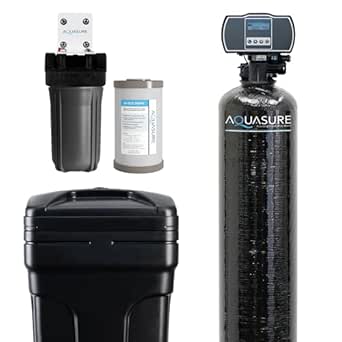 | Best for Larger Families Who Want Added Filtration | Model: AS-HS50SCZ | Hardness capacity: 50,000 grains | Recommended household size: 3–4 bathrooms; up to 5 people | VIEW ON AMAZON | See Our Full Breakdown |
| Aquasure Harmony 40,000-Grain Whole House Water Softener |  | Best for Smaller Households Wanting Pre-Filtration | Model: AS-HS40SCZ | Capacity: 40,000 grains in description; specifications also state 40,000 gallons | Recommended home size: 3–4 bathrooms; up to 4 people | VIEW ON AMAZON | See Our Full Breakdown |
| Whole House Water Softener and 3-Stage Scale Reduction System |  | Best Compact Filter-Based Scale Treatment | Filtration stages: 3 | Filter types: PP sediment, CTO carbon block, and softening | Included filters: 9 total (3 complete sets) | VIEW ON AMAZON | See Our Full Breakdown |
| Aquasure Harmony 64,000-Grain Whole House Water Softener with Digital Metered Control |  | Best High-Capacity Pick | Model: WS-EM-64 | Capacity: 64,000 grains | Maximum flow rate: 13.3 gpm | VIEW ON AMAZON | See Our Full Breakdown |
| AFWFilters Fleck 5600 SXT Digital Water Softener with 10% Crosslink Resin |  | Best for Chlorinated Water | Capacity: 48,000 grains; 1.5 cubic feet | Resin: 10% crosslink | Control valve: Fleck 5600SXT, metered on-demand | VIEW ON AMAZON | See Our Full Breakdown |
| Aquasana SimplySoft 60,000-Grain Whole-House Water Softener |  | Best for Large Households | Capacity: 60,000 grains | Purification method: Ion exchange | Maximum flow rate: 16.6 gpm | VIEW ON AMAZON | See Our Full Breakdown |
| Aquasana SimplySoft 40,000-Grain Whole-House Water Softener |  | Best Certified Mid-Size Pick | Capacity: 40,000 grains | Recommended household size: Up to 5 people and 4 bathrooms | Purification method: Ion exchange | VIEW ON AMAZON | See Our Full Breakdown |
| Aquasure Harmony Series 48,000-Grain Whole House Water Softener |  | Best Softener-and-Pre-Filter Bundle | Capacity: 48,000 grains | Recommended bathrooms: 3–4 | Maximum flow rate: 12 gpm | VIEW ON AMAZON | See Our Full Breakdown |
| Aquasure Harmony 32,000-Grain Whole House Water Softener |  | Best for Small Homes | Capacity: 32,000 grains | Recommended bathrooms: 1–2 | Control head: Programmable automatic digital metered | VIEW ON AMAZON | See Our Full Breakdown |
| EcoPure EPH130 Whole House Water Softener and Filtration System |  | Best for Combined Softening and Filtration | Brand and model: EcoPure EPH130 | System type: Whole-house water softener and filtration system | Purification method: Ion exchange | VIEW ON AMAZON | See Our Full Breakdown |
| NU Aqua 4-Stage Salt-Free Whole-House Water Filter System |  | Best Salt-Free Scale-Prevention Alternative | Brand and model: NU Aqua 4 Stage, part WU-STG4-WTSF | System type: Salt-free whole-house water filter and scale-prevention system | Stages: 4 | VIEW ON AMAZON | See Our Full Breakdown |
| 3-Stage Whole-House Water Softener and Filter System with Replacement Filters |  | Best Cartridge-System Value | Filtration stages: 3 | Maximum flow rate: 10 GPM | Filter life cycle: 6 months | VIEW ON AMAZON | See Our Full Breakdown |
| Kenmore 350 Whole-House Water Softener, 32,000-Grain Capacity | 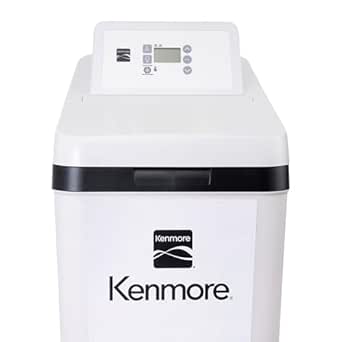 | Best for Smaller Households | Capacity: 32,000 grains | Recommended household size: 1–4 people | Purification method: Ion exchange | VIEW ON AMAZON | See Our Full Breakdown |
| Aquasure Harmony Series 70,000-Grain Whole House Water Softener |  | Best for Larger Homes Needing Iron Reduction | Listed capacity: 70,000 grains in title and features; description also states 32,000 grains | Recommended bathrooms: 4–6 in listed features; description also refers to 1–2 bathrooms | Purification method: Ion exchange | VIEW ON AMAZON | See Our Full Breakdown |
| whole house water softener system | Capacity | Warranty | Dimensions | Maximum flow rate |
|---|---|---|---|---|
| iSpring WCSTB45KG 45,000-Grain | 45,000 grains | 1-year limited manufacturer warranty | — | — |
| Aquasure Harmony Series 50,000 | — | 5-year extended manufacturer warranty with online activation within 60 days | 11 × 11 × 48 in | — |
| Aquasure Harmony 40,000-Grain | 40,000 grains in description; specifications also state 40,000 gallons | 5-year extended manufacturer warranty with online activation within 60 days | 9 × 9 × 55 in | — |
| Whole House Water Softener and | — | — | — | 10 gpm |
| Aquasure Harmony 64,000-Grain | 64,000 grains | — | 15 × 15 × 60 in | 13.3 gpm |
| AFWFilters Fleck 5600 SXT Digi | 48,000 grains; 1.5 cubic feet | 5 years | — | 14 gpm |
| Aquasana SimplySoft 60,000-Gra | 60,000 grains | 5/10-year limited warranty | 30 × 16 × 43 in | 16.6 gpm |
| Aquasana SimplySoft 40,000-Gra | 40,000 grains | 5/10-year limited warranty | 30 × 16 × 43 in | 15.5 gpm |
| Aquasure Harmony Series 48,000 | 48,000 grains | 5-year extended manufacturer warranty | 10 × 10 × 62 in | 12 gpm |
| Aquasure Harmony 32,000-Grain | 32,000 grains | 5 years; activation within 60 days required | 8 × 8 × 52 in | — |
| EcoPure EPH130 Whole House Wat | 175 pounds | 1 year parts and labor | 20.63 × 17.25 × 42.75 inches | — |
| NU Aqua 4-Stage Salt-Free Whol | — | — | 31 × 7 × 31 inches | — |
| 3-Stage Whole-House Water Soft | 10,000 gallons | — | 20 × 6 × 16 inches | 10 GPM |
| Kenmore 350 Whole-House Water | 32,000 grains | 1 year parts and labor; 3 years on electronics; 10 years on tank | — | 7.2 GPM |
| Aquasure Harmony Series 70,000 | — | 5 years with online activation | 13 × 13 × 57 inches | — |
More Details on Our Top Picks
iSpring WCSTB45KG 45,000-Grain Whole-House Water Softener with Brine Tank
The iSpring WCSTB45KG stands out for buyers who want a conventional ion-exchange softener with regeneration adjusted to water quality and usage. Its 45,000-grain capacity sits between the Aquasure Harmony 40,000-grain and 50,000-grain models, making it a middle-capacity choice rather than the largest option here. Automatic backwash and a digital display reduce the need to manage regeneration by hand, while the included brine tank makes this a more complete softening setup than a filter-only system. The stated third-party test result reports 99.71% hardness reduction, though that figure is not a substitute for matching capacity to household demand. At 75.6 pounds, installation may take more effort, and the corded electric valve needs an outlet. I’d choose it for automated softening, not for buyers seeking a compact or power-free unit.
Pros:- 45,000-grain capacity suits buyers between the listed 40,000- and 50,000-grain options.
- Control valve adjusts regeneration based on water quality and usage.
- Includes a brine tank, digital display, and automatic backwash.
- Ion exchange targets calcium and magnesium that cause hardness and scale.
Cons:- The 75.6-pound system may be demanding to position and install.
- Requires corded electric power for its controls.
- The stated capacity may not suit larger households with high water use.
Best for: Households seeking a mid-capacity ion-exchange system with automatic regeneration and an included brine tank.
Not ideal for: Buyers who need a lightweight installation, lack a nearby electrical outlet, or want a system that also reduces TDS.
- Capacity:45,000 grains
- Purification method:Ion exchange
- Control features:Programmable automatic control valve, digital display, automatic backwash and regeneration
- Maximum supported TDS:300 ppm
- Power source:Corded electric
- Weight:75.6 lb
- Included components:System, brine tank and lid, power adapter, accessories
- Warranty:1-year limited manufacturer warranty
Our verdict“Choose the iSpring if you want automated, whole-house ion-exchange softening in a mid-capacity system and can accommodate its weight and electrical requirement.”
Aquasure Harmony Series 50,000-Grain Whole House Water Softener with Digital Metered Control and Pre-Filter
For a household that wants both hardness treatment and a pre-filter in one setup, the Aquasure Harmony 50,000-grain model offers a broader job than the iSpring WCSTB45KG, which focuses on ion-exchange softening. Aquasure recommends this unit for three to four bathrooms and up to five people, and its metered valve schedules backwashing around water use rather than a fixed interval. The included sediment/GAC/zinc pre-filter is intended to reduce sediment, chlorine, odors, and other listed contaminants, so it adds a filtration layer before water reaches the softener. That extra treatment may suit homes dealing with more than hardness alone, but the supplied data does not specify filter replacement intervals or a maximum flow rate. The 11 × 11 × 48-inch tank also needs a suitable installation space. The extended warranty and lifetime tech support require online activation within 60 days, an administrative step absent from the basic product details for the smaller Aquasure 40,000-grain model.
Pros:- 50,000-grain capacity is the largest of the two listed Aquasure pre-filter models in this batch.
- Metered digital control schedules backwashing based on water use.
- Triple-purpose pre-filter targets sediment, chlorine, odors, and other listed contaminants.
- Specified for homes with three to four bathrooms and up to five people.
Cons:- Extended warranty and lifetime tech support require online activation within 60 days.
- The supplied specifications do not state maximum flow rate or filter replacement interval.
- The tank requires space for a 48-inch-tall installation.
Best for: Families of up to five in homes with three or four bathrooms who want metered softening plus a sediment, carbon, and zinc pre-filter.
Not ideal for: Buyers who want a clearly documented flow rate, dislike online warranty registration, or need capacity beyond the stated recommendation.
- Model:AS-HS50SCZ
- Hardness capacity:50,000 grains
- Recommended household size:3–4 bathrooms; up to 5 people
- Control:Programmable digital metered control valve with backlighting
- Pre-filter:Triple-purpose sediment/GAC/zinc
- Dimensions:11 × 11 × 48 in
- Material:Fiberglass
- Warranty:5-year extended manufacturer warranty with online activation within 60 days
Our verdict“Pick this Aquasure when your household fits its stated size range and you want pre-filtration alongside metered whole-house softening.”
Aquasure Harmony 40,000-Grain Whole House Water Softener
The Aquasure Harmony 40,000-grain model is aimed at buyers who want a smaller capacity than the 50,000-grain Harmony without giving up its metered control and sediment/GAC/zinc pre-filter. The stated fit is three to four bathrooms and up to four people, so it is a more natural match for a smaller household than the 64,000-grain Aquasure Harmony, which is recommended for four or more bathrooms. Its pre-filter adds treatment for sediment, odors, taste, and listed contaminants, while the softener targets hardness and scale. One point needs checking before purchase: the description says 40,000 grains, but the supplied specifications also list 40,000 gallons. Those are different measurements, so I would verify the actual capacity with the seller rather than assume the units are interchangeable. Warranty benefits also depend on online activation within 60 days. Despite that ambiguity, its stated TDS limit is higher than the iSpring WCSTB45KG’s.
Pros:- Metered digital valve manages backwashing automatically.
- Includes sediment, GAC, and zinc pre-filtration.
- Recommended for up to four people in homes with three to four bathrooms.
- Lists a maximum supported TDS of 2,500 ppm.
Cons:- Product data conflicts between 40,000 grains and 40,000 gallons for capacity.
- Extended warranty and lifetime technical support require online activation within 60 days.
- Lower stated capacity than the Aquasure 50,000- and 64,000-grain models.
Best for: Households of up to four people seeking a lower-capacity Aquasure system with metered regeneration and included pre-filtration.
Not ideal for: Buyers who need unambiguous capacity documentation, larger households, or a system without online warranty activation requirements.
- Model:AS-HS40SCZ
- Capacity:40,000 grains in description; specifications also state 40,000 gallons
- Recommended home size:3–4 bathrooms; up to 4 people
- Control:Automatic digital metered control valve
- Pre-filter:Sediment/GAC/zinc
- Dimensions:9 × 9 × 55 in
- Maximum supported TDS:2,500 ppm
- Warranty:5-year extended manufacturer warranty with online activation within 60 days
Our verdict“Consider this Harmony for a smaller household that wants pre-filtration, but confirm its capacity units before choosing it over the clearer 50,000-grain model.”
Whole House Water Softener and 3-Stage Scale Reduction System
This compact three-stage unit takes a different approach from the brine-based iSpring WCSTB45KG and Aquasure Harmony systems: it combines sediment, carbon, and softening filters in a 13 × 10 × 14-inch housing rather than using a large resin tank and brine regeneration setup. The clear housings let owners see trapped debris, and the package includes three complete filter sets, which gives buyers replacements on hand. Its specified 10 gpm maximum flow rate and 3/4-inch connections help with installation planning, but the stated capacity is only 10,000 gallons and filters are expected to last about six months. That makes ongoing cartridge changes central to ownership. It also does not reduce TDS, and the product data describes scale reduction rather than a conventional grain-capacity rating. I’d treat it as a compact filtration and scale-control option, not a direct substitute for the higher-capacity ion-exchange systems.
Pros:- Compact dimensions and 12-pound weight make it easier to fit than tank-based softeners.
- Three stages target sediment, rust, chlorine, odors, and scale.
- Includes nine filters across three complete sets.
- Clear housings allow visual monitoring of filter condition.
Cons:- Does not reduce TDS.
- Stated 10,000-gallon capacity and roughly six-month filter life mean recurring replacements.
- No grain-based hardness capacity is provided, limiting direct comparison with ion-exchange systems.
Best for: Homeowners with limited installation space who want sediment, chlorine, odor, and scale treatment with visible filter housings.
Not ideal for: Households seeking a conventional high-capacity ion-exchange softener, reduced TDS, or minimal filter replacement work.
- Filtration stages:3
- Filter types:PP sediment, CTO carbon block, and softening
- Included filters:9 total (3 complete sets)
- Inlet/outlet connections:3/4 in
- Maximum flow rate:10 gpm
- Capacity and filter life:10,000 gallons; about 6 months
- Dimensions and weight:13 × 10 × 14 in; 12 lb
- Supported water TDS:Up to 1,000 ppm; does not reduce TDS
Our verdict“Choose this compact system for multi-stage filtration and scale reduction where space matters, but skip it if you need conventional high-capacity water softening.”
Aquasure Harmony 64,000-Grain Whole House Water Softener with Digital Metered Control
Among the conventional softeners in this batch, the Aquasure Harmony 64,000-grain model offers the greatest stated capacity, making it the clearest fit for a larger household or a home with four or more bathrooms. Its 13.3 gpm maximum flow rate and programmable metered control support whole-house use while adjusting automatic flushing to demand. Unlike the Aquasure 50,000-grain model, the supplied description does not list a pre-filter, so buyers who want sediment or chlorine treatment should plan for filtration separately. The tradeoff for the larger capacity is physical: this freestanding unit weighs 149 pounds and measures 15 × 15 × 60 inches, a more demanding installation than the compact three-stage system or smaller Harmony models. It includes two cubic feet of prefilled resin and installation components, but its scale and capacity can be excessive for a small household.
Pros:- 64,000-grain capacity suits larger household demand.
- 13.3 gpm maximum flow rate is specified for whole-house use.
- Programmable digital metered control supports demand-based automatic flushing.
- Includes two cubic feet of prefilled resin and installation components.
Cons:- At 149 pounds, the unit is difficult to move and position.
- Its 60-inch height and 15 × 15-inch footprint require substantial installation space.
- No pre-filter is listed, unlike the Aquasure Harmony 40,000- and 50,000-grain models.
Best for: Owners of larger homes, especially those with four or more bathrooms, who need a high-capacity metered ion-exchange softener.
Not ideal for: Small households, tight utility spaces, or buyers who want sediment and chlorine pre-filtration included in the system.
- Model:WS-EM-64
- Capacity:64,000 grains
- Maximum flow rate:13.3 gpm
- Dimensions:15 × 15 × 60 in
- Weight:149 lb
- Tank material:Fiberglass-lined polyethylene
- Control head:Programmable digital metered
- Included resin and warranty:2 cu. ft. premium-grade prefilled resin; 5-year warranty
Our verdict“Choose this Aquasure when your home needs more capacity than the smaller Harmony models provide and you have room for a heavy, tall tank.”
AFWFilters Fleck 5600 SXT Digital Water Softener with 10% Crosslink Resin
I’d shortlist this system for homes where chlorine exposure is a concern and a conventional, metered softener is the goal. Its 10% crosslink resin is designed to resist chlorine, while the Fleck 5600SXT on-demand valve regenerates based on water use rather than a fixed schedule. The 48,000-grain capacity sits between the Aquasure Harmony 32,000-Grain and the Aquasana SimplySoft 60,000-Grain, making this a middle-capacity choice rather than a fit for every large household. The package includes a bypass and drain fittings, which helps fill out the installation setup, but it still requires plumbing work and room for two tanks. I’d choose it over the Aquasure Harmony 48,000-Grain if resin chlorine resistance is a priority; the Aquasure includes a pre-filter, which this system does not.
Pros:- 10% crosslink resin is designed to resist chlorine
- Metered Fleck 5600SXT control regenerates according to water use
- Includes mineral tank, brine tank, bypass, and drain fittings
- 14 gpm maximum flow rate for residential plumbing
Cons:- Separate mineral and brine tanks need substantial installation space
- Connecting it to household plumbing may require professional installation
- No pre-filter is included for sediment, odors, or other contaminants
Best for: Homeowners with chlorine-treated water who want a metered, 48,000-grain softener and have space for separate mineral and brine tanks.
Not ideal for: Renters, buyers seeking a compact or installation-ready appliance, and homes needing a bundled sediment or carbon pre-filter.
- Capacity:48,000 grains; 1.5 cubic feet
- Resin:10% crosslink
- Control valve:Fleck 5600SXT, metered on-demand
- Maximum flow rate:14 gpm
- Inlet/outlet:1 in NPT
- Mineral tank dimensions:10 in diameter × 54 in
- Brine tank dimensions and salt capacity:14 × 36 in; 250 lb
- Installed height:62 in
- Warranty:5 years
Our verdict“Choose this if you want chlorine-resistant resin and metered operation in a complete 48,000-grain setup, and can accommodate its two tanks.”
Aquasana SimplySoft 60,000-Grain Whole-House Water Softener
For a larger household, the standout is the 60,000-grain capacity: it gives this model more headroom than the Aquasana SimplySoft 40,000-Grain when several bathrooms and residents add up to frequent water use. Its metered regeneration adjusts to consumption, and the product states that its settings can use up to 50% less salt and 28% less water than standard time-based regeneration. That makes it the capacity-led pick here, not the simplest package to install: the installation kit and recommended pre-filter are sold separately, and the listed power source is manual. I’d favor the Aquasana 40,000-Grain for a household of up to five people and four bathrooms; this 60,000-grain model is aimed at larger homes. Its 16.6 gpm maximum flow rate is also the highest among the five systems reviewed here.
Pros:- 60,000-grain capacity is suited to larger households
- Metered regeneration can reduce salt and water use versus time-based operation, according to the product
- 16.6 gpm maximum flow rate
- IAPMO certified to NSF/ANSI 44 and CSA B483.1
Cons:- Installation kit and recommended pre-filter are sold separately
- Manual power source may not suit buyers expecting a fully powered control setup
- Larger capacity may be unnecessary for smaller homes
Best for: Owners of larger homes with five or more residents and four or more bathrooms who want high capacity and metered regeneration.
Not ideal for: Smaller households that do not need the added capacity, or buyers who want an installation kit and pre-filter included.
- Capacity:60,000 grains
- Purification method:Ion exchange
- Maximum flow rate:16.6 gpm
- Operating pressure:20–125 psi
- Dimensions:30 × 16 × 43 in
- Material:Fiberglass
- Certifications:IAPMO certified to NSF/ANSI 44 and CSA B483.1
- Supported water TDS:Up to 2,000 ppm
- Warranty:5/10-year limited warranty
Our verdict“Pick this over the SimplySoft 40,000-Grain when a larger household needs more softening capacity and can source the installation extras separately.”
Aquasana SimplySoft 40,000-Grain Whole-House Water Softener
I’d place this model between compact, small-home softeners and higher-capacity systems. Its 40,000-grain capacity is specified for homes with up to five people and four bathrooms, while ion exchange treats hardness minerals at the point of entry rather than at a single tap. The NSF/ANSI 44 and CSA B483.1 certifications give buyers a clear standard to compare against; the Aquasure Harmony 32,000-Grain is a smaller-capacity option aimed at one or two bathrooms, while the Aquasana SimplySoft 60,000-Grain targets larger homes. Metered operation is stated to use less salt and water than standard time-based regeneration, though the installation kit and optional pre-filter are extra. This is a sensible capacity match for many family homes, but not a filtration system for sediment or odors, and it still needs salt.
Pros:- 40,000-grain capacity is specified for homes up to five people and four bathrooms
- Certified to NSF/ANSI 44 and CSA B483.1
- Metered operation is stated to use less salt and water than time-based regeneration
- Supports city or well water
Cons:- Installation kit and optional pre-filter are sold separately
- Requires salt for softening
- Installation may call for plumbing support
Best for: Families in homes with up to five people and four bathrooms who want a certified, whole-house ion-exchange softener for city or well water.
Not ideal for: Buyers seeking a salt-free system, bundled pre-filtration, or a smaller unit specifically sized for one or two bathrooms.
- Capacity:40,000 grains
- Recommended household size:Up to 5 people and 4 bathrooms
- Purification method:Ion exchange
- Maximum flow rate:15.5 gpm
- Operating pressure:20–125 psi
- Dimensions:30 × 16 × 43 in
- Supported water TDS:Up to 3,568 ppm
- Certifications:NSF/ANSI Standard 44; CSA B483.1
- Warranty:5/10-year limited warranty
Our verdict“Choose this over the 32,000-grain Aquasure Harmony if your home needs mid-size capacity and you value the stated certifications.”
Aquasure Harmony Series 48,000-Grain Whole House Water Softener
This Aquasure is the most treatment-ready package in this group: alongside a 48,000-grain ion-exchange softener, it includes a sediment, carbon, and zinc pre-filter intended to help reduce sediment, odors, and chlorine. That makes it a different proposition from the AFWFilters Fleck 5600 SXT, which offers chlorine-resistant resin but no bundled pre-filter. The programmable metered head lets owners set operation around household demand, and the recommended fit of three to four bathrooms places it in the middle of the range between the Aquasure Harmony 32,000-Grain for smaller homes and the Aquasana SimplySoft 60,000-Grain for larger ones. The tradeoff is a relatively modest 12 gpm maximum flow rate and a heavy 120-pound system. Warranty benefits also depend on online activation within 60 days.
Pros:- Includes sediment, carbon, and zinc pre-filter
- 48,000-grain capacity is aimed at homes with three to four bathrooms
- Programmable digital metered control supports customized operation
- Corrosion-resistant tank and bypass valve are designed for household use
Cons:- Maximum flow rate is 12 gpm, below the Aquasana SimplySoft models in this batch
- System weighs 120 lb, making handling and installation more demanding
- Online activation within 60 days is required for the stated extended warranty and support
Best for: Households with three or four bathrooms that want a whole-house softener bundled with sediment, carbon, and zinc pre-filtration.
Not ideal for: Buyers needing a higher maximum flow rate, a lightweight installation, or warranty and support benefits without online activation.
- Capacity:48,000 grains
- Recommended bathrooms:3–4
- Maximum flow rate:12 gpm
- Control head:Programmable digital metered
- Included filter:Sediment/carbon/zinc pre-filter
- Dimensions:10 × 10 × 62 in
- Weight:120 lb
- Purification method:Ion exchange
- Warranty:5-year extended manufacturer warranty
Our verdict“Pick this over the AFWFilters system if bundled pre-filtration matters more to you than chlorine-resistant resin or a higher flow rate.”
Aquasure Harmony 32,000-Grain Whole House Water Softener
For a home with one or two bathrooms, I’d favor a system sized to that demand over paying the space and capacity cost of the Aquasure Harmony 48,000-Grain or Aquasana SimplySoft 60,000-Grain. This model pairs 32,000-grain capacity with a programmable metered control head, so regeneration can respond to use rather than follow a simple fixed schedule. Its 8 × 8 × 52-inch tank and 67-pound weight also make it the most compact and lightest option among these five. Prefilled resin reduces one setup step, but the product data lists a resin tank and brine tank—not a sediment or carbon pre-filter—so it is focused on hardness reduction rather than broader water treatment. Warranty and lifetime US-based technical support benefits require online activation within 60 days, another task to plan for after installation.
Pros:- 32,000-grain capacity is specified for homes with one or two bathrooms
- Compact 8 × 8 × 52-inch tank and 67-pound system weight
- Programmable automatic metered control head with backlit display
- Includes prefilled resin and a brine tank
Cons:- Capacity is a poor fit for larger homes or heavier water demand
- No pre-filter is listed for sediment, chlorine, or odors
- Online activation within 60 days is required for stated warranty and support benefits
Best for: Owners of smaller homes with one or two bathrooms who want a compact, metered whole-house softener.
Not ideal for: Larger households with several bathrooms, or buyers who want a bundled pre-filter or do not want to manage online activation.
- Capacity:32,000 grains
- Recommended bathrooms:1–2
- Control head:Programmable automatic digital metered
- Dimensions:8 × 8 × 52 in
- Weight:67 lb
- Tank material:Fiberglass-lined polyethylene
- Maximum supported TDS:1,000 ppm
- Included components:Water softener resin tank and brine tank
- Warranty:5 years; activation within 60 days required
Our verdict“Choose this over the larger Aquasure and Aquasana models if your home has one or two bathrooms and compact sizing matters more than extra capacity.”
EcoPure EPH130 Whole House Water Softener and Filtration System
The EcoPure EPH130 suits households that want ion-exchange softening and filtration in one whole-house unit, rather than pairing a softener with a separate filter. Its AutoSense control adjusts regeneration to household use, which may help reduce unnecessary salt use; the product reports up to 40% less salt than traditional systems. It is sized for up to five people and multiple bathrooms, making it a stronger fit for a busy home than the Kenmore 350, which is aimed at households of one to four.
The tradeoff is a substantial installation footprint: at 42.75 inches tall, this is not a compact utility-room pick. Its one-year parts-and-labor warranty is also shorter than the Aquasure Harmony Series 70,000-Grain’s stated five-year warranty. Choose EcoPure for its combined treatment and usage-based regeneration, but verify the filtration details and available installation space before buying.
Pros:- Combines ion-exchange softening and filtration in one system
- AutoSense adjusts regeneration to household water use
- Designed for households of up to five people and multiple bathrooms
- Includes a bypass valve
Cons:- Large, tall unit requires space for whole-house installation
- One-year parts-and-labor warranty is limited compared with the Aquasure 70,000-grain model’s stated warranty
- Available product details do not specify filtration targets or media
Best for: Households of up to five people with multiple bathrooms that want softening and filtration combined in one point-of-entry system.
Not ideal for: Small homes with limited utility-room space or buyers seeking a clearly specified, longer-warranty system.
- Brand and model:EcoPure EPH130
- System type:Whole-house water softener and filtration system
- Purification method:Ion exchange
- Capacity:175 pounds
- Household size:Up to 5 people
- Dimensions:20.63 × 17.25 × 42.75 inches
- Material:ABS
- Warranty:1 year parts and labor
- Included component:Bypass valve
Our verdict“Choose the EcoPure EPH130 if you want household-sized softening and filtration together and have room for its tall installation footprint.”
NU Aqua 4-Stage Salt-Free Whole-House Water Filter System
The NU Aqua takes a different route from the salt-based softeners in this roundup: it pairs scale-prevention media with four filtration stages rather than using ion exchange to remove hardness minerals. Sediment, KDF, GAC, and carbon block media target particulates, chlorine, some heavy metals, odors, and unpleasant taste, while its salt-free design avoids electricity, backflushing, and brine discharge. Compared with the Kenmore 350, it asks for less salt-system upkeep, but it does not provide the same mineral-removal approach to softening.
That distinction matters if your goal is to reduce hardness itself: NU Aqua says it preserves calcium and magnesium, so buyers should not expect conventional soft-water results. The listed maximum supported TDS is 300 ppm, another limit to check against a water report. This is a sensible fit for people prioritizing broad filtration and scale management without a brine system, not for those specifically seeking ion-exchange softening.
Pros:- Combines scale-prevention media with four filtration stages
- Targets sediment, chlorine, odors, unpleasant taste, and listed heavy metals
- Does not require salt, electricity, backflushing, or brine discharge
- Preserves calcium and magnesium
Cons:- Does not remove hardness minerals, so it is not a conventional ion-exchange softener
- Maximum supported TDS is listed as 300 ppm
- Requires point-of-entry installation across the home’s water supply
Best for: Homeowners who want point-of-entry filtration and scale prevention without salt, electricity, or brine discharge.
Not ideal for: Buyers who need calcium and magnesium removed for conventional soft-water performance or whose water exceeds the stated 300 ppm maximum supported TDS.
- Brand and model:NU Aqua 4 Stage, part WU-STG4-WTSF
- System type:Salt-free whole-house water filter and scale-prevention system
- Stages:4
- Filtration media:Sediment, KDF, GAC, carbon block, and scale-prevention media
- Maximum supported TDS:300 ppm
- Dimensions:31 × 7 × 31 inches
- Weight:53 lb
- Material:Aluminum
Our verdict“Pick NU Aqua for salt-free filtration and scale management, but choose the Kenmore 350 or another ion-exchange unit if you need hardness minerals removed.”
3-Stage Whole-House Water Softener and Filter System with Replacement Filters
This cartridge-based system stands out for a different kind of convenience: it arrives with three complete sets of filters, listed as about 1.5 to 2 years of supply, and includes a bypass valve for maintenance. Its sediment, GAC, and softener cartridges address rust, chlorine, odors, and hard-water scale while preserving natural minerals. The listed 10 GPM flow rate and compatibility with well and municipal water make it more flexible across water sources than the salt-free NU Aqua, which does not remove calcium or magnesium.
The compromise is recurring cartridge work. Filters are listed for replacement about every six months, and the system does not reduce TDS. Its 10,000-gallon capacity also makes water use and replacement timing worth tracking. Compared with the Kenmore 350’s regenerating resin system, this model avoids a conventional brine-tank setup but puts filter changes at the center of ownership. I’d choose it for buyers who prefer a compact cartridge format and have a plan for ongoing replacements.
Pros:- Includes three complete sets of replacement filters
- Works with well and municipal water
- Listed maximum flow rate is 10 GPM
- Includes a bypass valve for filter maintenance
Cons:- Cartridges require replacement about every six months
- Does not reduce TDS
- Listed capacity is 10,000 gallons, so replacement timing depends on household use
Best for: Well- or municipal-water households wanting cartridge-based softening and filtration, with replacement sets included and room to maintain filters on schedule.
Not ideal for: Households seeking low-touch maintenance, TDS reduction, or a system sized by a stated grain-capacity figure.
- Filtration stages:3
- Maximum flow rate:10 GPM
- Filter life cycle:6 months
- Filter supply:3 complete sets; approximately 1.5 to 2 years
- Capacity:10,000 gallons
- Dimensions:20 × 6 × 16 inches
- Port size:3/4-inch brass threaded ports
- Water compatibility:Well and municipal water
- Spare part availability:5 years
Our verdict“Choose this cartridge system if you value included replacement sets and broad water-source compatibility over fewer maintenance intervals.”
Kenmore 350 Whole-House Water Softener, 32,000-Grain Capacity
The Kenmore 350 is the most clearly sized option here for a modest household: its 32,000-grain capacity is recommended for one to four people, and its 7.2 GPM maximum flow rate suits homes that do not need a larger system’s throughput. IntelliSoft learns water-use patterns and regenerates as needed, helping match operation to a smaller household rather than treating it like the Aquasure Harmony Series 70,000-Grain, which is positioned for four to six bathrooms.
A digital display showing flow rate and salt levels gives owners a straightforward way to monitor the system, and the listed clear-water iron reduction adds a useful benefit beyond hardness treatment. The tradeoffs are real: this remains a salt-based system requiring routine monitoring, and its household recommendation may be too small for larger families or high simultaneous water use. Its one-year parts-and-labor warranty is shorter than the Aquasure model’s stated five-year warranty, though the Kenmore lists longer coverage for electronics and the tank.
Pros:- IntelliSoft adjusts regeneration to learned household water use
- Digital display shows flow rate and salt levels
- Helps reduce hardness minerals and clear-water iron
- Lists a 10-year tank warranty and 3-year electronics warranty
Cons:- Requires salt and routine monitoring
- Recommended for only one to four people
- Maximum flow rate is 7.2 GPM
Best for: One- to four-person households seeking a compact, monitored ion-exchange softener with usage-based regeneration.
Not ideal for: Large households or homes with heavy simultaneous water demand that may outgrow its household sizing and 7.2 GPM flow limit.
- Capacity:32,000 grains
- Recommended household size:1–4 people
- Purification method:Ion exchange
- Installation type:Freestanding
- Maximum flow rate:7.2 GPM
- Valve:3/4-inch high-flow
- Warranty:1 year parts and labor; 3 years on electronics; 10 years on tank
- Certification:NSF certified
Our verdict“The Kenmore 350 is a practical fit for smaller households that want an easy-to-monitor salt-based softener, not a high-capacity system for a large home.”
Aquasure Harmony Series 70,000-Grain Whole House Water Softener
The Aquasure Harmony Series 70,000-Grain is aimed at homes with four to six bathrooms, with fine mesh resin intended to reduce hardness and help address iron levels up to 10 ppm. Its programmable metered control head supports automatic regeneration, while the included triple-purpose pre-filter and appliance scale-protection focus make it a broader whole-house proposition than the Kenmore 350, which is sized for one to four people and a lower maximum flow rate.
I would treat the product details cautiously, though: the title and features list 70,000 grains, but the description also states 32,000 grains and refers to a one- to two-bathroom system. The pre-filter’s claim to eliminate 99% of listed contaminants is not independently supported in the supplied details. The stated five-year warranty also requires online activation. This may suit larger homes if the seller confirms the capacity and sizing in writing; without that clarification, the contradictory specifications make it a riskier choice than the clearly sized Kenmore.
Pros:- Title and features list a 70,000-grain capacity
- Designed for homes with four to six bathrooms
- Fine mesh resin is stated to reduce iron up to 10 ppm
- Programmable metered control head supports automatic regeneration
Cons:- Product details conflict between 70,000 and 32,000 grains
- Household sizing also conflicts, listing both four to six bathrooms and one to two bathrooms
- Pre-filter’s 99% contaminant claim is not independently verified in the supplied details
Best for: Owners of larger homes who need a high-capacity ion-exchange softener with stated iron reduction and can confirm the unit’s actual capacity before purchase.
Not ideal for: Buyers who need consistent, unambiguous capacity and household-sizing information before choosing a system.
- Listed capacity:70,000 grains in title and features; description also states 32,000 grains
- Recommended bathrooms:4–6 in listed features; description also refers to 1–2 bathrooms
- Purification method:Ion exchange
- Iron reduction:Up to 10 ppm
- Control head:Programmable digital metered control head
- Dimensions:13 × 13 × 57 inches
- Container capacity:160 lb
- Maximum supported water TDS:1197 ppm
- Warranty:5 years with online activation
Our verdict“Consider this Aquasure for a larger home only after confirming its actual grain capacity and bathroom sizing with the seller.”

How We Picked
I compared the 15 listed systems on buyer-relevant differences: stated grain capacity, control type, included filtration or scale-reduction stages, system format, and the maintenance each design implies. I gave more weight to options whose listed features make their role clear, such as metered controls for regeneration management or higher capacity for homes with greater demand. I also distinguished conventional salt-based softeners from salt-free scale-reduction and filtration systems, since they do not offer the same treatment outcome.
The ranking favors systems with a useful balance of softening capacity and practical features, rather than treating the highest grain rating as an automatic winner. Products with narrower roles rank for the buyers they suit, not as universal substitutes. Since the supplied product details do not establish household size, water hardness, flow rate, installation needs, or contaminant-reduction performance, I avoid claiming that any option fits every home; buyers should verify those points against their water test and the manufacturer’s specifications.
Factors to Consider When Choosing Whole House Water Softener System
Before choosing a system, start with your water test and treatment goal, then check that the equipment fits your plumbing and maintenance routine. The product list includes conventional softeners, systems with filtration, and salt-free scale-reduction products; treating them as interchangeable can lead to the wrong purchase.
Size Capacity From Hardness and Household Demand
Grain capacity describes how much hardness a softener can remove between regeneration cycles, not how many people it can serve in every home. A useful sizing estimate needs your water hardness, daily water use, and any iron that the manufacturer says the unit can handle. A common mistake is choosing the biggest capacity available without checking whether its dimensions, plumbing requirements, or regeneration settings suit the home. Too small a unit may regenerate often; an oversized unit may cost more to install without solving a real need. The 32,000- to 70,000-grain range in this lineup shows why matching capacity matters more than picking a model by its number alone. Ask the seller or installer to size the unit from a recent water test and your household’s usage pattern.
Decide Whether You Need Softening or Scale Reduction
Salt-based ion-exchange softeners remove hardness minerals from water, while salt-free systems are generally intended to reduce scale formation rather than produce conventionally softened water. That distinction affects what you can expect at taps, in cleaning, and on appliance surfaces. Buyers focused on reducing scale may prefer to investigate salt-free options, but should not assume they will deliver the same feel or mineral removal as an ion-exchange unit. If your goal includes softer-feeling water or reduced hardness readings, confirm the treatment method and expected results before buying. The lineup includes both types, so compare treatment claims rather than relying on the word “softener” in a product name. A water test and a clear statement of your goal make this choice much easier.
Treat Filtration as a Separate Requirement
A softener is not automatically a drinking-water filter, and a pre-filter does not necessarily remove every contaminant you may care about. First identify whether you need sediment protection, taste and odor treatment, or reduction of a specific contaminant, then check that the system’s documented certifications and media match that need. Multi-stage systems can combine treatment steps, but added stages bring replacement parts and service tasks. A frequent buying error is assuming that “three-stage” or “four-stage” means broader protection without checking the function of each stage. Compare replacement-filter availability and intervals alongside the initial equipment configuration. If the priority is a contaminant with health implications, use a certified treatment claim suited to that contaminant rather than a general filtration label.
Check Regeneration Controls and Salt Routine
Conventional softeners need a brine tank and periodic salt replenishment, so the ongoing routine matters as much as the control head. Metered controls base regeneration on measured water use, which can be a better fit for homes with changing occupancy than a simple time-based schedule. They do not remove the need to check salt, maintain the brine tank, or set the unit correctly. Ask how the system handles a power outage, how regeneration settings are adjusted, and whether the control interface is understandable to the person who will maintain it. A simpler unit may be easier to manage, while digital controls can offer more flexibility. Choose based on the maintenance you will actually keep up with, not just the number of settings.
Verify Flow Rate, Plumbing Fit, and Installation Needs
Grain capacity does not tell you whether a unit can supply the flow your household needs when several fixtures run at once. Check the rated service flow, connection size, bypass arrangement, and required drain access against your plumbing before ordering. Also measure the installation area, including room to open the brine tank and reach valves for servicing. A system with more capacity or extra filtration stages may require more space and additional plumbing work. Some installations are manageable for experienced DIYers, but drain connections, local plumbing rules, and warranty terms can make professional installation the safer choice. Confirm these details before purchase to avoid discovering that a promising system cannot fit or operate properly in your home.
Compare Total Upkeep, Not Just the Equipment
Salt, replacement cartridges, resin or valve service, and installation all affect the long-term ownership burden. Salt-free systems avoid routine brine salt additions but may have their own media or filter replacement schedule, so “no salt” does not always mean “no maintenance.” Systems that combine filtration and softening can reduce the number of separate devices, yet they may add cartridge costs and service steps. Before choosing, find the manufacturer’s maintenance schedule and confirm that consumables are available where you live. Also check warranty coverage for the control valve, tank, and media rather than treating the warranty as a single blanket promise. Paying more can make sense when a feature directly reduces a problem you have, but extra stages or capacity are poor value if you will not use them.
Frequently Asked Questions
How do I know whether a 32,000-, 50,000-, or 70,000-grain system is right for my home?
Use a water test to find hardness, then combine that result with household water use and any iron the system must address. Grain capacity indicates the hardness load a unit can treat between regeneration cycles; it is not a direct household-size rating. A larger unit can be a poor fit if it does not match your usage or available installation space. Ask for a sizing calculation based on your actual test results rather than selecting the largest number in this roundup. The 32,000- to 70,000-grain range here offers choices, but no capacity is universally right.
Will a salt-free whole-house system soften my water like a salt-based unit?
Not necessarily. Salt-free scale-reduction systems are generally designed to limit scale formation, while ion-exchange softeners remove hardness minerals from the water. That means the water may not feel or measure the same as water treated by a conventional softener. If you specifically want lower hardness readings or the familiar results of softened water, verify the treatment method before choosing a salt-free model. If your main goal is scale management and avoiding routine salt handling, a salt-free option may still be worth comparing.
Does a pre-filter or multi-stage system mean I can skip drinking-water filtration?
No. A pre-filter commonly serves a different purpose from a drinking-water filter, and the number of stages alone does not identify which contaminants are reduced. Check the function and certification of each stage against the contaminants shown in your water test or local water report. If you need treatment for a specific health-related contaminant, choose a system with a claim certified for that contaminant. You may need a separate point-of-use filter even when a whole-house system includes filtration stages.
Is a metered control worth choosing over a simpler softener?
A metered control can base regeneration on water use, which may suit households whose occupancy or daily demand changes. That can be more practical than relying on a fixed schedule, but it does not eliminate salt checks or regular upkeep. A simpler control may be a sensible choice when usage is predictable and ease of operation matters more than flexible settings. Compare the control type with your household routine and confirm that you can access clear setup instructions. Do not pay for controls you do not need or understand.
What should I check before buying a system with both softening and filtration?
Confirm what the softening component removes, what each filter stage is intended to treat, and how often those filters need replacement. Check service flow and connection requirements as well, since combined equipment still has to meet your home’s peak water demand. Look for documented certifications that match your treatment goals rather than relying on broad wording such as “whole-house filtration.” Add cartridge availability and maintenance access to your decision, because a system that is hard to service can become a burden. If the filter targets are unclear, ask the manufacturer for a stage-by-stage explanation before purchasing.
Conclusion
For the broadest balance in this lineup, I would start with the Aquasure Harmony 50,000-Grain, especially if its metered control and pre-filter match your water and installation plan. Buyers seeking a best-value direction can compare the smaller-capacity Aquasure Harmony options, but should choose only after sizing from a water test. For a premium-capacity choice, the 70,000-grain Aquasure is aimed at greater treatment demand, while the Fleck 5600 SXT is a strong fit for buyers who prioritize its digital control valve and 10% crosslink resin. Beginners may prefer a clearly specified system whose setup and service instructions are easy to follow; confirm installation support before selecting, since product names alone do not establish ease of use. For specific needs, consider salt-free NU Aqua or scale-reduction systems only if scale management—not conventional mineral removal—is your goal, and look to combined filtration models when their documented stages match your water concerns. My final recommendation is to test the water first, then choose the system type and capacity that solve that measured problem.