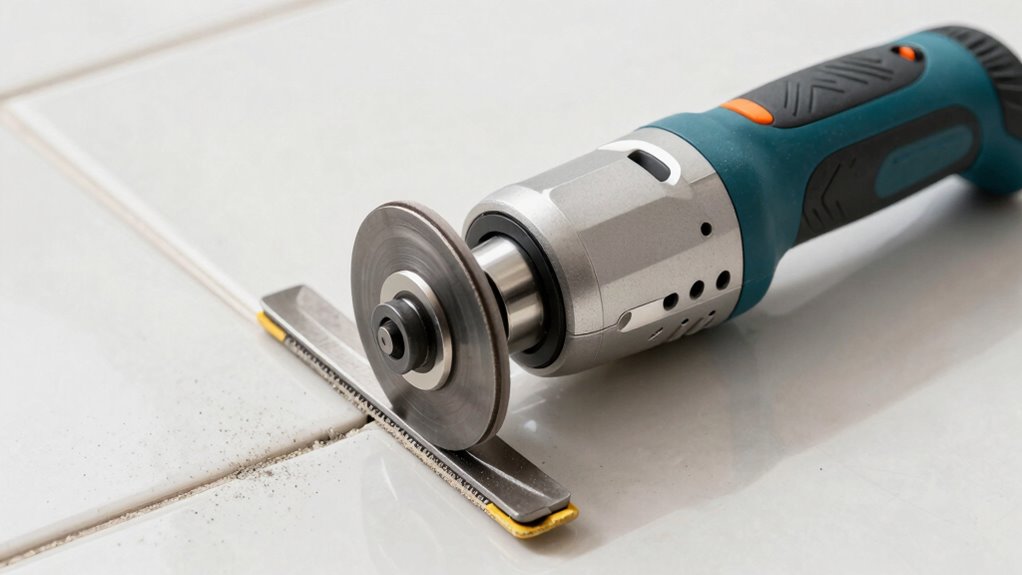

Choosing an electric grout removal tool means balancing fast material removal against control around fragile tile. My leading pick for a larger, dusty job is the Himopuer 1200W tool, which pairs a high-speed diamond blade with built-in dust collection. For narrow joints where limiting tile damage matters more than raw speed, the Regrout Tool Electric Grout Remover is a more focused choice. I also rate the Hyde 19503 as a practical option for small repairs, thanks to its light body and low-dust operation.

Get home appliances delivered free with Prime
- Fast, free delivery on millions of items
- Prime Video, Amazon Music and more included
- Member-only deals all year
These tools are not interchangeable. A wheeled rotary cutter can clear broad runs quickly, while a pulsing grout-specific tool or an oscillating model gives more control in corners and close to tile edges. In this guide, I compare their intended joint sizes, speed control, weight, dust handling, and flexibility so I can match each tool to the job rather than treat power as the only measure.
Complete the kit


Key Takeaways
- The Himopuer is the only pick here with a built-in vacuum and 1200W motor, but its 5.4 kg weight and fixed speed make it better for longer runs than delicate detail work.
- The Regrout Tool weighs about one pound and is designed for joints up to 1/8 inch, making it the control-first choice for narrow tile joints.
- The Hyde 19503 is similarly aimed at grout up to 1/8 inch and emphasizes low dust, but its cord still ties it to an outlet.
- The Rubi RUBISCRAPER-250 covers a stated 1/16-to-3/16-inch joint range and includes resharpenable carbide blades, though its 5.72-pound body is not the lightest option.
- The ENERTWIST is the most versatile general-purpose tool, not a dedicated grout cutter; its variable speed and 33 accessories suit mixed projects, but grout-specific blades may need to be sourced or selected carefully.
| 1200W Electric Grout Removal Tool with 9000 RPM Diamond Blade |  | Best Overall for Longer Grout Runs | Power: 1200W | Voltage: 220–240 V | No-load speed: 9000 rpm | VIEW ON AMAZON | See Our Full Breakdown |
| Regrout Tool Electric Grout Remover |  | Best for Narrow Joints and Careful Work | Intended use: Grout removal | Maximum joint width: 1/8 inch | Action: Pneumatic pulsing | VIEW ON AMAZON | See Our Full Breakdown |
| Rubi RUBISCRAPER-250 Oscillating Multi-Tool Kit |  | Best for a Wider Range of Joint Sizes | Power: 250W | Speed settings: 3 | Speed range: 6500, 8000, and 9500 i.p. | VIEW ON AMAZON | See Our Full Breakdown |
| Hyde 19503 Regrout Tool 3-Speed Electric Grout Remover |  | Best Lightweight Pick for Small Repairs | Voltage: 120 V | Power source: Corded electric | Speed settings: 3 | VIEW ON AMAZON | See Our Full Breakdown |
| ENERTWIST 4.2 Amp Oscillating Multitool Kit with 33 PCS Accessories |  | Best Multi-Use Option Beyond Grout | Power source: Corded electric | Voltage: 120 V | Wattage: 500W | VIEW ON AMAZON | See Our Full Breakdown |
| electric grout removal tool | Weight | Voltage |
|---|---|---|
| 1200W Electric Grout Removal T | 5.4 kg | 220–240 V |
| Regrout Tool Electric Grout Re | 1 pound | — |
| Rubi RUBISCRAPER-250 Oscillati | 5.72 pounds | — |
| Hyde 19503 Regrout Tool 3-Spee | 15.3 ounces | 120 V |
| ENERTWIST 4.2 Amp Oscillating | 2 kg | 120 V |
More Details on Our Top Picks
1200W Electric Grout Removal Tool with 9000 RPM Diamond Blade
The Himopuer makes the most sense when the job involves a substantial length of grout and dust control is part of the plan. Its 1200W motor, 9000 rpm speed, and 100 mm diamond blade are aimed at rapid cutting through grout and related material. The built-in vacuum and dust bag give it a practical advantage over the other dedicated options here: the Hyde is also described as generating little dust, but does not list a built-in vacuum, while the oscillating tools do not offer an integrated collection setup in the supplied details.
Its adjustable cutting depth and four-wheel design help explain why it leads this list. The wheels can support steadier movement over a run, and depth adjustment gives the operator a way to limit how far the blade enters the joint. That is a useful combination for repetitive work, although it does not replace careful alignment. Automatic blade retraction is another safety-oriented feature, but I would still treat a fast diamond blade as a tool that needs deliberate handling near tile edges.
The tradeoff is substantial: at 5.4 kg, or about 12 pounds, it is much heavier than the one-pound Regrout Tool or the 15.3-ounce Hyde. It also runs at a fixed high speed, unlike the Rubi and ENERTWIST, which offer speed settings. That makes the Himopuer a stronger choice for open, relatively straight runs than for intricate work around corners or delicate tile. Its stated 220–240 V supply is also a compatibility point buyers should verify before choosing it; it is not listed as a standard 120 V tool.
Pros:- 1200W motor and 9000 rpm diamond blade are suited to fast removal.
- Built-in vacuum collects dust into a bag.
- Adjustable cutting depth and automatic blade retraction add control features.
- Four-wheel design can help guide the tool along tile joints.
Cons:- At 5.4 kg, it is the heaviest option listed and may tire the user.
- Fixed high speed offers less finesse than variable-speed alternatives.
- 220–240 V rating needs checking against the worksite supply.
Best for: Tile owners or contractors clearing longer grout runs who value built-in dust collection and a wheeled cutting guide.
Not ideal for: Anyone prioritizing lightweight handling, variable speed, very fine corner work, or a 120 V tool without checking electrical compatibility.
- Power:1200W
- Voltage:220–240 V
- No-load speed:9000 rpm
- Blade diameter:100 mm
- Blade thickness:1.2 mm
- Weight:5.4 kg
- Dimensions:34 × 13 × 17 cm
Our verdict“I rank the Himopuer first for larger grout-removal jobs where its dust collection and guided cutting outweigh its heavy, fixed-speed design.”
Regrout Tool Electric Grout Remover
For small joints and tile edges where a broad rotary cutter feels excessive, the Regrout Tool is the most focused pick in this lineup. Its pneumatic pulsing action and tungsten carbide tips are designed for sanded or unsanded grout in joints up to 1/8 inch wide. At about one pound, it is also dramatically easier to hold through detailed work than the Himopuer or Rubi, both of which weigh more than five pounds.
The design is aimed at control rather than clearing a whole floor quickly. Adjustable speed lets the user moderate the tool, and its stated ability to maneuver around corners suits repair work where the joint changes direction or sits close to an exposed tile edge. Compared with the Hyde, it shares a narrow 1/8-inch maximum joint width and a grout-specific purpose; the supplied details do not give the Hyde’s weight in pounds and ounces as light as this model, but do list the Hyde at 15.3 ounces, so the two are close in handling weight.
That specialization also sets its limits. Joints wider than 1/8 inch fall outside its stated range, and buyers tackling broad, deep grout lines may prefer the Rubi, whose listed joint range reaches 3/16 inch, or the Himopuer for faster runs. The product information gives no motor power or dust-collection system, so I would not choose it on assumptions about speed or cleanup. Its strongest case is precise, narrow-joint work where a light tool matters more than broad coverage.
Pros:- About one pound, making it the lightest listed tool.
- Adjustable speed supports controlled removal.
- Tungsten carbide tips are specified for sanded and unsanded grout.
- Designed to maneuver around corners and reduce tile chipping.
Cons:- Limited to grout joints up to 1/8 inch wide.
- No power rating or integrated dust collection is specified.
- Its narrow-joint focus is less suited to broad, high-volume removal than the Himopuer.
Best for: DIY users repairing narrow tile joints, working around corners, or seeking a light grout-specific tool.
Not ideal for: People removing grout from joints wider than 1/8 inch or clearing large areas where speed and dust collection are priorities.
- Intended use:Grout removal
- Maximum joint width:1/8 inch
- Action:Pneumatic pulsing
- Speed:Adjustable
- Tips:Two tungsten carbide tips
- Weight:1 pound
- Compatible surface:Tile
Our verdict“I recommend the Regrout Tool for careful work in narrow joints, not as a fast solution for removing grout across a large tiled area.”
Rubi RUBISCRAPER-250 Oscillating Multi-Tool Kit
The Rubi stands out among the dedicated grout options because its listed working range covers 1/16- to 3/16-inch joints. That gives it more scope than the Regrout Tool and Hyde, each specified for joints up to 1/8 inch. If a tiled surface has joints of varying widths, that range can make the Rubi a more adaptable choice without moving to the Himopuer’s large rotary-blade format.
It is a 250W oscillating tool with three speed settings at 6500, 8000, and 9500 oscillations per minute. The kit includes resharpenable tungsten carbide blades, two steel blades, a fast blade-change system, and a carrying case. The ability to resharpen carbide blades can be useful for owners who expect repeat tile work, while the steel blades give the kit some choice for related repair tasks. Compared with the ENERTWIST, which is a more general multitool with 33 accessories, the Rubi is more specifically organized around grout removal and tile repair.
Its weight is the clearest drawback. At 5.72 pounds, it is far less convenient for extended overhead or close-up hand work than the Hyde or Regrout Tool. The product is also described as intended for grout removal, tile repair, and related precision tasks, so it is not the broadest all-purpose choice. I would favor it over the Himopuer when speed settings and a stated wider joint range matter more than dust collection, but skip it if minimal arm fatigue is the main concern.
Pros:- Stated joint range spans 1/16 to 3/16 inches.
- Three speed settings support different grout and tile-repair tasks.
- Resharpenable tungsten carbide blades can serve repeat users.
- Fast blade changes and a carrying case simplify kit handling.
Cons:- At 5.72 pounds, it is heavier than the Hyde and Regrout Tool.
- No integrated dust collection is listed.
- Its task range is more focused than the general-purpose ENERTWIST.
Best for: Tile renovators working across mixed joint widths who want replaceable, resharpenable blades and speed choices.
Not ideal for: Buyers who need an especially light tool, built-in dust collection, or broad household multitool use.
- Power:250W
- Speed settings:3
- Speed range:6500, 8000, and 9500 i.p.
- Joint sizes:1/16 to 3/16 inches
- Blade material:Tungsten carbide and steel
- Weight:5.72 pounds
- Included:RUBISCRAPER-250 kit and carrying case
Our verdict“I would choose the Rubi over the narrower-joint tools when its 3/16-inch reach and serviceable blades matter more than low weight.”
Hyde 19503 Regrout Tool 3-Speed Electric Grout Remover
The Hyde is a straightforward choice for short repair sessions, especially when a compact tool and limited dust matter more than clearing a large floor. It weighs 15.3 ounces, far less than the Himopuer or Rubi, and the supplied description says it produces little to no dust. That makes it an appealing alternative to the Regrout Tool for users who want a light, corded electric option with listed speed settings and included carbide bits.
Hyde specifies removal of sanded or nonsanded grout at up to one inch per second and a maximum depth of 1/8 inch. That depth cap makes it a better fit for shallow grout removal and spot repairs than for a deep, demanding extraction. Its three-speed controls are presented as a way to work on tiles, liners, V-caps, and corners. The Regrout Tool has the same stated 1/8-inch joint-width limit and a similarly grout-focused purpose, while the Hyde adds a stated removal rate and included hex key alongside two carbide bits.
There is a specification ambiguity buyers should not ignore: the listing gives three speed settings but also reports both minimum and maximum rotational speed as 7100 rpm. I would confirm how the settings operate before relying on a particular speed range. The tool is corded, and the 120 V supply limits where it can be used without an appropriate power source. For small jobs, those drawbacks may be manageable; for long runs, the Himopuer’s dust bag and wheeled guide or the Rubi’s broader joint-size range may be more useful.
Pros:- Lightweight 15.3-ounce body is easy to position for detail work.
- Designed to generate little or no dust.
- Includes two carbide bits, a hex key, and cord-mounted storage.
- Listed for sanded and nonsanded grout in corners and around tile features.
Cons:- Maximum removal depth is limited to 1/8 inch.
- Corded design restricts movement around the work area.
- Listed minimum and maximum rotational speeds are both 7100 rpm despite three speed settings.
Best for: Homeowners handling shallow grout touch-ups who want a light corded tool and low-dust operation.
Not ideal for: People removing grout deeper than 1/8 inch, working far from an outlet, or expecting a clearly stated variable rpm range.
- Voltage:120 V
- Power source:Corded electric
- Speed settings:3
- Listed rotational speed:7100 rpm minimum and maximum
- Maximum removal depth:1/8 inch
- Weight:15.3 ounces
- Included:Two carbide bits and hex key
Our verdict“I recommend the Hyde for light, shallow repairs where low dust and easy handling matter more than depth or jobsite portability.”
ENERTWIST 4.2 Amp Oscillating Multitool Kit with 33 PCS Accessories
The ENERTWIST is the most versatile tool in this group, but that does not make it the most direct grout-removal pick. Its 4.2-amp, 500W motor and six speed settings support cutting and sanding across metal, tile, wood, and other materials. The 33-piece accessory set and tool-less blade changes make it a sensible purchase for someone who also expects to handle general renovation tasks. Compared with the Rubi, it offers a broader accessory-oriented setup; compared with the grout-specific Regrout Tool, it does not list a maximum joint width or a dedicated pulsing action.
For grout work, the important question is whether the appropriate accessory is included or available for the joint and tile at hand. The supplied details describe a range of accessories but do not identify a specific grout blade, so I would check the kit contents and accessory compatibility rather than assume the set is ready for every grout-removal job. Its variable 8000–16000 OPM range and 5-degree oscillation angle allow more speed adjustment than the Himopuer’s fixed 9000 rpm, which can help users tune the tool for different materials, but the operating motion and blade remain different from a purpose-built grout remover.
The cord is the main practical limit: it reduces freedom of movement compared with cordless tools, though none of the other listed models is described as cordless either. At 2 kg, it is also heavier than the Hyde and Regrout Tool, but lighter than the Rubi by the listed figures. I place it fifth because its strongest advantage is general utility, not a clearly documented grout-specific cutting setup. Choose it when a single corded multitool will serve many jobs; choose the Rubi or Regrout Tool when grout work is the central task.
Pros:- Six speed settings offer more adjustment than the fixed-speed Himopuer.
- 33-piece accessory kit and carrying bag support varied household tasks.
- Tool-less accessory changes make swaps easier.
- 500W motor is specified for work across tile, wood, and metal.
Cons:- Not presented as a grout-specific remover, and a grout blade is not identified in the supplied details.
- Corded operation limits movement around a room.
- At 2 kg, it is heavier than the Hyde and Regrout Tool.
Best for: DIY renovators who want one corded multitool for grout-adjacent work, sanding, and cutting across several materials.
Not ideal for: Buyers seeking a dedicated grout cutter with a stated joint-width capacity, included grout blade, or specialized dust collection.
- Power source:Corded electric
- Voltage:120 V
- Wattage:500W
- Speed range:8000–16000 OPM, six settings
- Oscillation angle:5°
- Weight:2 kg
- Accessories:33 pieces
Our verdict“I would buy the ENERTWIST for mixed renovation work, but not as my first choice when grout removal is the main job.”

How We Picked
I ranked these tools by how directly they address electric grout removal, not by broad power claims alone. My first question was whether the tool is purpose-built for grout or is a general oscillating multitool that can take on grout with an appropriate accessory. Dedicated tools can offer a more relevant cutting action, tip, or blade, while a multitool gives buyers more uses beyond tile work.
I then compared the details that change the experience on a real repair: joint-width limits, speed adjustment, tool weight, blade or tip material, dust handling, and access around corners. For larger jobs, cutting speed and dust management matter; for a shower niche, backsplash, or chipped tile edge, controlled movement and manageable weight can matter more. I also considered the limitations stated for each product, including narrow joint capacity, fixed speed, corded operation, and restricted task range.
The ordering reflects those differences. I put the Himopuer first for its dedicated cutting setup and integrated dust collection, while recognizing that its weight and fixed high speed can make fine work tiring. The Regrout Tool ranks highly for narrow, careful removal, and the Rubi offers a wider stated joint range with serviceable blades. The Hyde suits small, low-dust repairs, while the ENERTWIST is last as a grout-specific recommendation because it is a multitool rather than a dedicated grout remover. I have not treated any model as suitable for every tile, grout type, or project size.
Factors to Consider When Choosing Electric Grout Removal Tool
I would match the tool to the grout line and the amount of removal before comparing headline motor figures. The right choice for a single damaged corner may be very different from the right one for a full room.
Start with joint width and removal depth
Check the grout joint before choosing a tool. The Regrout Tool and Hyde are specified for work up to 1/8 inch, while the Rubi lists a 1/16-to-3/16-inch joint range. The Himopuer lists adjustable depth but does not give a joint-width range in the supplied specifications, so I would verify fit for narrow joints before purchase. Hyde also gives a maximum removal depth of 1/8 inch, a useful boundary if old grout must be removed more deeply. Do not assume a blade can enter a joint safely just because the motor has enough power.
Choose cutting style for the job
A rotary diamond blade like the Himopuer’s is aimed at quicker progress over longer runs, while oscillating blades and pulsing tips are better suited to controlled movement and smaller sections. The Regrout Tool’s pneumatic pulsing action is designed around narrow tile joints; the Rubi and ENERTWIST use oscillation, but the Rubi is the more grout-focused of the two. When working near tile edges, favor a setup you can guide steadily over one that simply promises a faster cut.
Treat weight and handling as performance factors
Tool weight changes how long a job feels. The one-pound Regrout Tool and 15.3-ounce Hyde are easier to position for corners or short repairs than the 5.4 kg Himopuer or 5.72-pound Rubi. The Himopuer’s wheels may help guide it on a run, but they do not remove the burden of moving and holding a heavier machine. For a large floor, that weight may be an acceptable trade for its cutting setup; for a backsplash or repeated hand-height work, a lighter model may be easier to control.
Compare speed control, not just maximum speed
Speed control can help adapt a tool to the tile, grout, and accessory. The ENERTWIST offers six settings, while the Rubi and Hyde list three and the Himopuer has a fixed 9000 rpm speed. The Regrout Tool is described as adjustable-speed without a numeric range. More settings do not automatically make a tool safer or more accurate; they give the user more ways to tune operation. For the Hyde, note that the specifications list both minimum and maximum rotational speed as 7100 rpm even though three settings are claimed, so clarification from the seller may be useful.
Plan for dust, accessories, and power
Dust handling can affect cleanup and visibility. The Himopuer has a built-in vacuum and collection bag, while the Hyde is described as producing little or no dust; the remaining supplied descriptions do not specify integrated collection. Check replacement blades or tips as carefully as the initial kit: the Rubi’s resharpenable carbide blades are a notable maintenance feature, and the ENERTWIST’s accessory count does not confirm that a grout-specific blade is included. Finally, verify voltage. The Himopuer is listed at 220–240 V, while the Hyde and ENERTWIST are listed at 120 V.
Frequently Asked Questions
Which electric grout removal tool is best for a large area?
For a longer run, I would start with the Himopuer because it combines a 1200W motor, a diamond blade, a wheeled design, and built-in dust collection. Its weight and fixed speed make it less appealing for delicate corners, and buyers should confirm its 220–240 V requirement matches their worksite. The Rubi can suit a broad range of joint widths, but it does not list an integrated dust collector.
Which model is easiest to control around corners?
The Regrout Tool is a strong match for narrow, detailed work because it weighs about one pound, has adjustable speed, and is designed to maneuver around corners. The Hyde is also light and is described for corners and tile features, though its maximum removal depth is 1/8 inch. For either tool, the stated joint limit and the tile maker’s guidance should shape how close and deep the cut goes.
Can an oscillating multitool remove grout?
An oscillating multitool can be used for grout removal when fitted with a suitable grout blade, but I would check the accessory type and compatibility rather than assume any blade in a kit is appropriate. The ENERTWIST offers variable speed and broad household use, but its supplied details do not identify a grout-specific blade. The Rubi is the more directly grout-oriented oscillating option in this comparison.
Do electric grout removers create dust?
Dust depends on the tool, accessory, grout, and work method. The Himopuer lists a built-in vacuum and dust bag, and the Hyde is described as generating little to no dust. The other product descriptions do not specify integrated dust collection, so I would plan for suitable cleanup and protective equipment rather than assume the work will be dust-free. Follow the tool instructions and use appropriate eye and respiratory protection.
How do I avoid damaging tile while removing grout?
Use a tool that fits the joint, set a controlled depth or speed where available, and work carefully without forcing the blade into the tile edge. The Regrout Tool’s pulsing action is designed to help reduce chipping and scratching, while the Himopuer offers adjustable depth but runs at a fixed high speed. No feature eliminates risk; test a discreet area first and stop if the tile begins to chip or move.
Conclusion
My pick depends on the scale and precision of the job. For longer runs with dust collection, I would choose the Himopuer, provided its voltage suits the worksite and its weight is manageable. For narrow joints and close work around corners, the lightweight Regrout Tool is the better fit; for shallow touch-ups with low-dust operation, the Hyde is a practical alternative. The Rubi is my choice when joint widths vary up to its listed 3/16-inch range and resharpenable blades matter. If grout removal is only one task among many, the ENERTWIST offers the broadest general-purpose use, but I would confirm the right grout accessory before buying.
Halloween Picks
halloween
As an affiliate, we earn on qualifying purchases.